
Explore political cartoons, satire, and even the function of parody Twitter accounts in greater depth with our political satire playlist–curated from our video archive.
Are traditional forms of comedy and satire–such as the late show monologue or the political cartoon–actually subversive? Do newer forms do a better job of speaking truth to power? Can satire hold governments to account? Bring regimes to its knees? Does it spark fear in the power-hungry dictator or paranoid president? Can satire inspire real debate, or does it encourage further retrenchment? Does it normalize the abnormal or fact-check the patently absurd? Does satire, in fact, trivialize politics? You can explore these big questions in greater depth with our political satire playlist, curated from our video archive.
“Humor is the voice of the people...but it has its limits.” –Bob Mankoff
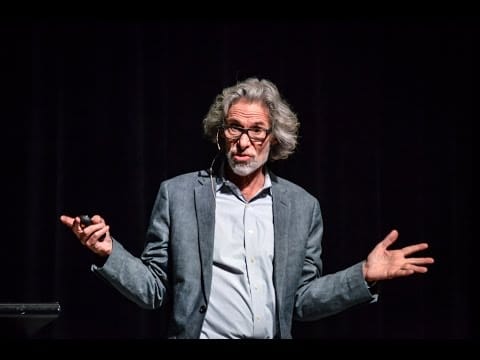
During the 2015 Citizens Festival, New Yorker cartoons editor Bob Mankoff was asked about the role of humor and cartoonists in society. He replied: “Humor is the voice of the people. It is the voice of democracy. But it has its limits,” Mankoff said. “Much more harm is done by respect than disrespect.”
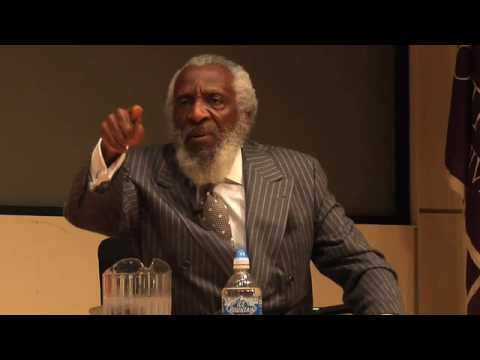
“In America, we look for the cheap way out.” –Dick Gregory
Here in Chicago, comedian Dick Gregory famously launched a write-in campaign against Mayor Richard J. Daley in 1967. While speaking with Sun-Times political reporter Laura Washington during the 2010 Laughter Festival, Gregory said, “I couldn’t understand why he [Daley] was so upset [about the campaign]...you’d have to go back to the early days of the Roman Empire to find someone more powerful.” Gregory described white police officers who would come up to him and say, “you can die for what you’re doing” during the campaign. While Gregory’s bid drew national attention to the fight for civil rights in Chicago and Richard J Daley’s power, Gregory jokingly admits that “If I’d won, I’d have asked for a recount.”
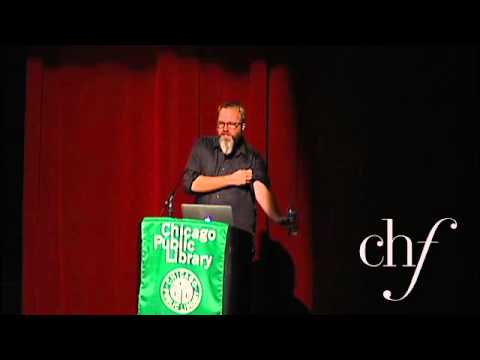
“One liner-jokes about the news of the day is one thing. But the account [@MayorEmanuel] began to tell a story...far beyond the election.” — Dan Sinker
If there’s an origin story for Dan Sinker’s War and Peace-length parody Mayoral Twitter account, it was sitting on a couch, having a beer, and wondering about “how pissed off Rahm Emanuel must be” that the news outlet Politico had broken the story that Rahm was leaving the White House to run for Mayor of Chicago. ”I just began to write pretty profane and outrageous things that night — mainly directed at the news organizations that were beginning to spin out this story that Politico had broken. There was not a plan beyond that,” Sinker said. “Before the end of the night 300 people were following that account. By the end of the next day, almost 1000 people were. So I just kept going.”
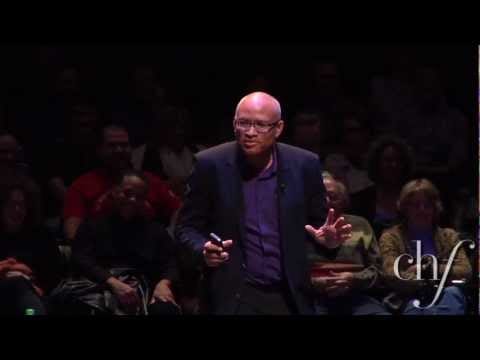
“This is my first political comedy bit—and I’m gonna bring it back for you.” —Larry Wilmore
Even before The Nightly Show, Larry Wilmore was Jon Stewart’s Senior Black Correspondent for The Daily Show. Wilmore came to CHF during 2012’s America Festival to discuss the inherent racism of “Birtherism” and Obama conspiracy theories, the state of American politics in 2012, President Obama’s re-election prospects, and more. On the prospect of President Obama being a secret Muslim, Wilmore took the conspiracy to its logical conclusion: “I don’t even understand the secret Muslim stuff. Thinking Obama — how can he be a secret Muslim? How are you President of the United States and you sneak praying to Allah five times a day? How does that work?”
Whether it’s a political cartoon, a mayoral write-in campaign, or a parody Twitter account that wraps on Election Night with an homage to The Sopranos, the terrain on which political comedy and satire plays out remains ever evolving.
Become a Member
Being a member of the Chicago Humanities Festival is especially meaningful during this unprecedented and challenging time. Your support keeps CHF alive as we adapt to our new digital format, and ensures our programming is free, accessible, and open to anyone online.
Make a Donation
Member and donor support drives 100% of our free digital programming. These inspiring and vital conversations are possible because of people like you. Thank you!