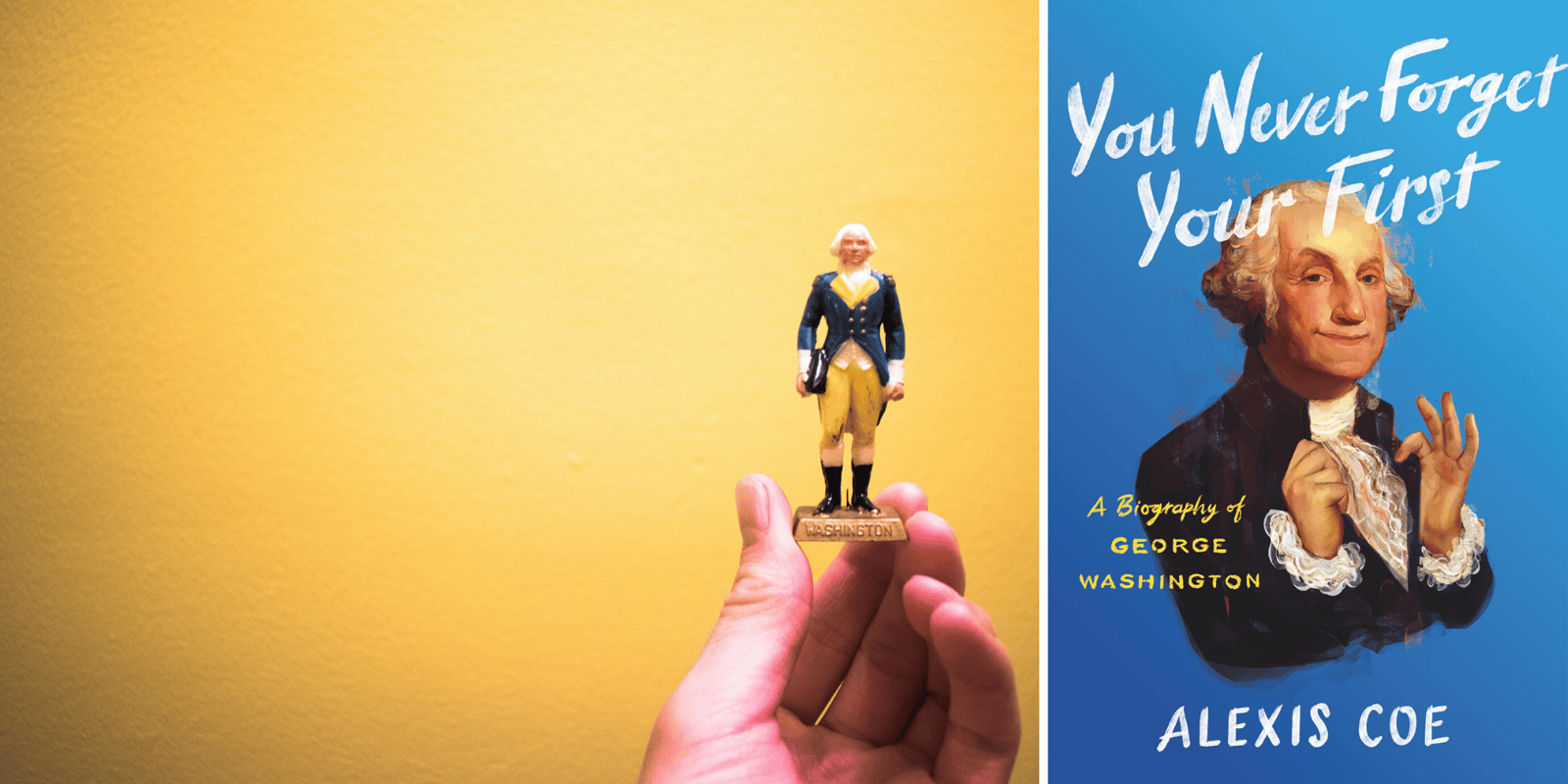
Historian Alexis Coe’s biography about George Washington isn’t just another addition to the overcrowded genre of what she deems “dad history” or history written about men for men by men. You Never Forget Your First peels away myths about America’s first president and in so doing critically questions what we take for granted about our country’s past.
Alexis Coe is here to tell you everything you never knew about George Washington.
What inspired you to write You Never Forget Your First?
Coe: I’ve come to expect a decent amount of sentimental Great Man speak in history books, but Washington biographies are lousy with it. At first, I was just bummed that potential new readers—aka people who don’t get gifted size matters books on Father’s Day—were left out. But after I started checking primary sources against citations, there was no looking back.
When I pitched the book in early 2016, I was thinking about all the connections I knew people would make—like Barack Obama, Washington was raised by a single mother, and like Thomas Jefferson, he owned hundreds of people. When I began writing it in in the fall, around the presidential election, there was a palpable urgency for people to better understand how much Washington, with a mandate from the Founders, shaped the presidency, and how quickly things went to hell. Washington’s greatest fears were partisanship and foreign interests meddling in American affairs! And yet, the progenitors of the nasty partisanship we see today were members of the cabinet he invented. Jefferson described those meetings as if they were violent altercations, saying that Washington “pitted” him against Hamilton “like two cocks” A book that told you all that, from basically cradle to grave (but not 1,000 pages) was the George Washington biography I wanted to see in the world.
The title of the book—a clever play on a familiar saying—denotes the tone and interspersed humor in your writing. How does the title speak to your book’s uniqueness?
Coe: It began as a working title, a joke I made to convince my agent that this book wasn’t going to be all wooden teeth and no bite—because that’s the sort of crazy thing that comes to mind when people think about George Washington: Dentures made of WOOD. And yet, even if we know that’s absurd because mouths are wet and wood hates wetness, we don’t think critically about Washington, or about him at all, and so we haven’t stopped to think about what his dentures were actually made of: Ivory from animals and human teeth from people he enslaved.
It’s safe to say that while every American knows that George Washington was their first, he’s been romanticized to the point that he’s a faceless phallic monument in the capital city he envisioned—and who even remembers that last part?
Often biographers wax poetic about their subject and view them through the lens of nostalgia. Why did you want to write a biography that provides a more nuanced view of Washington and separates his personhood from the mythology that surrounds him?
Coe: The past has been inhospitable to women and people of color, so as a woman biographer, I’m unmoved by nostalgia. There’s no time I’d rather live in than the present, with an eye towards the future. I am driven, however, by primary sources and a fear of being bias. That often means I hold two things at once, and as a result, what emerges on the page is, I hope, balanced. Washington was manly, but didn’t father any children. Washington fought for liberty, but enslaved hundreds of people. Washington was a doting step-father and grandfather to young children, but a negligent son to his aging mother. He can be all those things at once.
What is the most surprising fact you discovered about Washington that readers may not know?
Coe: Washington went into the presidency with a lot of important friends and allies—Thomas Jefferson, Thomas Paine, other people not named Thomas—and left estranged from many of them. He couldn’t shake the worldview of a military general and a slave master, meaning he expected everyone to carry our orders without question. They didn’t, of course, and he wasn’t exactly approachable, so they often responded by writing an essay (often under a rather unimaginative pseudonym, like Hamilton’s “An American”). Washington was rather sensitive about all that, but he could be incredibly critical of and cold to other people. And once he was done with you, he was done.
What are some surprising findings you uncovered about the women in Washington’s life? How did being a female historian—a field in which women are underrepresented—affect how you viewed and wrote about these women, if at all?
Coe: I was shocked by the way male biographers have treated Mary Washington, George Washington’s mother. She’s been called every name in the book, from crusty to unfeeling. But the criticisms, many of which are subjective and feel inappropriate for a biographer to make, are often incorrect. Chernow describes Mary as illiterate, and yet we have letters in her hand and know she read the bible, constantly, and that’s hardly the worst of it. I wish these Thigh Men of Dad History, as I came to call them, were as interested in family and women in Early America as military history or Washington’s thighs.
The office of the president was structured specifically for George Washington. How has the structure and precedents set during Washington’s presidency affected the state of politics today?
Coe: I think of the first presidency as a fourth trimester: Washington had carried the baby to term, and now he had to figure out how to keep it happy, healthy, and growing. And much of what he did has been adopted by every president, like having a cabinet or leaving office after term limits. When someone decides to violate Washington’s norms, like FDR with term limits, then his precedents are codified into law.
It’s important to remember that when came to choosing the first president, there were no backups. Delegates opted for a single executive (versus three! Can you imagine?!) because they assumed Washington would take it. He genuinely balked, making the very valid point that whole point of not having a king was that America wasn’t dependent on a single person, that the country outlive any one leader. So they peer pressured him into it! That’s how great everyone thought he was—at the beginning. By the time he left office after two terms, no one was begging him to stay.
What are some similarities and differences you have noticed between Washington’s presidency and the current administration?
Coe: Where to begin! Well, how about the fact that Washington constantly spoke out against foreign interference and allegiances? Washington hated inherited titles, pomp and circumstance, and petty, public fights. He insisted on paying his own way and had a long history of public service. He turned down military parades. I could go on and on...The only thing that they seem to have in common is that they’re both racist and sexist, but I don’t think Trump realizes that. Or knows anything about Washington—though that doesn’t stop him from making things up, like that Washington had two desks or that Washington took over airports when he fought the British in the 18th century.

Alexis Coe is an award-winning historian and author of the narrative history book Alice + Freda Forever (soon to be a major motion picture). Coe is a consulting producer on Doris Kearns Goodwin’s George Washington three-part series on the History Channel. She’s the cohost of Audible’s “Presidents Are People, Too!” and the host of “No Man’s Land.” Her writing has appeared in The New York Times, The New York Times Magazine, The New Yorker, The Atlantic, Slate, Time, and many others. Her latest book is You Never Forget Your First: A Biography of George Washington.
Header image credit: Unsplash
Become a Member
Being a member of the Chicago Humanities Festival is especially meaningful during this unprecedented and challenging time. Your support keeps CHF alive as we adapt to our new digital format, and ensures our programming is free, accessible, and open to anyone online.
Make a Donation
Member and donor support drives 100% of our free digital programming. These inspiring and vital conversations are possible because of people like you. Thank you!