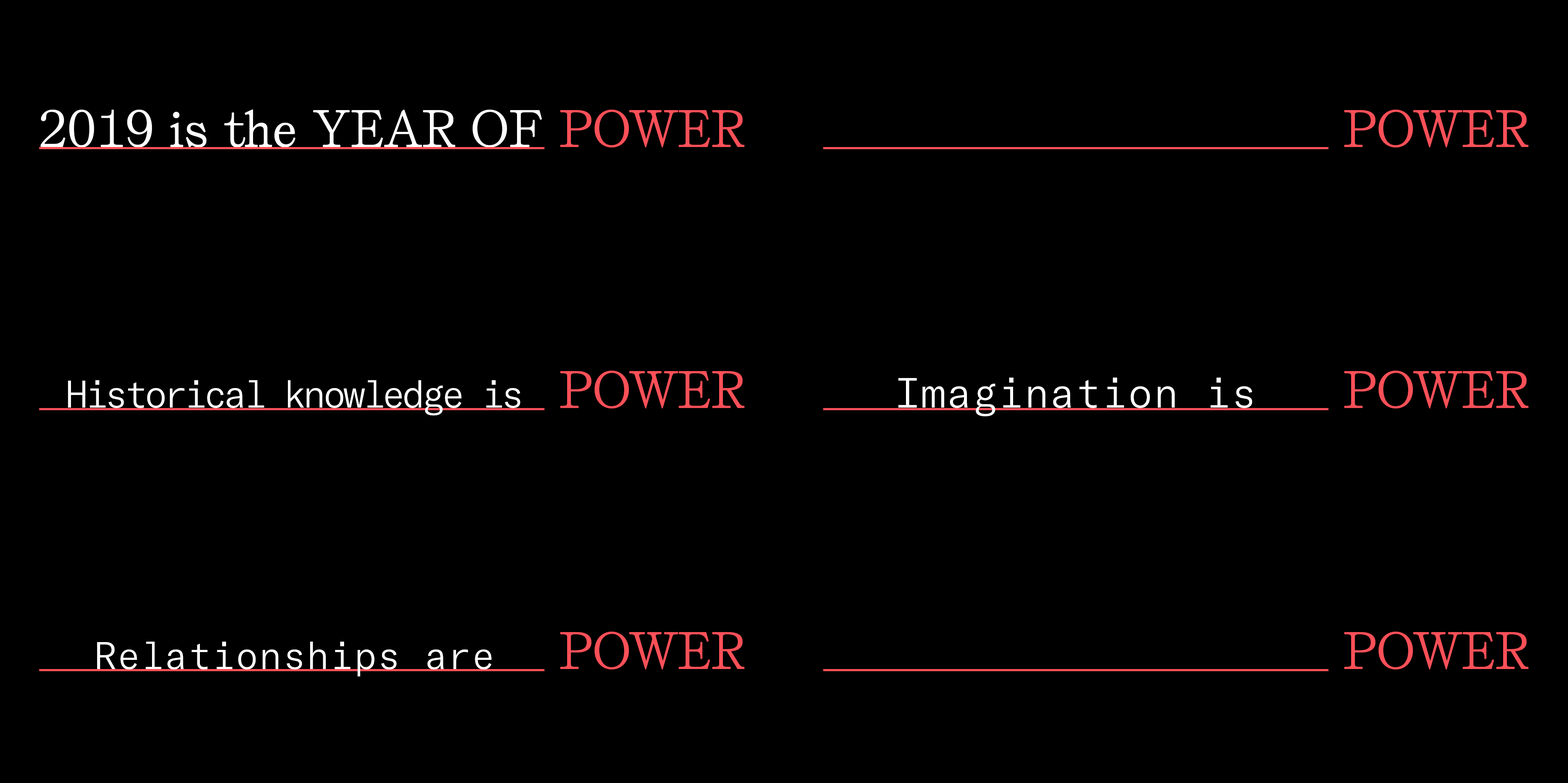
The second week of the 2019 spring festival covered all kinds of terrain: from the power of fungi on the micro level to people-powered movements and policy change on the macro level. The second slate of speakers and conversations inspired sharp questions from audiences, sweet photo ops at book signings, and a shared collective reflection on power, purpose, imagination, and change.
1) Historical knowledge is power.
George Packer described the American diplomat Holbrooke, who “loved history so much he wanted to make it.”
Historian Deborah Lipstadt emphasized the importance of nuances in historical writing: “I’m a historian, which means I deal with what was, not what is, and certainly not what will be….No country is free of faults but we can’t have myopic lenses. History has nuances that we must consider.”
Economist Raghuram Rajan underscored the importance of knowing the histories of populism for grappling with our present state of affairs. He cited greater government transparency, the 1890 Sherman Antitrust Act, the establishment of the Federal Reserve and the FDA–all results of earlier populist movements in US history.
Writer and PEN America President Jennifer Egan described the importance of reading fiction from the 1930s to inform her writing of the novel Manhattan Beach: “Nonfiction is explicitly trying to convey information about the times. But fiction does it sort of by accident: relaying the times through specific details while focusing on a story.”
Law Professor Danielle Citron suggested that the past regulation of online harassment has been inadequate: “We have to reconsider the broad immunity lawmakers have given to online content platforms.”
Environmentalist Bill McKibben reminded us about the people power behind the first Earth Day in the US: “In 1970, on the first Earth Day, there were 20 million Americans on the street–that was 1 in 10. Those people took power into their hands.”
2) Community is power.
Charlene Carruthers and adrienne maree brown had an intimate conversation about how we tend to underestimate the power of joy and community in building social justice movements. They also underscored the importance of being unapologetic: “Unapologetic is about throwing off oppression. Oppression is the thing that makes us want to apologize.”
Eve Ewing described the characters in her comic Ironheart: “I wanted to know who are the people that hold her [Riri] down. The real heroes are her neighbors, her mom...I’m interested in those stories.”
Anand Giridharadas discussed the ways in which well-to-do, well-intentioned people tend to focus on making minute changes in the status quo rather than the large-scale changes necessary to alter the conditions for people who are suffering: “We live in a world of staggering inequality. Growing inequality. We tend to write about inequality by writing about the people at the bottom. You wouldn’t ask a theater-goer about the architectural decisions of the theatre. They didn’t build it. They’re just here in it.”
Raghuram Rajan believes “the power to do things has moved from the community to the national government and international level. We need to push power back to inclusive localism–the big revolutionary move is the decentralization of power. Enable communities to do more.”
Bill McKibben, Cheryl Johnson, Stephanie LeMenager, and Josh Ellis discussed a variety of environmental and social justice minded approaches to mitigating climate change at hyper local (classroom), local (neighborhood), national, and international levels. McKibben stressed the importance of not letting this present moment of climate awareness go to waste, and reminded us: “Those who are least responsible for climate change are the ones most effected.”
David Brooks suggested “We can have one conversation a week or a month with someone unlike ourselves. ... it will improve our communities and culture.”
“For something to be real it has to be imagined as real.” –Aleksandar Hemon
3) Imagination is power.
Amor Towles gave advice to new writers: “write from as many different perspectives as possible.”
Professor Stephanie LeMenager discussed the possibilities of Environmental Humanities: "Fiction teaches us that no world is inevitable... It helps us envision possible futures."
Aleksandar Hemon on writing and fiction: “One of the functions of fiction is to make things imaginable and therefore real...Information is not the same as access to it, it's just raw information. For something to be real it has to be imagined as real. And the past, to be comprehensible, has to be imaginable.”
"We've had 60 years of hyper-individualism, and now we need a shift." –David Brooks
4) Relationships are power.
In a wide-ranging and moving talk about success, happiness, and meaning, David Brooks discussed the relationships and commitments that define a purposeful life: "We all have a sentimental desire. What the heart wants the most is an intimate connection with another.” And later: “The connection with the other person is so encompassing, you don't have to think about yourself. You get your joy from other people's happiness.”
Radical Mycologist Peter McCoy: “Mycology is a very inaccessible science. Radical Mycology was a way to share all the insights on fungi and how it’s influenced our world and human culture. And Radical Mycology Convergences allows these communities to come together and share knowledge.”
Aleksandar Hemon described how urban design affects our social interactions: “The way to engage with a space is to do it physically: I could understand the city intellectually, but I had to bump into the facts of Chicago….Cities are organized to keep distance between people. But people are people, and they will find ways to get close to each other.”
Activist Cheryl Johnson on environmental organizing: “It’s going to take an ‘environmentalist village’ to change the climate movement.”
Asides, Observations, & Miscellany
Amor Towles wishes he was his main character: “everyone has a reader crush on the Count” and “We have come to demand more factual accuracy from our novelists than our presidential candidates and that’s crazy.”
David Brooks had some jokes: I'm the only American adult man who finished Eat Pray Love. And: “Writing a book on character doesn't actually give you good character. ..but buying one does.”
“This is the city I grew up in and I’m just now been invited [to CHF]. “This is my Coachella moment.” —Charlene Carruthers
“Whatever you call yourself, if you’re fabulous that’s really what matters...doesn’t matter what gender.” —Frank DeCaro at the Shortlist-exclusive event
Chanteuse Maude Maggart gave audiences a tour of American songbook and cabaret classics through the lens of power: “When you haven't got the coin you're always in the way... life's a very funny proposition after all” Or this memorable line from Marilyn Miller in the 1929 musical, Sally: “But honey are you making any money, that's all I wanna know?”
Videos of these presenters and all the spring programs will be made available as soon as possible through our open digital archive.
Become a Member
Being a member of the Chicago Humanities Festival is especially meaningful during this unprecedented and challenging time. Your support keeps CHF alive as we adapt to our new digital format, and ensures our programming is free, accessible, and open to anyone online.
Make a Donation
Member and donor support drives 100% of our free digital programming. These inspiring and vital conversations are possible because of people like you. Thank you!