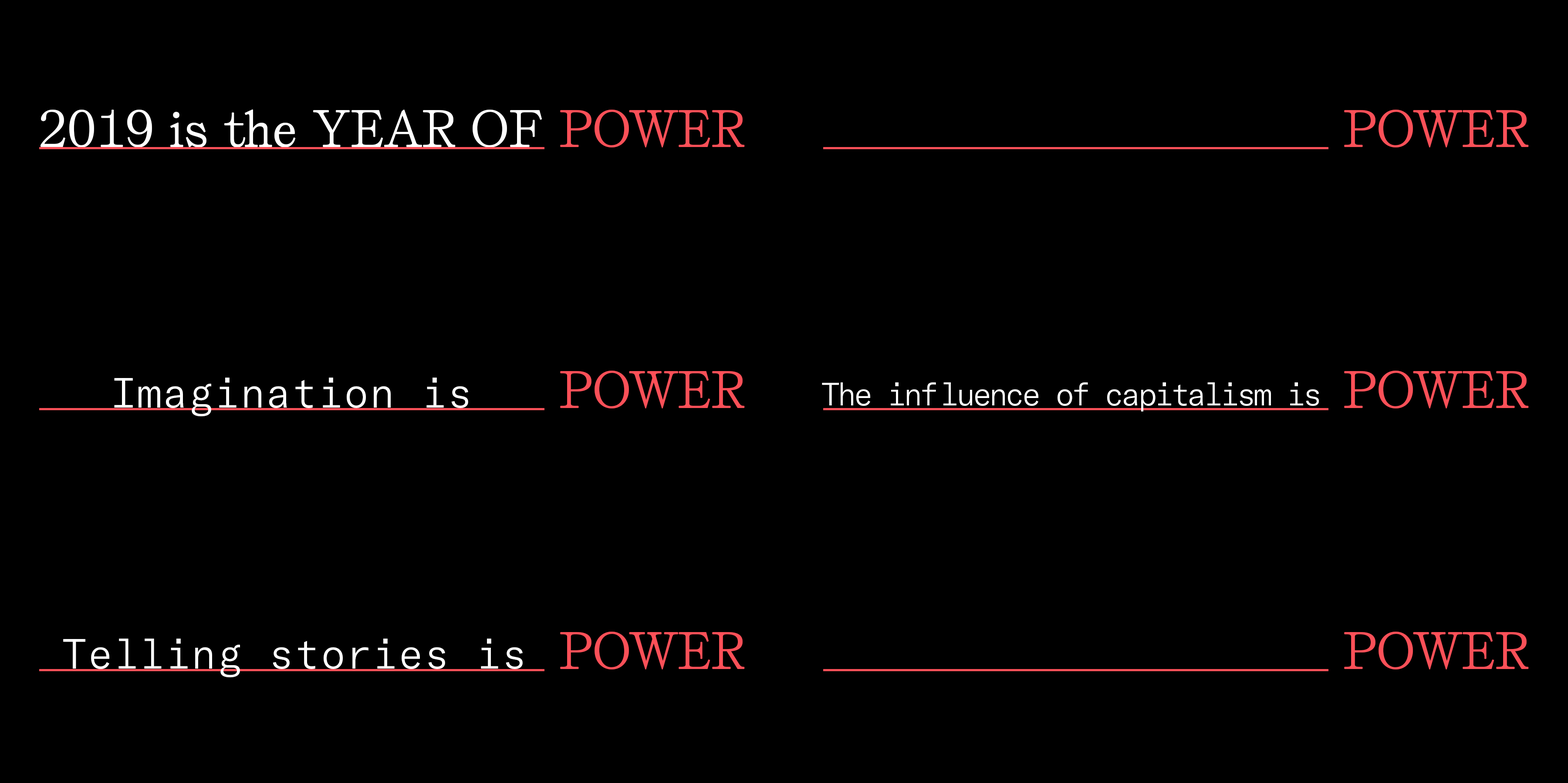
Our 2019 theme is in invitation to question forms of power: how it moves, how we get it and lose it, how it changes us, and how it can change the world. The programs and speakers presented thus far during the 2019 spring festival have sparked great insights and reflection–from the individual sense of empowerment that comes with owning who you are, to the power of grief after losing a loved one, to the power of community to make change.
“Real purpose has to be greater than your name in lights...it has to be so strong and clear that it outlasts you.” –Stacey Abrams
1) Clarifying your purpose is power.
Melinda Gates, speaking with the President and CEO of The Chicago Community Trust, Dr. Helene D. Gayle, addressed how her philanthropic work with the Bill & Melinda Gates Foundation has impacted her: “Getting into contraceptive and gender work has made me incredibly bold…I realized this is who I am, take it or leave it.”
Idra Novey spoke about the power friendships and camaraderie have in social change, and for staying true to your convictions: “Real change, especially policy change, happens slowly, and over a long time.”
In a conversation with journalist Mary Mitchell, Stacey Abrams made a number memorable proclamations: First, that “ambition should be driven by the mission of what you want.” She continued: “Power means nothing if you do not aggregate purpose to your power.” And later: “Greatness is about the highest achievement, but that isn’t possible without purpose. Real purpose has to be greater than your name in lights...it has to be so strong and clear that it outlasts you.”
2) Imagination is power.
In mid-April, theoretical physicist Michio Kaku addressed the timely topic of black holes for an enrapt audience at the Music Box Theatre, and how non-physicists might conceptualize them: “If a spinning star collapses, it flattens into a ring. If you fall through the ring, you might see another universe on the other side...much like a looking glass.”
Also earlier in April, Valerie Jarrett, former Senior advisor to President Obama, told powerful stories about her upbringing in Chicago and how her parents raised her “aspirationally...not for the the world as it was, but for what they hoped it would be.”
Historian of religions Jeffrey J. Kripal urged us to reconsider belief itself: “What we consider impossible isn’t impossible at all...The way we think about humans, about ourselves, comes from what we refuse to believe. If we put those things back on the table, the way we see the world could radically change.” And later: “The future of knowledge will rely on the integration of consciousness and the cosmos.”
Stacey Abrams implored audiences to “Dare to want more… we should strive for everything we can imagine. The minute we start to edit our ambitions, we get stuck in the least possible accomplishment.”
Virgie Tovar’s lecture encouraged the audience to reevaluate the cultural obsession with weight, and explained that fat positivity is simply the idea that fat people are human. She emphasized the power of imagination: “Giving yourself permission to envision yourself as a fat person in the future is an extraordinary act because it frees up mental real estate to thrive holistically. How we imagine ourselves in the future deeply impacts what we do in the present.”
3) The influence of capitalism is power.
Tovar also revealed the deception of the diet industry: “How are diets related to capitalism? They are both outcomes-oriented.” And she described how the idea of body image has been co-opted by marketing: “‘Body image’ is not a robust critique. . it's a watered down version of fat positivity.”
Journalist Marc Lamont Hill situated victims of police brutality in larger institutional contexts: “When Mike Brown gets shot by Darren Wilson, I think about everything that led us there...The state is relieving itself of its responsibilities to citizens; let’s privatize everything. And the most vulnerable become disposable.” He continued: “People like Mike Brown are seen as inefficiencies in the market. And so, they get thrown out.” Professor Barbara Ransby added: “There’s a correlation between the market and the disposability of marginalized people, and then there’s the insertion of state violence.”
"Friendships and camaraderie are important for social change, and for staying true to your convictions." –Idra Novey
4) Speaking up is power.
Valerie Jarrett emphasized : "What we really need is the courage to speak up, and to listen to the needs of women. If you can do it, then you're making it easier for the next person. When you are able to say what you need, that's very powerful."
Marc Lamont Hill with Barbara Ransby emphasized people power: “Politicians don’t have feelings, they have interests. If you can convince them certain changes are in their interest, you can swing them to your side.”
In a comprehensive discussion of the expanding power of prosecutors, journalist Emily Bazelon stated: “There’s an urgency to these issues around reform right now–more people are more open to the idea that mass incarceration has gone too far.” She continued: “Questions about criminal justice reform are entering the conversation around the presidency; for example, recent questions around whether incarcerated people are able to vote. We can insist this conversation matters, and that’s powerful.”
In a wide-ranging conversation with Coya Paz about what it means to break the silence about injustices, Idra Novey suggested “Often when people stand up to power, it isn’t for themselves–it is to help someone else.” She continued, “When there is an act of violence you have to live with, the bridge out of it is to speak your truth. Do not let yourself be pushed into silence. You are powerful.” And sometimes silence is powerful, too, especially in the context of complicity: “What presents as silence to other people, presents as a roaring truth to those witnesses who knew.”
5) Telling stories is power.
Melinda Gates emphasized how learning from women around the world changed her: “These women’s stories animated my life...I hope they animate others.” And later: “Qualitative information is vital–it's data with a soul. Data is often sexist: it doesn't exist around women's lives and especially their health.”
In conversation with Lolly Bowean, Alex Kotlowitz recalled his reporting for This American Life on Harper High School, where he planted myself in the social workers room–a windowless room on the first floor: “It says a lot about of the hierarchy of social work in our schools.” He remembered fondly a social worker telling him, “I appreciate you in advance." And later: “There’s a power in telling stories, and a greater power in telling your story.”
Author Sigrid Nunez linked writing with memory and narrative: "You are what you remember. We all go through life with our minds constantly blending memory and imagination to write this narrative called My Life."
Finally, the importance of storytelling in the legal system was born out in four unique versions of Please Continue, (Hamlet)–a hybrid trial/play that illuminates the inner-workings of the justice system and shows the law as an act of constant interpretation. Four unique unscripted trials, with four unique sets of judges, attorneys, and medical examiners, yielded unique outcomes: At the end of the first performance, Hamlet was found not guilty. On the second performance, the judge declared a mistrial due to a hung jury. For the third performance, he was found guilty of involuntary manslaughter. In the last performance, Hamlet was found not guilty. But all performances inspired engaging conversations and debates among the audience–whether or not they were selected for the jury. This experience showcased powerfully how the humanities are a way into important civic conversations–about sentencing, the role of mental health in trials, and injustices of the criminal justice system.
Asides, Observations, & Miscellany
Well for one thing, it SNOWED ALL DAY on April 27. Thanks to those of you who cozied up with us at the UIC Forum on that very un-spring-like day!
Jeffrey Kripal: “Trying to prove the existence of the paranormal by using the scientific process is like going to the North Pole to prove the existence of zebras.”
A 6th grader in the audience posed a question to Virgie Tovar, wanting to know how to help 5th grade girls at her school who are afraid of peer pressure to lose weight and conform to a certain image that they feel starts in 6th grade. What can I do to help? Tovar advised her to reflect on: What do you love to do? What are your strengths? “Lean into that and create a powerful message.” In a separate event, Tovar also had an in-depth conversation with a small group of young women who were interested to learn about how diet culture is a product of marketing and not medicine, and shared their own stories around body image.
Alex Kotlowitz on why his book is called An American Summer: "It's us. It's Parkland. It's Newtown. It's Chicago."
Sigrid Nunez: "You would need such sizable jaws to tear up the first volume of Karl Ové Knausgaard.”
Mayor-elect Lori Lightfoot gave a surprise introduction to the Stacey Abrams program on Saturday evening, which was part of CHF’s Joanne H. Alter Women in Government Lecture series. Lightfoot said: “We must behold the fearless legacy that Joanne Alter left in this city.” And, introducing Abrams: “I would like to think that Joanne Alter is saying: Job well done.”
Become a Member
Being a member of the Chicago Humanities Festival is especially meaningful during this unprecedented and challenging time. Your support keeps CHF alive as we adapt to our new digital format, and ensures our programming is free, accessible, and open to anyone online.
Make a Donation
Member and donor support drives 100% of our free digital programming. These inspiring and vital conversations are possible because of people like you. Thank you!