Q&A: Archaeologist Rebecca Graff on Jackson Park and the Chicago World's Fair
As a historical archaeologist and Associate Professor of Anthropology at Lake Forest College, Rebecca Graff explores the relationship between temporality and modernity, memory and material culture through archaeological and archival research. Graff’s new book, Disposing of Modernity, focuses on the late 19th century in American history. Graff looks at the archaeological materials she recovered from Chicago’s Jackson Park and from Charnley-Persky House, a contemporaneous site on the Gold Coast well-known for its architectural importance.
On November 11th, CHF will host a discussion about community organizing as part of our Chicago Neighborhood Check-In series. Among other topics, panelists will discuss the community response to building the Obama Presidential Center in Jackson Park. Ahead of the program, CHF asked Dr. Graff about what she uncovered as the first person to lead an archaeological excavation in Jackson Park, near the site of the Obama Center, and what her findings mean for the Park today.
CHF: How did you come to dig in Jackson Park? What were you looking for and what did you find?
Rebecca Graff: During an anthropology department event when I was a graduate student at the University of Chicago, I was standing on a balcony overlooking the Midway Plaisance and my professor, Raymond Fogelson gestured a sweeping hand and said, “100 years ago, this was the center of the world.” He was talking about Chicago’s World’s Columbian Exposition, which was held in Jackson Park and the Midway Plaisance for six months in 1893.
I soon learned that no one had actually used archaeology to look at the Fair! I got a permit from the Chicago Park District, lined up a crew for surveying the site, and led an undergraduate archaeological field school for excavating it. I was interested in seeing what, if anything, remained from the Fair.
In almost every single excavation unit we put in, we found the remnants of infrastructure from the Fair—pipes and conduits left in place when the Fair ended. What I did not expect were the remains of one of the buildings from the White City: the Ohio State Building, which served as a meeting place where visitors could rest and relax in between visiting the larger exhibit buildings.
CHF: How did finding the remains of the Ohio Building impact what is known about the site?
Graff: Finding the remains of the Ohio Building, which was purportedly thrown into Lake Michigan, was unbelievably surprising. That these delicate plaster columns were still intact in Jackson Park a hundred and fifteen years after the Fair was a revelation.
We were also able to recover some artifacts likely from the Ohio Building or those who visited or worked there. In that regard, what was really exciting was learning more about the servants who lived inside the Ohio Building for the six months of the fair, maintaining the structure, cleaning it, and even cooking some meals. It was like a whole other world was brought to life through this finding, focusing on the behind-the-scenes labor force whose work made the Fair a success.
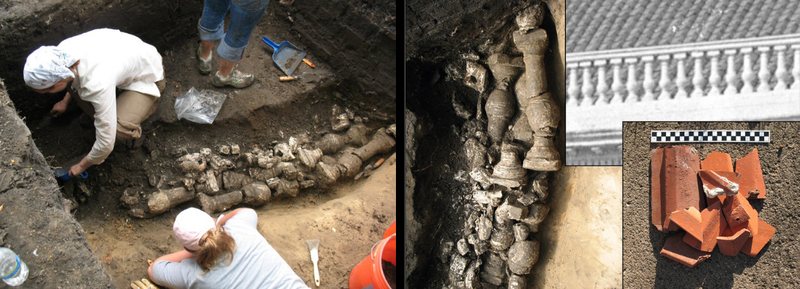
Left image: Excavation in Jackson Park, 2008. Photograph by Rebecca S. Graff. Right image: Photographic collage of plaster columns and terracotta tiles from the Jackson Park archaeological excavation with an image of the Ohio Building. Photograph by Rebecca S. Graff.
CHF: How would you relate your dig in Jackson Park to the discussion about the site on which the Obama Presidential Center is to be built?
Graff: I was the first person to lead an archaeological excavation in Jackson Park. In 2017, work was conducted by the Illinois State Archaeological Survey. They did review my report and previous excavation records. Their report reinforces some of the arguments I made—most notably, that there is a lot of the World’s Fair still underground in Jackson Park.
There are things that we find archaeologically that are at odds with the documentary record, and there are things that we find that are congruent with what we already know. But overall, the archaeological record is a different evidentiary line about human experiences at the Fair from say, a socioeconomically-elite white person’s diary entries. As such, it provides a way to look at different and more varied human experiences from those whose lives are not captured in newspaper articles or historic archives.
CHF: You have said you would like to see an exhibition dedicated to the history of the park and of the World’s Fair included in the Obama Presidential Center. What would you want to put into that exhibit?
Graff: I think that Jackson Park is fantastically interesting in so many ways. Having a strong sense of place and history is the job of the Obama Presidential Center as we look toward the future.
I’d love to see an exhibit that uses some materials from our excavation to address that narrative. One really special juxtaposition that comes to mind would be to place the plaster columns from the Fair alongside a collection of items of personal adornment like buttons, a religious medal, and children’s barrettes from the early 21st century, all of which demonstrate the human experiences that continue to center around Jackson Park.
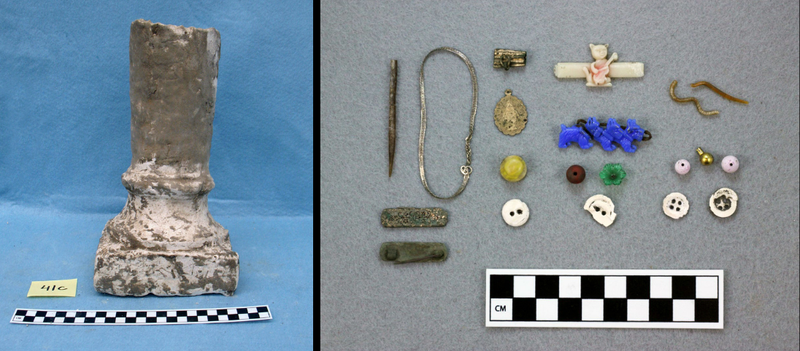
Left image: Photograph of plaster column from the 1893 Ohio Building, now in the collection of the Illinois State Museum. Photograph by Ryan J. Cook. Right image: Photograph of a bar pin, shell buttons, a religious medal, collar stud, plastic child’s barrettes, and other some objects of personal adornment recovered from the 2008 archaeological excavation in Jackson Park. Photograph by Rebecca S. Graff.
CHF: Based on your research, what do you think some of the trade-offs of building the Obama Presidential Center on the Jackson Park site are?
Graff: I would never want to claim that a site like Jackson Park should be frozen in time or that it shouldn’t continue to evolve as a public park site. That said, I do think that there has to be space for further archaeological work at the site to recover the information about the Fair and about the entire life history of Jackson Park before it is permanently destroyed by construction. I hope that the latest plans for the Center set things up for them to be good stewards of their section of Jackson Park.
Join us on November 11th for our Chicago Neighborhood Check-In: Community Organizing!
[Hero image description: The banner image at the top of the web page is a close-up of the book cover for Rebecca Graff's Disposing of Modernity. The vintage, sepia-toned photograph is taken from a balcony looking down at a body of water surrounded on four sides by ornate buildings.]
Become a Member
Being a member of the Chicago Humanities Festival is especially meaningful during this unprecedented and challenging time. Your support keeps CHF alive as we adapt to our new digital format, and ensures our programming is free, accessible, and open to anyone online.
Make a Donation
Member and donor support drives 100% of our free digital programming. These inspiring and vital conversations are possible because of people like you. Thank you!