Henry Winkler: Lessons from a Real Sweetheart
S3E1: Henry Winkler: Lessons from a Real Sweetheart
Apple Podcasts • Spotify • Pandora • Overcast • Pocket Casts
Beloved actor Henry Winkler sits down with his friend and Barry co-star D’Arcy Carden as they chat Happy Days, school survival, fly fishing… and a little bit of shark jumping.
Read the Transcript
D'ARCY CARDEN: When people say this is Hollywood's nicest man, he's so much more than that.
HENRY WINKLER: And what a body.
[Audience applause]
[Theme music starts]
[Cassette player clicks open]
ALISA ROSENTHAL:
[Theme music plays]
[Audience applause]
HENRY WINKLER: Thank you for being here. Before we start, I would just like to say D'Arcy is a very good friend of Stacey and mine. We acted together and it is a pleasure that we asked her to come here tonight and she flew. And thank you.
D'ARCY CARDEN: The pleasure is truly mine. Thank you for screaming. The pleasure is so mine. I'm honored that you asked me. I love and adore you. And it's so nice to meet you all tonight. I would fly anywhere for you, sir. Chicago's a treat.
HENRY WINKLER: Thank you.
D'ARCY CARDEN: Hi, everybody. Thank you for coming out. I would like to talk about my friend Henry Winkler's beautiful new book, Being Henry: the Fonz and Beyond. And I read this book this week and it was I think I've told you, we've been hanging out today and I've been trying not to talk to him and Stacey, his wonderful wife, about the book, because I want to talk about it with you guys. But I it was it is funny. It is moving. I cried a lot. A lot. I took a picture of myself crying, which I never do. It's it's I cannot wait for you all to read it. It's just wonderful. You're here because you love Henry, and you're going to get to know Henry so much so much more and so much more intimately. And it's just wonderful. I love it. And I can't wait for you all to read it and tell all your friends.
HENRY WINKLER: Me too. I just. I can't wait either.
D’ARCY CARDEN: And they’re, yeah. Okay. So I have gotten to know Henry over the last we we were on the show "Barry" together. So it's been about seven years. And I, we were we. I'm just going to talk about Henry for a little bit and then we can talk about the book. We were sort of instantly friends.
HENRY WINKLER: Yes.
D'ARCY CARDEN: I would say not even sort of. We met.
HENRY WINKLER: Yes.
D'ARCY CARDEN: And we bonded very quickly.
HENRY WINKLER: We did. And you were my assistant in the first year of "Barry," right? You were Gene Cousineau's assistant?
D'ARCY CARDEN: Yes. Natalie Greer.
HENRY WINKLER: And somehow that faded into. I don't know where.
D'ARCY CARDEN: I don't know where either.
HENRY WINKLER: And then you became Sarah Goldberg's assistant?
D'ARCY CARDEN: Yes.
HENRY WINKLER: Sally's assistant.
D'ARCY CARDEN: That's right.
HENRY WINKLER: You were everybody's assistant.
D'ARCY CARDEN: I was everybody's assistant.
HENRY WINKLER: You were Bill Hader's assistant.
D'ARCY CARDEN: In real life, yes. That's right. Yes. So we we sort of we there's so many fun stories about "Barry." And we have a while so we'll talk about some of them. But it was I the way you sort of took me under your wing and became my dear, dear friend so quickly has been one of the most rewarding, rewarding relationships of my entire life. And I want to tell you guys a few things. I want to tell you what type of friend Henry is. Okay. Henry is the type of friend and Stacey too Stacey Winkler, who is here, who I adore and love. And you'll you'll get to know her well in the book as well. Henry is the type of friend who calls you and checks in. He especially called me a lot during Covid when I was really lonely and missing friends. And we we we had more phone calls than maybe anyone in my life. And it was really, really meaningful to me. Henry is the type of friend that when you're leaving his house, you're getting in your car. He says, "Wait, wait!" And he runs inside, goes in the backyard, clips a few roses from his beautiful rose bushes, wraps them in paper, in tinfoil, and brings them out to your car. Henry is the type of friend that when you tell him that you are going to be on Broadway for the first time, he says, "Oh my fucking God. Broadway." Henry is the type of friend that when you're on Broadway, he checks in with you every single Monday when you don't have a show to see how that week went. During rehearsals, during the show, asks where you are in rehearsals. "Is the tape on the floor? Are you gelling with the cast? Have you memorized your lines?" It was one of the in the time that I was doing Broadway, it was one of the things I look forward to the most. Again, it made it so much more special.
HENRY WINKLER: And I'm also the kind of friend that Stacey and I went and saw you.
D'ARCY CARDEN: Yeah you did.
HENRY WINKLER: And thoroughly enjoyed you up on that stage. You wiped the stage clean. You know, there was nobody else on that stage but you.
D'ARCY CARDEN: You really - see this is the kind of friend he is. I'm telling you. There's so many more.
HENRY WINKLER: What else? What else?
D'ARCY CARDEN: Okay. I'm going to tell you more. Henry is the type of friend that when you're having trouble while you're doing a project, play a movie or TV show and you're doubting yourself. He looks you in the eye and says, "You know." And he made me write it down on a Post-it note and put it on my mirror so that everyday I could look in the mirror and think to myself, "I know." And it really did help me. You, Henry and Stacey are the type of friends that when you move into a new place or you start a new project, they send you the biggest orchid plants you could possibly imagine. Those are orchids, right?
HENRY WINKLER: Yes, they are.
D'ARCY CARDEN: They're the big - I've never I've never seen -
HENRY WINKLER: And they were real. They were not silk.
D'ARCY CARDEN: No, they're real.
HENRY WINKLER: Yeah.
D'ARCY CARDEN: And a man. Not just a delivery guy. Maybe the guy who planted the damn plant himself delivers it.
HENRY WINKLER: All the way from Thailand.
D'ARCY CARDEN: It's incredible.
HENRY WINKLER: We sent him.
D'ARCY CARDEN: It's incredible.
HENRY WINKLER: Yeah.
D'ARCY CARDEN: Okay. Henry is the type of friend that you that when I was sort of doing my first couple of award shows, which can be very overwhelming, and I'm part of a cast. I'm not nominated for anything. Henry when he saw me on the red carpet, linked arms with me and took me to each one of his interviews. And this is HENRY WINKLER. So he's in the prime time spot. He's nominated for things. They want to talk to him. They don't want to talk to this scrub. But because he's bringing me to each and every interview, I got to be I got to be on TV. And that was not that he didn't that was not not on purpose. You knew what you were doing.
HENRY WINKLER: I knew what I was doing.
D'ARCY CARDEN: It was it was again, very meaningful to me.
HENRY WINKLER: Yeah I thought it would make me look good.
D'ARCY CARDEN: Henry is the type of friend that when your husband goes out of town and you have just moved into a big, scary new house and you're afraid to sleep there alone, Henry and Stacey say, "Well, you'll be staying at our house. Well, you will absolutely be staying at our house. You're not staying in that house alone. You'll come to our house." And they're you guys. When I went into my little room, my little room. It's a beautiful house. I'm sure you can imagine. There was toothpaste on the on the on the on the sink. There was a fresh toothbrush. There was a towel. There was gum. There was candy. There was water. They had the TV on a channel that they thought I might enjoy. I mean, every detail. Was thought of.
HENRY WINKLER: Because you never know when you need to be a manager of a hotel. It could happen like that, you know?
D'ARCY CARDEN: And it did. And it does. And you know that, it was amazing. And then in the morning, we woke up. Henry made me coffee. We talked. I mean, this is just what I'm saying is this is a dear friend. What I'm also saying is you may know that this is Hollywood's nicest man. I'm sort of doing this because when people say, isn't he just the nicest man you ever met, I almost I almost want to - this is what I say. He's so much more than that. Nice is pretty easy, actually.
HENRY WINKLER: And what a body. Thank you.
D'ARCY CARDEN: And what a body.
HENRY WINKLER: Thank you.
D'ARCY CARDEN: And that leads us to let's talk about this book, shall we? Now, the book just came out this week and people will be reading it for decades and centuries to come. But the fun thing about reading it this week is that it's this week really this month, let's say, is the 50th anniversary, the 50th anniversary of when you auditioned for and got a great little role in a show called "Happy Days." 50 years. On August 30th.
HENRY WINKLER: When I auditioned,
D'ARCY CARDEN: October, October.
HENRY WINKLER: I had six lines.
D'ARCY CARDEN: Is that true?
HENRY WINKLER: Yeah. Yeah, that's true. I had hair down on my shoulders and I had a gigantic sweat stain that it looked like the Hudson River was flowing under my arm. And I walked into this room, 11 people. The head of casting behind a very impressive desk, Milly Gussie at the time, the head of Paramount Casting, Garry Marshall. Ed Milkis, Tom Miller from Milwaukee. That's why "Happy Days" was set there. And I was petrified because every actor in the waiting room was famous. Everybody I had seen on television and then me. And so I walked into the into the room and I introduced myself. And there was a young man named Pasquale. And Pasquale was going to read with me. He was reading the other part. And I don't know what happened, but I had I was always able I am always able to go with my instinct when it comes to my work. But in the beginning of my life, I could not be as authentic. And something snapped. And I just looked at Pasquale and I said, "Don't you look at me like that? Do not look me in the eye, buddy. All right, let's start." And then we were done. I flipped the script in the air. I sauntered out of the room, and on my birthday, October 30th, 1973, they called and said, "Would you like to play this role?" And I said I would. I would. Now, my parents call, very short Germans and they call and my they say, you know, "They've going to take you, your sister. And vat's his name." They never actually called my sister's first husband by his first name. Lovely people. "And they're taking you, your sister and vat's his name on a trip to Europe because we don't know how long they're going to be around." Now, that was 1973. My mother, bless her soul, died in 1989. But they don't know how long they're going to be around. And I said, I can't come because I just got a small role on a on a show in in Hollywood. And my mother said I it was like yesterday, "Oh, this is great. Here tell your father."
D'ARCY CARDEN: Yup, I um, now when you accepted the role of the Fonz of Arthur Fonzarelli, we all know him well. I do. You remember you had a conversation with whoever it was that offered you the role, and you said something about as long as I can.
HENRY WINKLER: Show the emotion.
D'ARCY CARDEN: Thank you.
HENRY WINKLER: That, you know, when he takes off his jacket, eventually he has got. Who is he going to be cool for in his apartment? And they said yes. And I said yes. And I had the greatest time. And, you know, I said, "Hey," for ten years it was like, really easy to memorize. And then I added my own word, which came from my favorite sport at the time. "Whoa."
D'ARCY CARDEN: Your own word?
HENRY WINKLER: Yeah. "Aye."
D'ARCY CARDEN: "Aye."
HENRY WINKLER: "Aye" and "whoa." But the reason that it was great to have the words is because I could reduce paragraphs to sound. You know? I could talk through the sound, you know? "Hey. She is so beautiful. Hey, I'm hungry. Hey, do not mess with me." And so because you cannot be cool when you talk that much. Unlike me in my real life.
D'ARCY CARDEN: Right. So just saying the word. You conveyed so much emotion.
HENRY WINKLER: Absolutely.
D'ARCY CARDEN: Yes. Most actors want more and more and more words. But you said less, less, less - amazing. And part of that I'm imagining is you went to school at Emerson and Yale drama. Alright. So. Alright.
HENRY WINKLER: I got into Yale. I applied to 28 colleges. I got into one. Emerson College in Boston. I am in the bottom 3% academically in America. That is quantified. And I took geometry for four years. Same course. I took it in regular school. I took at summer school, regular school, summer school, regular school summer school regular school summer school. And I finally passed it in the summer of 1963 with a D-minus. If I did not get that D-minus, I could not go to Emerson in Boston.
D'ARCY CARDEN: Yeah.
HENRY WINKLER: I don't know why I had to take that much geometry because from that day in August of 1963 until tonight, not one person has ever said "hypotenuse" to me. What were they thinking? So I finally figured out that we have to teach our children how they learn, not what we think they should learn. And if there are young people in this audience, if you are still going to school, I want to say to you now how you learn and how difficult it is has nothing to do with how brilliant you are.
D'ARCY CARDEN: That's so well said. And I imagine it took a long time for you to get to that point. That's such I mean, that's such a profound.
HENRY WINKLER: I felt I was stupid until about last Tuesday.
D'ARCY CARDEN: What changed?
HENRY WINKLER: Yeah. But, you know, my parents called me dummerhund. For those of you who don't speak German, that means dumb dog. Very lovely. Very lovely people. You know, my teachers, every all the adults in my life said I was lazy and stupid, that I would never meet my dream. I would never achieve much. And I. I didn't want to be stupid. I didn't think I was stupid. But yet you, you know, you identify. Well, if they say it, it must be true. So you sink it. And so it completely cuts off your ability to try something that you think is going to make you look dumb or or, you know, just you will not achieve. So this is another lesson that I have learned in my life. I'm here to tell you and I don't mean to be presumptuous. Every single person in this room is powerful. I know this. You some of you don't know your power. Some of you haven't tasted it. Some of you are afraid. Some of you absolutely have been in touch with your power. But here it is. You do not know what you can achieve until you just put one foot in front of the other. Writing books. I had trouble getting hired because, you know, I was the Fonz. And they would say, he is so funny. He is a wonderful he's won - but he was the Fonz.
D'ARCY CARDEN: Typecast. Yeah.
HENRY WINKLER: Yeah. And so a friend of mine said, write books for children about your learning challenges. And I said, "Well, I can't do that because I'm learning challenged." And he said, "I'll introduce you to my friend Lynn, who knows everything about children's books." And I want to tell you, the dummerhund, about 16 days ago, our latest children's book came out. And that makes 39.
D'ARCY CARDEN: That's a lot of books. Yeah. That's amazing.
HENRY WINKLER: And I'm telling you, I mention it only because I absolutely knew I couldn't do it until I just tried. And you figure it out.
Broadway
D'ARCY CARDEN: That message really stuck out in the book to me. You said you said the schizophrenia of this is when you get a big opportunity, the schizophrenia of of are you crazy? How dare you? And then finally shut up and just try it. That really, yeah.
HENRY WINKLER: It's true. It's true. And so many times I did a play on Broadway in 2000. Neil Simon, the most prolific playwright. First he asked me to come downtown in L.A. and read his play out loud so he could hear it because his genius was that he would during preview rewrite it. We started with version four and opened on Broadway with version 11. It well, I'm telling you, it was amazing. But I said, How can I read out loud? I can't read at all. How am I going to read out loud for Neil Simon? And I was so willing to say no to so many things, convinced I couldn't do it. And finally I just said, You know what? I am bored with just saying, no, just shut up and try it.
D'ARCY CARDEN: Shut up and try it.
HENRY WINKLER: And we ran for nine months with the great late John Ritter.
D'ARCY CARDEN: "The Dinner Party."
HENRY WINKLER: It was so funny.
D'ARCY CARDEN: So funny. And. You say you can't catch a fish unless your fly is in the water?
HENRY WINKLER: Yeah, well, I love fly fishing.
D'ARCY CARDEN: Yes, that's right. Yeah. So funny. And. You say you can't catch a fish unless your fly is in the water?
HENRY WINKLER: Yeah, well, I love fly fishing.
D'ARCY CARDEN: Yes, that's right.
HENRY WINKLER: Yeah. Stacey and I go at least once a year. It is like a washing machine for your brain. It is the the lapping of the water and the beauty that is around you. And you can only concentrate on that fly. And you have a fourth of a second as the fish takes your fly and realizes it's not the real thing and spits it out. And then you have to be in line. You have to be in tune with the trout. It goes. You bring it back. It goes. You bring it back. Then you take a picture. You give it a kiss. I like to sign a laminated picture of the Fonz. Put it on in his mouth. I am hanging in nests all over the West.
D'ARCY CARDEN: I believe it.
HENRY WINKLER: Oh!
D'ARCY CARDEN: I would see it. I love it. And now here's a question. On average, who catches bigger fish, you or Stacey?
HENRY WINKLER: Okay, my wife does. But let's not talk about that.
D'ARCY CARDEN: Just curious.
HENRY WINKLER: I don't know what it is, but. And we fish in separate boats because there were a lot of arguments. You know, there are rules. The guy sits in the middle of the boat. The person in the front has all of the water in the front all the way up to the oar. The person in the back has up to the oar and all the way behind in the back of the river. But sometimes my wife's water looks so fishy. My fly, well, I don't know how it happened. And so now we we fish in separate boats and meet for lunch.
D'ARCY CARDEN: That's right. And this, this this marriage has been for how many years?
HENRY WINKLER: We have been married for 45 years.
D'ARCY CARDEN: So we're going to trust that that's a good way to make it work.
HENRY WINKLER: I'm telling you. I think the ear is the center of all relationships. And separate boats.
D'ARCY CARDEN: Good advice. Now, speaking of our darling Stacey.
HENRY WINKLER: Yes.
D'ARCY CARDEN: Stacey's point of view is a very fun and unexpected part of this book. I was reading the book page by page. And then at one point it switches over to Stacey's point of view. The font change, it says Stacey. It's clearly from her. And I thought to myself, I know this is an audio book. What, is Henry doing it voice for Stacey. What I got I got it. So I immediately downloaded it on Audible. And then I went back to the beginning and I read each page while I listened to Henry's voice. It was really a kind of incredibly cool way to read the book. I would recommend it. But when Stacey's part starts, it's wonderful. Stacey's voice.
HENRY WINKLER: Yes.
D'ARCY CARDEN: Now. Yeah.
HENRY WINKLER: Because the director said, would would Stacey do this instead of hiring an actress? And I asked Stacey and she just went right into the studio on her own and recorded her section.
D'ARCY CARDEN: Amazing.
HENRY WINKLER: Of of the book, her point of view.
D'ARCY CARDEN: I was wondering. Yes. If it took convincing. It sounds like it didn't. She got it.
HENRY WINKLER: She got it.
D'ARCY CARDEN: I love her. I love you. You, too. The the it's an aspirational and inspirational relationship. And I love you both.
HENRY WINKLER: I can't wait to have it.
D'ARCY CARDEN: Were you um now one thing about the book and that maybe people would be surprised about is to read about your relationship with your parents.
HENRY WINKLER: Yes.
D'ARCY CARDEN: And I was. I was sort of blown away with your honesty in this book and how real you were.
HENRY WINKLER: Well if you think that was honest, my wife was my secret weapon. She was my editor at home and she said, "Hey, buddy, you've got to pull back on that." And so I took out a sentence or two.
D'ARCY CARDEN: Yeah.
HENRY WINKLER: But here to say they were I joke about them, but they were really worse. And, then I tell ya.
D'ARCY CARDEN: You got to laugh to keep from crying.
HENRY WINKLER: You do. You do. They were. They were very. So here it is. I deeply respect that they had to leave their country and come to a new country. They had to learn a new language. My father started a business. We lived above our means and I had a pretty good life. But here's what I don't I can't reckon with when you are a parent. And I know that you know this. The child comes full blown. They come who they are and who they're going to be. And you have to see them and listen to them, because I believe a heard child is a powerful child. And. So I promised Stacey and myself I would be a completely different parent and that my children could say what was on their mind, that I literally would see them. They would my parents would yell at me and punish me. And I wasn't exactly sure what happened. I would walk into the room and they would start and my brain would turn
HENRY WINKLER: gray. And then I would go into my room and I would listen to music. And sometimes I would listen to arias from opera because the music was so big and it would calm me down and my brain would return back to normal. I had a problem. I was not an extension of who they were. I embarrass them because I did not do well. They saw it. If I stayed at my desk long enough, I was going to get it. And they didn't understand dyslexia. I understand that. But you do see your child has a problem and then you say, I'm going to figure out how to make this easier, better, take care of it somehow. Or understand.
D'ARCY CARDEN: Right.
HENRY WINKLER: And they could not. They they didn't have the capacity. And that was tough.
D'ARCY CARDEN: I bet.
HENRY WINKLER: It was tough.
D'ARCY CARDEN: You said.
HENRY WINKLER: And I'm 78 and I have cleared myself of most of my rage, but not all of it.
D'ARCY CARDEN: Not all of it. You know.
HENRY WINKLER: No, I still have a speck left.
D'ARCY CARDEN: A little and you got to keep a little bit just for that extra.
HENRY WINKLER: Yeah. It could come out at any moment.
D'ARCY CARDEN: You know, in the book, you talk about how you you would make the decision when your parents would treat you badly. You would say to yourself, I will never parent like this. I will never parent my kids the way they parent me. But my big how question, my how question is how when you were a little guy, just a little kid making your way through the world, did you not let their poison infect you? How did you become. Because I know you're an amazing parent. I know your children. I know you're your wife. I know that you are. You did what you hoped to do. You are a great dad. But how did you not, you know.
HENRY WINKLER: I'm not sure.
D'ARCY CARDEN: Yeah.
HENRY WINKLER: I'm not sure. I think maybe there is an emotional component to dyslexia. But also I will tell you that what I realized when I was working on the book, I worked with this wonderful man, James Kaplan, and, you know, he would mold all my stories. We flew him to California. I didn't know this was my responsibility. I thought I was getting a lot of money. And he just I flew him out twice. I had to put him up in a hotel. I fed him three times a day. This man was an eater. But he also was lovely to work with. And when I looked at the whole book, I finally realized it literally was the journey from where I started being who I thought I should be to becoming a more authentic me, to being who I am. And, you know, people would ask me all the time, so tell me, how is it to be cool? Tell me how to be cool. And I finally realized being your authentic self is powerful and you are cool. It is magnetic. And it is. It is filled. Because once you know about yourself, you know about everybody. Our exteriors are different, but our core is the same. And I just had a thought with my with my parents. My little self was so like in shock that I literally covered it over with, like, Chernobyl thickness of cement. And I, I started about 8 or 9 years ago with a a therapist, a talking doctor. And I if I were to give her a gift, this woman, I would have to give her a gift the size of a skyscraper because she literally helped me jackhammer of fisions open in the cement, you know, so that like, a little, little plant would come up now. And I am getting to be a full garden instead of who I imagined you're supposed to be.
D'ARCY CARDEN: And when. When.
HENRY WINKLER: That was a long answer.
D'ARCY CARDEN: Oh, it was so good, though. Yes, we can use it. When when you think about, you know, you're starting to.
HENRY WINKLER: I had a lot of coffee.
D'ARCY CARDEN: I know. It was.
HENRY WINKLER: Yeah.
D'ARCY CARDEN: We're. We're jacked up. It's great. We're buzzing. But how much of that do you think this sort of like realizing who you are and how much of that is the shrink and how much of that is - an amazing therapist? I think she's been an amazing therapist.
HENRY WINKLER: She is wonderful.
D’ARCY CARDEN: How much, what?
HENRY WINKLER: I want to just tell you what, the very first day I met this doctor, I sat down and I went, Hi, Henry. Hi. I'm so happy I'm here. So, do you have any children? And she said, "How will that help you?" I have not asked her another question. I think I think about a couple of weeks ago, I found out she doesn't like peanut butter.
D'ARCY CARDEN: After years! Yeah. So how much of that is her? It sounds like she's incredible. And how much of that is a you being at a place in your life where you're sort of ready?
HENRY WINKLER: I was at a place that's a great question.
D'ARCY CARDEN: Thanks!
HENRY WINKLER: I was at a place where I could hear her and I could go with her on the journey. I was not. I had a therapist years ago who after a few months said, "Hey look, with the end of our session, thanks for coming. Would you read a script that I..." I said, "It was so nice to see you. Good bye. Forever."
D'ARCY CARDEN: Yeah.
HENRY WINKLER: This woman literally. It might be me, but I did not know that me until she led me or helped me get to that me.
D'ARCY CARDEN: That's amazing. Maybe the perfect time to meet her.
HENRY WINKLER: You know what might - I knew things intellectually. I knew I was presumptuous. I would tell people great things that I knew.
D'ARCY CARDEN: Yeah.
HENRY WINKLER: And then the bottom of my brain was soldered shut. So none of what was here ever filtered into my whole body. You know, when you have coffee in the morning, if you drink coffee or tea and you put like cream in it and the cream swirls around the liquid and fills up the cup. My thoughts never swirled until recently.
D'ARCY CARDEN: That's amazing. It's. I mean. I know. I know.
HENRY WINKLER: I just felt the swirl of just acting out the swirl.
D'ARCY CARDEN: I, I, I was think I've thought about this so much when I was reading the book and when we were just talking to you over the years, the way, you know, you've been a public person now for 50 years and you have this incredible reputation in, you know, in the community, in the business, but also in literally in the world, which is a funny thing to say, but true. So it's funny to read this book where you're sort of looking back and and it's refreshing. But to look looking back on things that you wish you had done differently or things you didn't like about yourself or you wish you had handled this differently or that differently because you were still you've been so well loved and respected.
HENRY WINKLER: Yeah but you know - not until recently could I let that love in unless my children and my puppies. But that was basically it. And I left Stacey always just on the fringe. I, I love her very much. I appreciate and respect her very much. But I was not able I was like, you stopped at the.
D'ARCY CARDEN: Right.
HENRY WINKLER: You know, like. Like I had.
D'ARCY CARDEN: A barrier?
HENRY WINKLER: A barrier. Yeah. Yeah. And then finally, I can. It is an amazing thing. My. I am amazed myself.
D'ARCY CARDEN: That is incredible. I love it. I want. What? You took a breath, you said "t."
HENRY WINKLER: No. I was just thinking that I always appreciated. I heard what people were saying to me. I felt the warmth, but they couldn't possibly be saying this about me. I kept looking to see who they were talking to, you know, And it's no joke. I mean, what I'm telling you is, is the is the actuality of it. Now, I can enjoy sharing the moment with whoever it is in whatever language they're telling me.
D'ARCY CARDEN: I see that. I've seen it. I see that I it's it's inspiring to me. I love it. That's one of my favorite things about you. I have so many questions and so little time. I have pages of questions. Luckily I can ask you later, but I, I, I know also that the audience has a lot of questions, so I'm going to just sort of I want to talk about "Barry." Oh, have us back, won't you? Well, I I'm going to ask you some some sort of lightning round questions. These are just some top of the brain. Maybe you're maybe you're saying a word. Maybe you're saying a sentence. Okay. Okay. I'm going to say: Ready? Here we go. Just for your. For your mind. Best concert.
HENRY WINKLER: Best concert. I love music, but I can't make music. I use music when I'm memorizing a monologue. And I. I'm. This is not lightning. But, but.
D'ARCY CARDEN: A slow rumble.
HENRY WINKLER: Bruno, Bruno Mars and Bruce Springsteen. You know. Oh, my God. The and uh Brandi Carlile. I don't know if you know. Oh, my God. Brandi Carlile. So Stacey and I just went to Brandi Carlile's concert. And I could not leave the venue until I hugged Brandi Carlile. And she had friends with her. Annie Lennox sang. Oh, my God. With such power, my hair like. And we were like. And bllww! And the last friend was Joni Mitchell. Wow. Just had her 80th birthday. Okay. So I go backstage. I finally get to hug Brandi Carlile and Bret and Joni Mitchell is sitting is sitting in a dressing room. And I walked up and I said, Ms. Mitchell, I am Henry Winkler. I and she, "I know who you are." I said, "And this is my wife, Stacey." And she went, "Oh, so you married the Fonz?"
D'ARCY CARDEN: Wow.
HENRY WINKLER: Okay.
D'ARCY CARDEN: Okay.
HENRY WINKLER: Okay.
D'ARCY CARDEN: That's really good.
HENRY WINKLER: What else could go, that was it.
D'ARCY CARDEN: Oh, amazing. I have more, but. But I won't - okay. Okay. Yummiest cake.
HENRY WINKLER: Yummiest cake. Yes. Okay. Uh a uh, I can do this really quickly.
D'ARCY CARDEN: I know you can.
HENRY WINKLER: A chocolate bundt cake. No icing with mushy chocolate chips. And your banana bread.
D'ARCY CARDEN: Thank you.
HENRY WINKLER: Whoa!
D'ARCY CARDEN: Thank you. I do really good banana bread. Okay. Favorite Thanksgiving food. Okay.
HENRY WINKLER: Okay. Okay. I love Thanksgiving. I love Thanksgiving.
D'ARCY CARDEN: Favorite holiday, I think.
HENRY WINKLER: But I wait 364 days a year for the sandwich the next day. Wonder Bread, mayo, fried stuffing and cranberry sauce right out of the can, cannot stand those little berries. Turkey. A little more mayo. Smoosh it. Cut it. Oh, my God.
D'ARCY CARDEN: Okay. This the list goes on. But I think I think this will this answer will not be one word. So I'm just going to say: Patrick Mahomes.
HENRY WINKLER: Not a sports person, but I was on Rich Eison's talk show. He is a sports show. And while he is talking to me about the last season of "Barry," I just blurted out, "Do you know Patrick Mahomes?" Because I loved I watch football sometimes with my son and his friends and I just think he's so improvisorial and I think he is great. And if you ever meet him, say hi. So he played that for Patrick Mahomes, and Patrick Mahomes invited me to see him play at Sofi Stadium against the Chargers in L.A.. I'm invited on the field. Oh, my God. I'm standing there and I am 5'6" and a half. And I'm telling you, all of a sudden this behemoth comes running across the field with a smile on his face. And he says, "I," he said, "I have. A surprise for you?" "Yes, sir." Honest to God, he gives me his jersey. Signed. I'm 78. I'm now 12. And so this Super Bowl in my living room, I wore the jersey. I'm sure that's why they won. And I said, "You know what? There is always a place at our table for you and your family. You can have like a stuffed chicken with ricotta and spinach a reduction sauce, and it's delicious." And he's running off now. He's talking to me like we're making, you know, and we're meeting in the supermarket. And he's going to be beaten to a pulp in a minute. And he's running off. He turns around. He said, "I'm going to take you up on that dinner." He is a fibber.
D'ARCY CARDEN: A sad ending to that story. It's a really fun story. And now we're all so sad. Well, the night is young. We don't know. Maybe he'll call you before Thanksgiving. I think he might. I think he might. Okay. Like I said, I have 5000 more questions, but I know you guys do, too, so.
HENRY WINKLER: Okay, so can. If there is somebody in charge of the lights, could we? Yes. Oh, so I can see everybody.
D'ARCY CARDEN: There are people out there. Hi. What is your name?
AUDIENCE MEMBER 1: My name is Meredith.
HENRY WINKLER: Hi, Meredith.
AUDIENCE MEMBER 1: Nice to meet you. I'm actually asking for Kylie, who's sitting here. She's a student with dyslexia, and her parents were students with dyslexia. So it's a two part question. Her question is, what was your biggest struggle? And from the parent perspective, if you think back to school and how miserable it was, what could your parents at school?
HENRY WINKLER: What was my favorite struggle?
AUDIENCE MEMBER 1: Biggest.
HENRY WINKLER: Biggest struggle! My. Okay. Okay. Okay.
AUDIENCE MEMBER 1: And then what could everybody have done better for you.
HENRY WINKLER: I got it. Meredith, Meredith?
AUDIENCE MEMBER 1: Yes.
HENRY WINKLER: I was bad in English. I was bad in math. I was bad in science. I was bad in history. I was great at lunch. But Meredith, I'm telling you now. School is the law. So you have to go to school. And you do the best you can as long as you try. As long as our children tried whatever the grade was that came home did not matter as long as they tried. And I want to tell you, if you your entire responsibility is to believe that you are as wonderful as you are, because when you are done with school, when it is behind you, you will soar like an eagle. What is your name?
AUDIENCE MEMBER 2: Jenna.
HENRY WINKLER: Hi, Jenna.
AUDIENCE MEMBER 2: My question is, for Gene Cousineau's character, were you inspired by any acting teacher you might have had?
HENRY WINKLER: I had 14 teachers, and that was in college and in graduate school. I had the nerve to apply to the Yale School of Drama. Being the dummy I was. And I got in. And so he was also based on an acting teacher in L.A. who was not supposed to be, I never had him, but he was not supposed to be such a nice person. As a matter of fact, I think he asked his students who were barely scraping together enough money to take his class to buy his artwork. Then you put all of that inside and you spin it around. Then you've got great creators like Bill Hader and Alec Berg. You've got great acting partners. And then he comes out and you you know, he was supposed to be a total asshole. And then I kind of liked a student or I thought, oh, you know, and they said, oh, yeah, we could write to where you're going also. And so then all of a sudden, Gene came out. And I have to tell you, I I'm not sure I will ever have something as wonderful to play in my life again.
AUDIENCE MEMBER 3: Pleasure to meet you. Thank you for being here tonight.
HENRY WINKLER: Thank you. What is your name?
AUDIENCE MEMBER 3: My name is Phil Smith. I've been a Shriners for 30 years next year, Chicago Shriners. I just want to tell you, I've been active in the Shriners hospitals. I'm going to recommend that your books are added to our rapport.
HENRY WINKLER: Oh wow thank you.
AUDIENCE MEMBER 3: At the hospital. I just want to say thank you for everything you do for the kids. And I just you know, one of the lines I remember when you were the Fonz, I was a little kid was you walked in and said, "Hey, I just want to let you know there's a man for every woman. And for some, there are more." You remember that line?
HENRY WINKLER: Believe me, that was my imagination. What is your name?
AUDIENCE MEMBER 4: Erin. Hi. Lovely to meet you.
D'ARCY CARDEN: Hi, Erin.
AUDIENCE MEMBER 4: Hi. For all the shows, which I can of course know what we can talk about. What have been some favorite costars?
HENRY WINKLER: Wow, that is a good question. D'Arcy For sure. Ron Howard was an amazing acting partner. When I started Happy Days, I was 27 years old. I was the oldest teenager. He was 18. He was so wise. You know, when we first we were first working together, I couldn't do a joke. I couldn't make it work. And, you know, I was an actor from New York. I was I had drama school, you know. And I just was pounding my script. I was really, really angry. And he put his arm around me, ten years younger, walked me to the back of the soundstage. And he said, "You know, I think the writers are working as hard as they can. I wouldn't hit my script." I said, "Ron, I will never hit my script as long as I live again." And we we are. He is like my brother, you know. So to pick a costar. Bill Hader. Oh, my God, you know it I cannot pick somebody. I am so grateful that I am still living my dream that I had on 78th and Broadway lying in bed thinking, "Am I ever going to be able to do this?" And I am doing it. Oh, my God.
D'ARCY CARDEN: Okay, now this. None of these questions are for me. But I have to say, Henry is an actor's actor. He is. He he you we all know his name. We all know his face. He could act like a star. He could act like a snob. He could act like a diva. He is the best acting partner you could possibly have. He is an ensemble member. And. And because he's at the top of the the car list.
HENRY WINKLER: D'Arcy Carden, and ladies and gentlemen.
D'ARCY CARDEN: Yeah yeah yeah. That because because you are the way you are on every show that you work on, that trickles down to everybody. And you really set the tone and you teach us all how to be.
HENRY WINKLER: Thank you. Wow.
D'ARCY CARDEN: I love you.
HENRY WINKLER: What is your name?
AUDIENCE MEMBER 5: My name is Michelle Thorne.
HENRY WINKLER: Hi, Michelle.
AUDIENCE MEMBER 5: From near Milwaukee. So, of course, excited to see the Fonz.
HENRY WINKLER: You and my statue.
AUDIENCE MEMBER 5: Yeah, right. That's right. Yes, right. I was doing some research and came upon a picture of you and your wife, Stacey, at an event I think was at Marlo Thomas's house supporting the Equal Rights Amendment in the late '70s.
HENRY WINKLER: Yes. Yes.
AUDIENCE MEMBER 5: And I was wondering if you would be so kind as to comment on why you supported the ERA?
HENRY WINKLER: I could not imagine not, I cannot imagine the the thought that that anybody is smarter than better than more powerful than a man and a woman. A woman should have equal rights. It is insane that we live in the greatest country in the world. Now, when I went to that event, our daughter Zoe was just born and I took her out with me when I made my speech and I said, I am here because I want Zoe to feel she could run for president. And that is why I thought it was so important to be there.
AUDIENCE MEMBER 6: Hi. I'm Nella. And I have dyslexia. And I was wondering, how did you get through when you knew people were talking behind your back?
HENRY WINKLER: Okay, so here it is. People talk behind your back because they don't feel really good about themselves. So your job is to feel good about yourself. You will not see these people again. You're going to grow up. They're not going to be in your vicinity. I want to tell you, I have had people say to me when I got a part in a play in school, "I should have gotten that part. I am better than you are." And I want to ask you, where are they now? That was great. Great question.
AUDIENCE MEMBER 7: My name is Dan. It's an honor to meet you. I would like to know at the time you were the Fonz and you jumped the shark on the water skis. Did you actually have any common knowledge that "Happy Days" was going downward or.
HENRY WINKLER: Got it. Good question. So.
D'ARCY CARDEN: Fair question. Fair question.
HENRY WINKLER: My father told me to tell Gary Marshall. "Tell him you water ski." "Dad, I'm not going to tell him I water ski." "Tell him you water ski." It's like, we were invited to the White House. My father said, "Take cake." I said - So I finally told Gary, I said, "You know what my father wants you to know? I water ski. Okay. I told you. Fine." All of a sudden, I'm on water skis. So that couldn't jumped the shark because I if I got hurt, there was no backup. But I did do all the waterskiing. And if you watch the episode, I let go of the rope and I ski up onto the beach and I step out of my water skis and I they they freeze frame, frame on my smile. Half that, half that smile is the Fonz going, "Hey, I made it." The other half is Henry going, "Holy mackerel, you made it." But we were number one for about four years or five years after I jumped the shark.
D'ARCY CARDEN: Yeah.
HENRY WINKLER: But, you know, a lovely man was in college and he and his friends thought it up. They had a book and a board game. And this is America, and they should live in health.
D’ARCY CARDEN: Thank you.
AUDIENCE MEMBER 8: Hi. My name's Michelle.
HENRY WINKLER: Hi, Michelle.
AUDIENCE MEMBER 8: Nice to meet you. Thank you for being here. I'm halfway through your book, and I'm like, wow, this guy has done some stuff.
D'ARCY CARDEN: Yeah.
AUDIENCE MEMBER 8: I want to know, what is your secret to reinventing yourself?
HENRY WINKLER: Michelle. I'm telling you, that is the secret. If I can pass anything on to you and I only found this out by living it. There was a time when it was really difficult to get a job as an actor. And so then I became a producer and I didn't know what I was doing. And with the first show we did was "MacGyver," and then it ran for seven years. And in its new iteration, it ran for five. I didn't know I could do that job. And then later on, I had a real a lot of trouble. And somebody said, write children's books for your about your dyslexia. And all of a sudden, this is my 41st book. Now, you you don't know what you can accomplish until you just try and there is no time better than exactly now, at this moment. I'm not kidding. You're. Oh, I'm too old. Oh, well, I'm too busy. I've got too much going. My work won't let me. I You know what? It's too hard. All of that stuff is not true. What is true is that you get to do what you want to do that you didn't know you could. And then you find out you can. And it is great. And I would just like to say, we are so happy that you came here tonight and that you listened because my parents never did.
D'ARCY CARDEN: Thank you so much, everybody.
HENRY WINKLER: Thank you.
[Audience applause]
[Theme music plays]
ALISA ROSENTHAL: That was Henry Winkler and D’Arcy Carden at the Chicago Humanities fall festival in 2023. Check out the show notes or head to chicagohumanities.org for the link to his book Being Henry… The Fonz and Beyond and some other fun stuff.
Chicago Humanities Tapes is produced and hosted by me, Alisa Rosenthal, with help from the awesome staff at Chicago Humanities who are programming these live events and keeping everyone sounding great.
Next up, we’ll be back in two weeks with author and poet Sandra Cisneros, known for her best-selling novel The House on Mango Street, for a wonderful, hilarious, wacky, poignant chat on her new book of poetry Woman Without Shame.
SANDRA CISNEROS: What keeps you motivated? Because writing is hard. You have to do it by yourself. You also need to recharge with other things besides other writers and, you know, find the wisest oldest tree and sit underneath it. And you can cry there because the oldest tree knows things that people don't know.
ALISA ROSENTHAL: For more than 30 years, Chicago Humanities has created experiences through culture, creativity, and connection. Wanna be a part of it? Check out chicagohumanities.org for information on becoming a member – where you’ll have access to exclusive name drops and other cool insider perks. But in the meantime, stay human.
[Theme music plays]
[Cassette player clicks closed]
SHOW NOTES
Watch the full conversation here.
CW: Profanity.
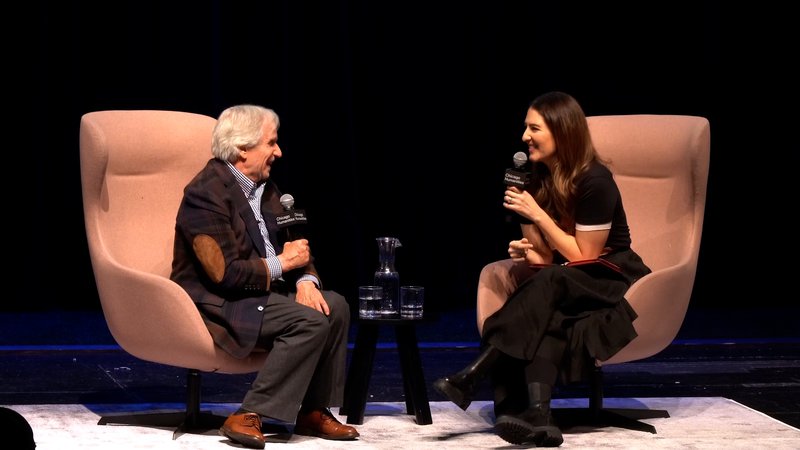
Henry Winkler ( L ) and D’Arcy Carden ( R ) on stage at Francis W. Parker School at the Chicago Humanities Fall Festival in 2023.
Henry Winkler, Being Henry: The Fonz… and Beyond
Recommended Listening
- Podcast
- April 4, 2023
Bob Odenkirk with Tim Meadows on Finding Your Comedy Voice
- Podcast
- October 10, 2023
Ed Begley Jr. Steps into the Energy Efficient Spotlight

- Podcast
- May 16, 2023
Jessica Lange Captures Truth in Photos
Become a Member
Being a member of the Chicago Humanities Festival is especially meaningful during this unprecedented and challenging time. Your support keeps CHF alive as we adapt to our new digital format, and ensures our programming is free, accessible, and open to anyone online.
Make a Donation
Member and donor support drives 100% of our free digital programming. These inspiring and vital conversations are possible because of people like you. Thank you!