Patti Smith Reflects and Lives in the Moment
S2E2: Patti Smith
Apple Podcasts • Spotify • Pandora • Overcast • Pocket Casts
Today’s episode features a first: two programs from the same speaker at different moments in history – Patti Smith, interviewed by Jessica Hopper in 2019, and back in 2022, telling stories and singing live with guitar accompaniment from her son Jackson.
Read the Transcript
[Theme music plays]
ALISA ROSENTHAL: Hey all, thanks for checking out Chicago Humanities Tapes, the audio arm of the Chicago Humanities live Spring and Fall Festivals. Tickets just went on sale for all our of Fall 2023 events, so head to chicagohumanities.org to check out that full calendar and grab tickets to see your favorite speakers before it sells out.
Today’s episode features a first: two programs from the same speaker at different moments in history. We’ve been lucky to have rock n’ roll icon Patti Smith at our festival three times - in 2014 receiving the Chicago Tribune Literary Award, in 2019 in support of her book Year of the Monkey, and in 2022 with A Book of Days.
Patti Smith is a walking, breathing time capsule of the New York ‘60s and ‘70s folk and punk scenes. I can’t recommend the book Just Kids enough. Her seminal album Horses has been hailed as one of the top 100 albums of all time, and she was inducted into the Rock and Roll Hall of Fame in 2007.
In 2019, she was interviewed for Chicago Humanities by music critic Jessica Hopper - author of The First Collection of Criticism By A Living Female Rock Critic, which is a collection of essays and interviews that I loved so dearly, it’s an awesome read.
The first half of today’s episode is this chat - filled with fascinating stories of roaming the country, lost loves, and intentional creative solitude. By the time she came back in 2022, the second half of today’s episode, she had taken up photography and published a book of those photos from a time of… less-intentional solitude.
When reviewing these programs back to back, I was struck by how surprisingly different the vibe was from 2019 to 2022 - I say surprising because the articulate and intuitive wordsmith Patti Smith wasn’t beat more down come 2022 like I’d expect - and perhaps like most of us were - instead she was filled with more vigor, more hunger to share her music and joy of life. Inviting her son Jackson on stage, her 2022 program is filled with reflections of the photographs of people and objects that are meaningful to her, and packed with live music and energy.
First up, her 2019 program “Year of the Monkey,” from the Chicago Humanities Fall Festival - interviewed by Jessica Hopper, at the massive Grainger Ballroom at Chicago’s Symphony Center.
[Theme music plays]
PATTI SMITH: Hello, everybody. So happy to spend the morning with you in Chicago. And and I got up 2 hours too early. I was so excited. So…
[Laughter and applause]
JESSICA HOPPER: Thanks for joining us. Thanks. How has your writing changed or charged your relationship with power?
PATTI SMITH: Well, I'm I, I don't I'm not sure I could answer that except to say that I have put I have been writing since I was about seven or eight years old. It's the one consistent vocation that I've had my whole life. And as I've gotten better and developed my skills, it gives me a lot of innate confidence. I mean, I feel a lot more confidence about my writing, and when confidence is a powerful feeling, it allows you to maneuver, negotiate life better. But also writing gives you a way, whether it's performing or talking to people, writing a little caption on my Instagram, anything. It's communication with people. And positive communication is has its own empowering aspect. And you can tell them just waking up, right? Even though I've been awake for hours, I haven't been talking.
JESSICA HOPPER: Speaking of your Instagram and also in this book, and M Train, it seems like you have a very particular relationships, a relationship with birthdays. People ask you to shout out their birthdays all the time, but also it seems that you're in a constant state of of memory, like remembering and honoring people's birthdays. Why are birthdays so important to you?
PATTI SMITH: Well, I mean, I it's the day we come on earth. I love my birthday. I was born in Chicago, December 30th, 1946. So it works that way too. When I come to Chicago, I feel very excited, excited to be in the city. But I was born here. It's I had my first breath here and, you know, and my first thoughts here. So birthdays are very important. I have one little funny thing. When I was young, I loved Willem de Kooning and I found out his birthday was April 24th, and when I was a teenager, I would send him birthday cards every year to his gallery every year. And then sometime later in like 1971 or 72, I became friends with Brice Marden and Brice Marden introduced me to Mr. de Kooning. We were in a bar in New York City and it was April. And I said, Oh, Mr. de Kooning, it was just your birthday happy birthday. And he said to me, Was that you?
JESSICA HOPPER: In your in your books, in your writing, you definitely talk about and write about, you know, having and sometimes carrying these totems and talismans and bits of things to remember people and places. Do you have any of those sort of things related to Chicago? What are your totems of Chicago or talismans of the city?
PATTI SMITH: Well, my totem of Chicago is myself like, well, I have my baby book. My mother made me a baby book. She wrote me a poem called Patti and I still have it with our dresses, pictures of her on Kedzie Boulevard where we lived in a rooming house. I have my baptismal certificate because I was baptized in Logan Square. And but truthfully, I've always been welcomed in Chicago. And so my secret talisman is just that. I've always felt very well-loved here. So that's that's my best talisman.
JESSICA HOPPER: So you wrote this book. Let's talk about this book. And so much of this book transpires in California and also in kind of a California of the mind. And I was wondering, what were the things that really helped or what were the things that sort of informed your imagination of California before you before you actually saw it for yourself?
PATTI SMITH: Well, actually, I'm a real East Coast girl. And I mean, I was raised on the East Coast after we left Chicago. And I didn't go to California until we toured Horses. And I think I saw my first palm tree in Los Angeles and had my first went to my first Taco Bell. And. But California, to me, it was all cultural. First of all, the the beat scene, the West Coast beat scene. Ray Bremser, the California poet. And then there was Art Pepper, I think was a West Coast player. And so, you know, the California beats and then, of course, the great music that came out of San Francisco. To me, California is it's the Grateful Dead. You know, it's the Jefferson Airplane. So I, I it's City Lights Books, these type of things. But, you know, I that's my particular association. But in this book, because I was roaming about because of circumstances, I became more attuned with its other kind of landscape, with Joshua Tree, with the desert, you know, with the old motels. And so that's that's sort of the California in in my book.
JESSICA HOPPER: Are dreams a refuge for you or are they a place of communion?
PATTI SMITH: Well, I've always been a big daydreamer. In fact, my report cards from first, second and third grade, it would say every single teacher. It was almost like a conspiracy. They'd say, Patty Lee is potentially intelligent, but she daydreams too much.Yeah. Patty, look, Patty Lee. Looks out the window all the time. Patty Lee has something else on her mind. And yeah, it was always my imagination was always very fertile. I always loved reading. I would write stories in my head, and, you know, the whole class would be learning Dick and Jane, and I'd be writing like, you know, a 19th century novel in my head. But and so some of it is dreaming, some of it's imagination. And so I have waking dreams, sleeping dreams, daydreams. And so you're right. It's a it's it's a big part of my sleeping and waking life.
JESSICA HOPPER: It also seems like you're very willing to kind of let the spell of a dream spill out into life or spill out onto the page. Why do you why do you think that is?
PATTI SMITH: I don't know. Your imagination is your friend. I spent. I spend a lot of time on my own, and, you know, it's. I don't have any trouble like you like. When I was little, I would talk to my toothbrush. I had my toothbrush serve me. It took care of my teeth. And one day I was coming home from school. I came home from school and my mother said, Patricia, it's time for a new toothbrush because you've had the other one a long time. And I. I was horrified. Well, what's going to happen to the old toothbrush? Oh, I threw it away. I was like, Oh, you threw it away. You know, as my pal I talk to talk to it every morning. So I, like, dig out the old toothbrush and hide it like we in our old apartment. We had floorboards that were loose. And so I hid it in there with a few other strange objects, but. But also, you know, like an em train. M Train. The book Before Year of The Monkey begins with a cowpoke I dreamed of who is really Sam Shepard. And the cowpoke really spills out through the whole book, talking to me in in. You're the Monkey. I have some inanimate objects talking to me. But for me, it's not weird, You know, I don't have a problem talking to an inanimate objects. Sometimes they're very, very interesting. More interesting than people. Present company excluded. I don't know, but I've always had it, You know, I've always been curious. You know, I'd read books and I always wanted to travel. I wanted to go to where they wrote about or where the French press impressionists lived or, you know, where, you know, Arthur Rimbaud wrote his poetry. I've I've always. But and even fictional characters. Where did that fictional character live? I wanted to see the village of Pinocchio, and that's what I did when I got older. And and the for me, one of the most wonderful things about touring with a rock and roll band was that I got to see the World and Finland, one of the first countries I went to. And and it's just well, it's like I had a pilgrimage with my sister just to look at the rooming house where we stayed when we were babies, you know, when we were toddlers, you know, to look at the church that I had been baptized. So some of it is from my own self, but I like to visit the resting places. I'll do a whole I did a huge trek to go visit Sylvia Plath's grave because it's in a very obscure area of Yorkshire. And you know, I visited the home of the Brontes and where Couldridge wrote and I find that, you know, it's like just a wonderful part of life. You know, I've recorded horses in Electric Lady because it was Jimi Hendrix Studio and it gives everything a give him a hand. It just magnifies everything. It's just it's for me, it just makes oh, there's there's so much strife and terrible things in the world. I mean, anything that can make you happy, that can make you feel connected with the past, the future, with our cultural voice, with with heaven, you know, is is wonderful. So, yeah, I'm an old pilgrim.
JESSICA HOPPER: Has your relationship to being alone changed over time?
PATTI SMITH: Yes, certainly. When I was really young, I like being with my siblings, but I didn't like being around people a whole lot. I just like to be with my books. Of course, when I was a teenager, like any teenager. I like my friends. And then I wondered, like boys. And I always wanted a boyfriend. And so, I mean, but after my husband passed away and my children grew, I found myself alone quite a bit. And and then I found that I no longer really craved companionship. I was fine on my own. And I, I, I really don't get lonely. But I do have my own companions writing is my friend. This book was my friend. When I was done that book, I felt really sad. It was like the toothbrush. No, don't go. But I have good friends. I just. I like my solitude. But I'm not a hermit. Like, my idea of solitude is going into a café, a quiet cafe, and sitting in a little corner and writing. So there's action, there's coffee, maybe there's music playing. But I still feel a little sense of aloneness. I'm not the kind of person that has to be in a room alone with, you know, no one bothering me. I, I don't. It's not like that. It's more like a lack of responsibility. You know, I'm just roaming around doing my thing. And, you know, I can sit and write in a cafeteria with all kinds of stuff going on and the clanking of silverware. But I just have my little seat and my coffee, and I'm totally happy.
JESSICA HOPPER: There's many things that are remarkable about your book, but that one of the things that's most remarkable to me is that you don't seem particularly nostalgic despite much of this work being, like deep in the past. Do you think do you think that's accurate? Like, maybe I maybe I'm sort of saying that's not like -
PATTI SMITH: Well, I could say I think nostalgia is somewhat painful. It's beautiful, but painful. And I wouldn't have known that as, you know, how to describe nostalgia. I don't think I'm so nostalgic as that. I just carry past, present and future with me continuously. But I saw this. I really like jet Japanese anime and I really like Ghost in the Shell has various series and in one of them, the major she she she's a cyber cyborg and she's entering into this space and she feels she's a machine, but she feels she does have some bit of human soul and she feels this strange feeling. She puts her hand on a doorknob and feels a shudder and she's wondering what the strange feeling is. And then she goes into a place and she finds memory in this room and she says, Oh, now I know what that strange feeling is. It's human nostalgia. And that really struck me because instead of it being a nice thing, she felt the pain of it. Because nostalgia, you know, is somewhat painful because often it's nostalgia for something. Our childhood, you know, perhaps a dead friend, you know, a beautiful meadow. That's not a meadow anymore. So I, I guess we all have nostalgia within us, but I try not to exercise it too much because truthfully, I have a lot of things I could be sad about, and I prefer to somehow allow myself to feel a certain loss and all, but try to turn that over. You know, I miss my husband, I miss my brother, I miss my parents, I miss my dog. But I try to turn that over and think, Wow, I had such an awesome dog, such a great husband. My mother was, you know, made the best French fries and and other things. Anyway, basically, I guess I'm trying to say I try to allow myself to feel happy in the face of all the strife in the world, all the things that we're facing as Americans, as human beings. Our personal things are global, things are political things, climate change, all of these things that are pressing upon us. We have to escape a little path of joy moving through it or or we would have a terrible life. So I try to hold on to that and, you know, just just move a little happily through life, as rough as it can be.
JESSICA HOPPER: What are what are your favorite works of friendship?
PATTI SMITH: My favorite works of friendship?
JESSICA HOPPER: Yeah, that other people have made.
PATTI SMITH: That they did or we did together?
JESSICA HOPPER: I mean, either answer this how you will. You choose.
PATTI SMITH: I mean, you know, I mean, truthfully, I've been very fortunate to have I like a I'm a worker. And my greatest friendships have really been work centric. I mean, Robert Mapplethorpe and I used to work on things together. And then even when we did the cover of Horses, he always called it our picture. And when I look at it, you know, I wrote this in the book, but when I look at the cover of Horses, I don't see myself. I see Robert and I. I see us. I see. And Sam Shepard and I wrote a play together, and I. I was I just gave him practical assistance on his last two books, because at the last book, he was unable to physically write. And I feel very proud to have assisted him. And I love his last book, A Spy in the First Person, because it was his last work. He put everything that he had in this work. And it also appealed to me because again, it was had it was sort of nonfiction autobiography, a genre I really like. And Sandy Pearlman did Beautiful. I love his my. My friend Sandy Pearlman, who is in the book, he wrote a lot of the great songs for Blue Oyster Cult. He produced The Clash. And my favorite song of his is Astronomy A Star and A Great Blue Oyster cult song that that he he wrote. But I'm very lucky. I have you know, I have friends who are actors. So I'm Ralph Fiennes as my friend and he's great in everything. So I'm very lucky to have work-centric friends and where we have personal friendship. But a lot of our friendship is based on similar esthetic understanding, each other's work, being able to talk freely about work. And that's a beautiful part of friendship for me.
JESSICA HOPPER: How does photography or how has photography informed your writing in your work of writing?
PATTI SMITH: Well, I always love photography. I loved it since I was very young when I when I spent half my childhood in libraries. And I loved Lewis Carroll. And once I found, you know, he was a photographer, he took beautiful photographs and learning about his photographs, I learned about Julia Margaret Cameron's photographs. And I've always loved photography and I've worked, of course, with many great photographers. But when I was a teenager, I read Nadja by André Breton. And what really interested me was not just the text was all these obscure photographs within the text that were taken by Man Ray and I loved this genre of of work, you know, not even directly illustrated. It's not like drawings or something and fairy tale books. Just the sometimes obscure pictures that somehow resonate the text. So when I did my first book Bable in 77, I did something similar, and I've pretty much had photographs in all of my books. But the nice thing about Year of the Monkey and an M Train, they're just my books, you know, They're not, you know, responsible to other people. They're just my life and my roaming around in my musings. So I was I just illustrated them the way I wanted with pictures that I take on the road. I mean, sometimes, you know, it could be, you know, an obscure Russian cafe or, you know, a defunct hotel or some object that's important to the text.
JESSICA HOPPER: Um do you have a favorite photograph of yourself?
PATTI SMITH: Hmm. That's a dangerous question. Well. I mean, I have favorites. It's hard for me to say favorite. I like photographs where I look. If I see a photograph that doesn't have to be flattering, but I feel like I know her. And it could be from any era. And a lot of the photographs I like are by my friend Judy Lynn, who took pictures of me in 68, 69, 70. She was one of the first photographers I worked with, and all our photographs we imagined were stills from French movies that weren't shot. And and I like them very much. But I also there's a picture of me taken in Chicago, like 1947, 48. I'm standing. With my little haircut, my little bob, I think, and just with my hands like this crying. And I still look just like that. I mean, I can look at that picture and go, yeah, I still her, you know, and I like that. I think probably one of my relatives took it but says like under it all it says is “Patricia, Chicago” you know “1949” or something. But I like that an anonymous photograph of of me crying in Chicago.
JESSICA HOPPER: I think we might all have those.
[Laughter]
[Theme music plays]
ALISA ROSENTHAL: And now, Patti Smith with guitar accompaniment from her son Jackson Smith at the Music Box Theatre, from the Chicago Humanities Fall Festival in 2022.
[Theme music plays]
[Applause]
PATTI SMITH: Hello everybody! So - I am really happy to be here. I'm here with my son, Jackson, and. And Jackson was born in Detroit. So not not very far. Not not far, far away. And I'm very grateful to be here, and tonight, of course, is going to be extremely professional. But of course, that's my definition of professionals, which, you know, is questionable at best. So um Jack and I will do a few songs for you and um. So I'll be doing that and and uh answering some of your questions. It's the sacred barrel. You know what? What's that thing that Johnny Carson did when he had, like, the big turbot Carnac? You know, this is the the. Well, maybe you don't remember, but anyway. Yes. Never mind. I love Johnny Carson.
JACKSON SMITH: I would sneak to the top of the stairs and watch Johnny Carson.
PATTI SMITH: Jackson.
JACKSON SMITH: I remember. I remember you and Dad watching the last episode. And Dad like, doing the ugly crying. Yeah.
PATTI SMITH: He cried. Yeah. We we. I actually was mad because I always wanted to be on the Johnny Carson show and I think they were too afraid I'd curse or something, which I would never do that on TV. I mean, I, I know that I do occasionally utter some foul word here or there, but not on TV. So because it's a family institution. And so I read a letter to them and said, please let me be on. I'll be really good. I'll wear a dress, you know, and. But I never got on the Johnny Carson show. And I used to fantasize when I knew there was one more that I would sing the last song. And I even had a good story to tell him about Pavarotti because he liked opera. I had I was already I knew the song, but they picked Bette Midler, so I was really mad. Not a Bette Midler. I was just mad. But anyway, Jack, if you would have told me, I would have let you come down the stairs and watch Johnny with us. I never knew that. Oh, that's so nice. Anyway uh, Jack and I will do a few songs for you and um this little song is called Grateful. And and we are we're both grateful to be here. And thank you all for coming tonight and and postponing whatever your favorite Sunday night show is. But, uh. I just realized that was really stupid because people can tape stuff and everything. Okay. So once again, we're so grateful to be here. So grateful that you all you all came. I'm going to dedicate this to my to my great niece, Noelle Thompson. And I just met her today. And I am so, so grateful for her.
[Guitar plays]
🎶 “Grateful”
Ours is just another skin
That simply slips away
You can rise above it
It will shed easily
It all will come out fine
I've learned it line by line
One common wire
One silver thread
All that you desire
Rolls on ahead
Like a ship in a bottle
Held up to the sun
Sails ain't going nowhere
You can count every one
Until it crashes unto the earth
And simply slips away
You can hide in the open
Or just disappear
It all will come out fine
I've learned it line by line
One common wire
One silver thread
All that you desire
Rolls on ahead
[Guitar solo]
Ours is just a craving
And a twist of the wrist
Will undo the stopper
With abrupt tenderness
Die little sparrow
And awake
Singing
It all will come out fine
I've learned it line by line
One common wire
One silver thread
All that you desire
Rolls on ahead
[Vocalizing]
🎶
PATTI SMITH: Grateful. Thank you. If any of you read M Train, I don't know. Did you read that book? Remember the cafe? Cafe Uno that I went to every day and then they closed it up and I was crying. In any event, I was so sad that they were closing this cafe that the owner gave me the table that I used to sit at. Aww. And on the table, there's a picture, a little Polaroid of me and Sam Shepard in the cafe, because Sam and I used to have coffee there a lot.
The Persian necklace that Robert that passed through my hands and Robert's hands back and forth to each other. He gave it to me on Valentine's Day in 1968, and we would give it back and forth to each other. So if he was having a hard time, I would give it to him. And then if I was having a hard time, he would give it to me. And I, you know, when I was having Jackson, Robert sent it to me so I could have it, you know, not because I was having a hard time, but because I had a big task. And then I kept it. And then when Robert became diagnosed with AIDS, we drove to New York to see him, and I gave it back to him. And after he died, it was given back to me. But yeah, it's really I can look at that and see our whole friendship in that one little necklace.
Maryam Mirzakhani, I love her. She was a a genius mathematician. And I have a great fondness for mathematics. I'm not very good at mathematics. I mean, I'm not good at a lot of stuff like that. Like, I can't play chess. You know, I'm not good at Scrabble. You know, there are certain things I'm not good at, but I still love them. And she she was an Iranian American, Iranian mathematician. She was also a mother. And she was the first Iranian and the first woman to win the Fields Medal. And the Fields Medal was given is given to. It's the highest honor you can get as a mathematician. And it's an awesome medal. And she she only lived to be 40. She died of cancer. And I just wanted to honor her. I think I honored her on National Woman's Day. And she's a great inspiration. And, yeah, and I. I think it's important to remember her. So. So I think it's time to take a little break and answer some questions.
All right, let's see what you puppies have given me today. What artists of today do you find inspiring? Hmm. Well, I like Ariana Grande [sic] for - that girl can really sing. She’s lovely. I think she's just, I like her. I think she's, she has an exquisite voice. What music do you listen to? Well, I don't have any Adriannie Ariana [sic] Grande records, but I really listen to the same old stuff, you know, My Bloody Valentine and Jimi Hendrix and Coltrane. Although these days I like sometimes when I can't sleep. As I started doing it during the pandemic, I couldn't sleep at night. So I sometimes will put a movie soundtrack on. Like occasionally I'll do the Naked Lunch soundtrack because Ornette Coleman's on that. That's good. But lately then for a while I was listening to Dune, the Dune soundtrack, and, uh, and Ghost in the Shell. I listen to that for like three years straight, not the, you know, the one from the cartoon. And now it's not called cartoon is called anime. Yeah, that music is genius. And lately I've been listening to the music from the Green Knight. I think the director or somebody. Lowery. Did you ever see that movie? It's awesome, right? It's so hard to explain to people how to get anything anymore. I used to be able to say, just go, you know, go to Sam Goody's or go to, you know, Tower Records, and it’ll be right there. But anyway. But I tend to listen to stuff I always listen to. I love listening. Every once in a while I'll go on the YouTube and I'll just start listening to stuff. Like the other day I was listening to Sparklehorse and what else was I listening to? Oh, there's some really good videos on there. Like you can see Glenn Gould playing early, Bo Diddley. And yeah, so I'm highly entertained. Okay. A good bunch of questions. We’ll come back to them.
Um, this was a favorite song of mine. I forget which album is on another side of now. It's not on another side. It doesn't matter. So an early Dylan album, and I used to play this song over and over, and it's one of those things, you know, it was in the sixties. I was like a teenager listening to this song. And, you know, here I am going to be 76 years old and singing it on stage. It just shows if you stick around long enough, all kinds of shit happens.
[Guitar plays]
🎶 “One Too Many Mornings”
Down the street, the dogs are barkin'
And the day is gettin' dark
As the night comes in a-fallin'
The dogs, they'll lose their bark
An' the silent night will shatter
From the sounds inside my mind
Just one too many mornings
And a thousand miles behind
From the crossroads of my doorstep
My eyes start to fade
And I turn my head to the room
Where my love and I have laid
An' I gaze down the streets
Sidewalks and the signs
Just one too many mornings
An' a thousand miles behind
[Guitar solo]
It's a restless hungry feeling
Don’t do anyone no good
And ev'rything I been sayin'
You be saying just as good
You're right from your side
And I'm right from mine
Just one too many mornings
An' a thousand miles behind
🎶
PATTI SMITH: Bob Dylan. Okay. Let's see what we got. Do you have a creative routine? Actually, I do. And I like to get up really early. And I go to a cafe and nearby cafe, and one of them opens at seven in the morning and another one opens at eight. So I go to one of them and I get my coffee and open up my notebook. And I write and I write, usually that early the cafes are just there's nobody there. So I'll write for a couple hours and then have a little breakfast and head home. And of course, I work all day in different forms, but that's my most favorite concentrated effort, you know, to just to sit for a couple hours and write. And if I'm having trouble writing, I just do it anyway. Then I'll just sit and think or make some kind of list or daydream. But I try to keep that space free from invasion of of other duties. And yeah, I mean, sometimes, I mean, I write any time of the day, but that's that's my special time. That's just for myself.
I have a little house, a little bungalow in Rockaway Beach, a little writer house. And I have a very unkempt yard, a lot of weeds and stuff. Things just grow there. Once there was an ear of corn growing in it. I've. It's by the beach. I don't know why is by the ocean. But. So one day I. You know, I came to work there and there was this flower. I think it's probably a sunflower or a Mexican sunflower. But I was thrilled to find that because I didn't plan it. It just it just stopped by. I don't. And, you know. This is my father was a very beautiful man. And he. He was a real humanist and he loved birds. And he always for years and years in South Jersey and their house in the backyard, he would feed the birds, but he always did it by himself and nobody really thought about it. He would be back there. Say, where's Daddy? Oh, your father is out there feeding the birds. And I didn't really think about it. So one day I came and visited from New York and I said, Where's Daddy? And Mommy said, He's out in the back. So I thought I would just say hello. And I, I open the screen door, and my dad was way at the end of the yard, and he he wasn't his back was toward me. And he had his hand arms out like this. And he was covered with birds. The birds loved him so much, and it was like seeing Saint Francis. He was completely covered with birds. And so I just quietly went back into the house and he. He collected china birds. And he he like, I think the last year or two of his life, he joined a Bird of the Month club, and they would send him a, you know, a bird of a, you know, a china bird. And this was the last when that came it came a few days after he died, and my mother said I could have it. And and it really exemplifies him. It's like the dove of peace, because he was you know, he was a very pacifistic person. I mean, he fought he had to fight in World War Two. He fought the Japanese in World War Two. But in his whole life, nothing broke his heart more than the fact that we dropped two atomic bombs on the civilians of Nagasaki and and Hiroshima. And he was a beautiful man. Which gives me an idea to do another song so.
[Guitar plays]
🎶 “Ghost Dance”
We shall live again
We shall live
What is it children that falls from the sky?
Tayi, taya, tayi, aye, aye
Mana from heaven from the most high
Food from the father, tayi, taye, aye
We shall live again,
We shall live again
Shake out the ghost dance
Give to your brother; give and take eat
Tayi, taya, it leaves two feet
One foot extended, snake to the ground
One foot extended, one turn around
We shall live again
We shall live again
Shake out the ghost dance
Stretch out your arms, now tip and sway
Bird of thy birth, tayi, taya
The ooh of the shoe, the oh of the soul
Dust off the earth that shakes from the tail
We shall live again,
We shall live again
Shake out the ghost dance
[Guitar solo]
Here we are, father, your holy host
Bread of your bread, ghost of they ghost
We are the tears that fall from your eyes
Word of your word, and cry of your cry
We shall live again,
We shall live again
Shake out the ghost dance
We shall live again,
We shall live
We shall live again,
We shall live
What is it father, that shakes through the night
What is it father, that moves through the light
What is it father, and tell me when
Father, will we live again
We shall live again
We shall live
We shall live again
We shall live
Shake out the ghost
Shake it out!
Shake it out!
Shake it out!
Shake out the ghost dance
🎶
PATTI SMITH: Thank you. And it's funny, I'm not used to singing that song without a bunch of us doing it. And I was thinking, where's was what happens in this section than I remembered? We have various people singing and singing the chorus. So I felt a little naked there. But. But it's it's always nice to sing. But everyone, there's so many people that were helpful and, you know, so my heart is thanking you all. And thank you to the Chicago Humanities. So. Well, you know what time it is. Do you know what time it is? It is time to get up. Come on, people. Get up. All right. You don't have to if you don't want to. Yeah. If you want to get up. I just thought it would be good. It's good to stretch your legs and get up and. And, you know. Yeah. Okay.
[Guitar plays]
🎶 “People Have the Power”
I was dreaming in my dreaming
Of an aspect bright and fair
And my sleeping it was broken
But my dream it lingered near
In the form of shining valleys
Where the pure air recognized
And my senses newly opened
I awakened to the cry
That the people have the power
To redeem the work of fools
Upon the meek the graces shower
It's decreed the people rule
Come on!
The people have the power
You know the words!
The people have the power
Make it so.
The people have the power
The people have the power
Vengeful aspects became suspect
And bending low as if to hear
And the armies ceased advancing
Because the people had their ear
And the shepherds and the soldiers
Well they lay beneath the stars
Exchanging visions
And laying arms
To waste in the dust
In the form of shining valleys
Where the pure air recognized
And my senses newly opened
‘Cause I awakened to the cry
The people have the power
The people have the power
The people have the power
The people have the power
[Guitar solo]
Where there were deserts
I saw fountains
And ike cream the waters rise
And we strolled there together
With none to laugh or criticize
Well and the leopard
And the lamb
Lay together truly bound
Well I was hoping in my hoping
To recall what I had found
I was dreaming in my dreaming
God knows a purer view
As I surrender to my sleeping
I commit my dream to you
The people have the power
To dream!
The people have the power
To vote!
The people have the power
To strike!
The people have the power
To love!
The power to dream, to rule
To wrestle the world from fools
It's decreed the people rule
It's decreed the people rule
Listen
I believe everything we dream
Can come to pass through our union
We can turn the world around
We can turn the earth's revolution
We have the power
People have the power
The people have the power
The people have the power
🎶
PATTI SMITH: Don’t forget it, use your voice! Jackson Smith! Thank you, everybody.
[Cheering and applause]
[Theme music plays]
ALISA ROSENTHAL: That was Patti Smith, live in 2019 and 2022. Head to chicagohumanities.org for the show notes, where you’ll find links to her books as well as Jessica Hopper, and the videos to the full conversations.
Chicago Humanities Tapes is produced and hosted by me, Alisa Rosenthal. This episode was produced with assistance from Christina Strauss. Many thanks go out to the entire staff at Chicago Humanities, who are programming these fantastic events and making them sound wonderful. For more than 30 years, Chicago Humanities has created experiences through culture, creativity, and connection. Check out chicagohumanities.org for more information on becoming a member so you’ll be the first to know about upcoming events and other insider perks. We’ll be back in two weeks with a brand new episode for you, another first, with our first original interview with one of our upcoming speakers - just for you listeners of the podcast. But you know, in the meantime, stay human.
[Theme music fades out]
SHOW NOTES
Watch the full conversations from 2019 here and from 2022 here.
![Alt-text: A black and white photo of Patti Smith singing into a microphone, with head and arms raised. She has long white hair and wears a baggy black suit.]](https://assets.chicagohumanities.org/uploads/images/191026_CHF-7327-2.width-800.jpg)
Patti Smith at the Chicago Humanities Fall Festival at the Symphony Center.
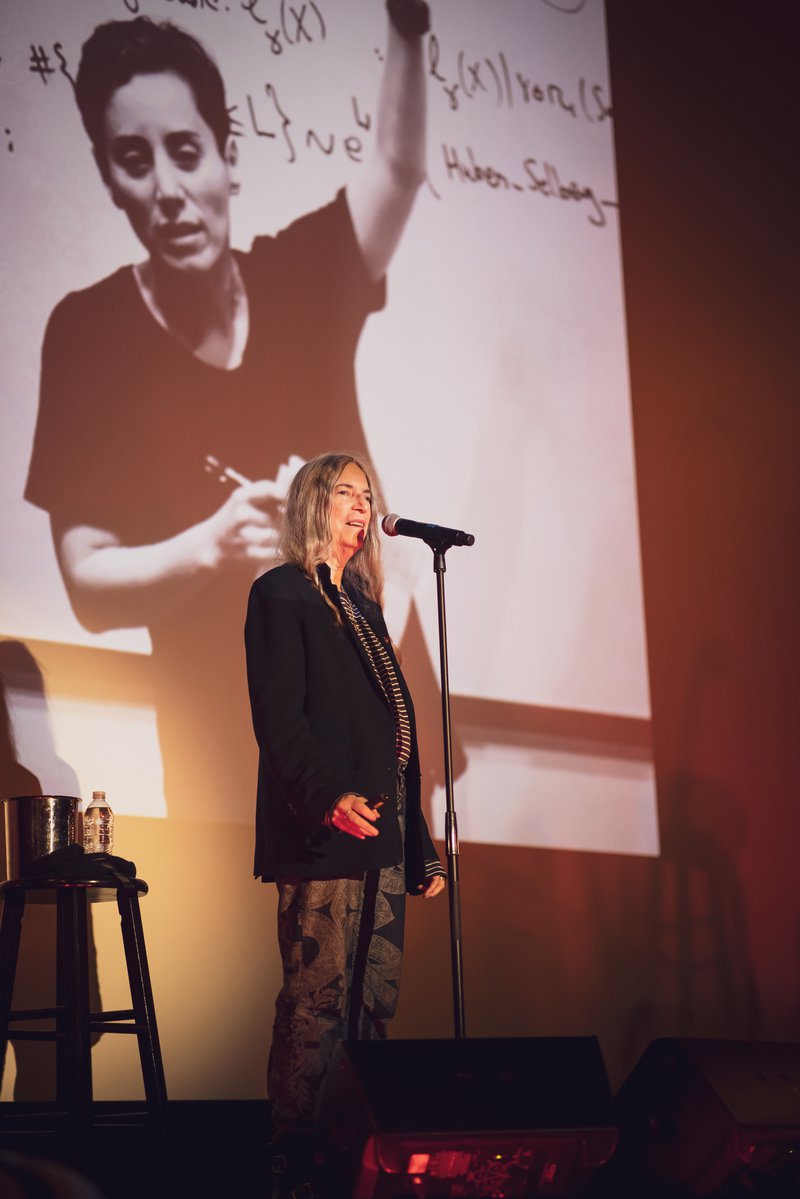
Patti Smith at the Music Box Theatre with a photo of Maryam Mirzakhani.
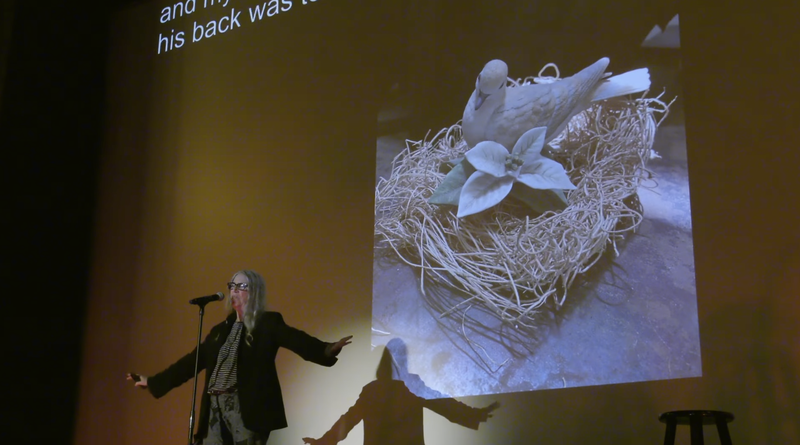
Patti Smith at the Music Box Theatre with a photo of a porcelain bird.
Patti Smith, Year of the Monkey
Patti Smith, A Book of Days
Jessica Hopper, The First Collection of Criticism By A Living Female Rock Critic
Recommended Listening

- Podcast
- July 11, 2023
Joan Baez on Music, Art, and Lifelong Activism

- Podcast
- March 5, 2024
Rachel Maddow on History, Now, and What’s Next

- Podcast
- November 21, 2023
Dream Dinner Party: Andrés, Bayless, Bittman, Voloshyna
Become a Member
Being a member of the Chicago Humanities Festival is especially meaningful during this unprecedented and challenging time. Your support keeps CHF alive as we adapt to our new digital format, and ensures our programming is free, accessible, and open to anyone online.
Make a Donation
Member and donor support drives 100% of our free digital programming. These inspiring and vital conversations are possible because of people like you. Thank you!