Ron Chernow on the Humorous Life of Mark Twain
S4E14: Ron Chernow
Apple Podcasts • Spotify • Overcast
Acclaimed author Ron Chernow, of Hamilton fame, is one of the most renowned voices in history and politics. Recipient of the 2015 National Humanities Medal, Chernow has dedicated his life to telling the stories of some of the most notable figures in history. Chernow joins The Interview Show host Mark Bazer to discuss his newest work, Mark Twain, a nuanced portrait of “the father of American literature.” Drawing on thousands of letters and hundreds of unpublished manuscripts, Chernow captures the exuberant genius whose career reflected the country's westward expansion, industrialization and foreign wars, and became the white author of his generation who grappled most fully with the legacy of slavery. Hear from Chernow as he sheds light on the life of Mark Twain — from his start as a brash journalist to his days as the most notable political pundit in the U.S.
Subscribe to the podcast • Let us know what you think by taking the short survey
Read the Transcript
[Theme music plays]
ANTHONY FLEMING III Hey everyone and thanks for listening to Chicago Humanities Tapes — the audio extension and archive of the live Chicago Humanities Spring and Fall Festivals. Producing around 100 events, discussions, and performances each year, we’ve become a year-round asset for thousands of people in Chicagoland and beyond.
At Chicago Humanities, we connect people to the ideas that shape and define us, and to the lifelong exploration of what it means to be – and stay – human. For more information on events and how to support Chicago Humanities by joining us as a member, visit chicagohumanities.org.
On today’s episode, Ron Chernow, the Pulitzer Prize-winning biographer of Hamilton fame, discusses his newest work: a nuanced portrait of “the father of American literature,” Mark Twain. Chernow sheds light on the life of Twain — from his start as a brash journalist to his days as the most notable political pundit in the U.S. Here’s Ron Chernow talking with Mark Bazer on June 3rd, 2025 at the First United Methodist Church at the Chicago Temple.
[Theme music plays]
[Applause]
MARK BAZER I feel like we're getting married. [Audience laughter]
RON CHERNOW You know, I have to tell you, Mark, before we start that Mark Twain always considered it bad luck to lecture in a church. He said because people were afraid to laugh in a church. We're gonna prove them wrong tonight.
MARK BAZER He had a lot of things to say about the church so we'll be respectful. First of all, congratulations, number one on the best seller.
RON CHERNOW Thank you.
MARK BAZER Dope. Yeah. So I want to, overall, go mostly chronologically through his life, but I want to start with something that you write at the end which goes against our popular conception of Twain. And that is: he didn't start wearing the white suit until very, very late in life. And we have this idea of him as this avuncular guy in a white suit with aphorism. And part of that is true, but there's so much more so talk.
RON CHERNOW He would occasionally earlier on wear the the white suit, but it was in 1906. So this is four years before he dies. He suddenly, he was lobbying in Washington. He suddenly appears in this blazing white suit and the reporters asked him what this was all about and he said it's the uniform of the American Association of Purity and Perfection of which I'm the president and sole member.
MARK BAZER Haha. [Audience laughter].
MARK BAZER And then he went on to say that he was the only cleanly clothed person in a dirty world. Not only would he wear the white suit but very often he would wear kind of raspberry colored socks or lime colored socks. So he was quite a sight to look at. He hated men's dark suits. He said that men's dark suits accumulated so much dirt that you could plant seeds in them and raise a crop.
MARK BAZER Yeah, but a white suit.
MARK BAZER Alright we don't have to.
RON CHERNOW Haha.
MARK BAZER But more broadly, what, there's Smith and Mark Twain and for me, at least this book, I don't know if it completely explodes if many things about the myth are true, but it shares so much I want to just ask you about the impetus for wanting to do it. Beyond, as you said when we were backstage, that day after day you would laugh at what you read. But what was the impetuous for wanting to tell the story, the real story?
RON CHERNOW Well, my fascination with Mark Twain, I should say, started back in 1974. I was 25 years old. I was a freelance magazine writer in Philadelphia and I saw one night there were posters up that said Mark Twain tonight! Hal Holbrook doing a one-man show of Mark Twain, and I went and he stood up there in the white suit with the cigar and the mustache, and it was, you know, 90 minutes of the most hilarious political witticisms. Ones that I still remember, you know, he said voting Mark Twain, there's no distinctly Native American criminal class except the Congress. [Audience laughter] Or, you, know, he said suppose you're an idiot and suppose you are a congressman. But I repeat myself. Anyway, these, these things kind of lodged in my head. Or he, he said I say and I say it with pride that we have legislatures that fetch higher prices than any other in the world. And it was a wonderful, wonderful show, and Hal Holbrook, of course, interested so many people in Mark Twain. I think we all should feel indebted to him. But, you know, there's an image of Mark Twain in the public imagination of this kind of charming, irreverent guy with the mischievous twinkle in his eye. And that was true, but I also became aware that that was not the whole story about the man. That under the surface, this will not shock you, but it had not really been explored. He was moody and temperamental and volatile and not an easy human being to be with.
MARK BAZER He was, in many ways, exhausting, I think. I mean, but let's go back for a second to his childhood. We all know Hannibal, Missouri. Is Mark Twain, as a child, Tom Sawyer? Or is Tom Sawyer who Mark Twain wanted to be as a child?
RON CHERNOW Well, you know, Mark Twain always said that, you know, Tom Sawyer was, in fact, the character based on his life. And Mark Twain, as a boy, indeed, by all accounts, was a very kind of mischievous, antic, devil-may-care character, perhaps not quite as outrageous as he portrayed himself in the book. Some people remember him as sort of much more quiet and gentle. But I have to tell you the story, when he was born in the town, not in Hannibal, but he was one the town of Florida, Missouri. So this is kind of way up in the northeast corner of the state. So they'd moved to this little town with a population of 100. And he said that when he was born, he increased the population by 1%. He said, there's nobody else who has a record of doing so much, not even Shakespeare. But then luckily, when he was four, they moved to Hannibal. Which was a sleepy, isolated town in a beautiful, remote, rural area, except the house is still there, you know, when you exit the door of the house and you look to the left, there's just a block or two away the broad, shining, magnificent Mississippi, the waterway. And here was this sleepy town that once or twice a day would suddenly come to life. You know, they would see a little puff of smoke in the distance, They would hear the steamboat whistle. The boat would pull up at the dock, again just a block or two from his house, and the entire house would come, town would come alive, and off that boat would be everything from circus acts to minstrel shows to traveling salesmen, the whole world kind of tumbled off of that. So even though he's living in a very kind of, you know, remote kind of backwater, the world, because the Mississippi is passing by, is bringing tremendous variety and interest into his life. And he had, this is very much kind of accidental life, as you know, from reading the book. You know, all these unplanned things happen. And just almost coincidentally, he keeps finding himself in one spot after another, where an enormous number of colorful characters, you know across his path.
MARK BAZER Well, he becomes a steamboat pilot. And that is one of the most prestigious jobs at the time. And it's also, he calls it later, and I don't quite believe him, but he calls it the happiest time in his life. It's also the time when he meets these characters who start to, I don't know if it's teach him, but give him some of the stories that become the impetus for what he would become.
RON CHERNOW I think actually it was the happiest time of his life, you know, he said later on, he said that was the darling existence, there's never been a period of my life that was happier than that. I've often wondered how his wife and three daughters reacted to reading that, but he always, it was interesting because he keeps revisiting in his mind his childhood. First in Tom Sawyer, which is a very kind of golden, you know, sunlit portrait of this town. Then in Huck Finn settling there's slavery in this much darker view of the town. And then as the years go by and he becomes more bitter and more pessimistic, he says of Hannibal, he said, half the people were alive and half of them were dead. A stranger couldn't tell the difference. So he goes from sort of romanticizing Hannibal to seeing much darker. In fact, one of the most interesting things that he wrote, we were talking backstage of how much interesting unpublished material there is by Mark Twain. He wrote something called Villagers, 1840-43. And what he did, there are little capsule summaries of 100 different people, including his own family, 100 different who he knew from Hannibal. He disguises them with their names, but otherwise it's clear who they are and kind of what happened to them. And in almost every case, it's kind of one horrifyingly tragic story after another. So he would say, she was the prettiest belle in town. And she married this handsome charming guy. He turned out to be an alcoholic who beat her, then he abandoned the family, then she was in a carriage accident and broke her legs, you know, and he kind of goes on like that. And, but he was never able to deal, I think, with that kind of tragic material. You know, when I think of, I don't know, what a Theodore Dreiser might have done with some of those.
MARK BAZER He also had a very low view of humanity.
RON CHERNOW Yeah, and it becomes lower. In fact, towards the end of his life, he not only talks about the damn human race, he says that if I had invented humanity, I would go hide my head in a bag.
MARK BAZER Why then, and part of it is technology changes, but why does he leave this, what he later views as an idyllic past? And let me also tee it up by saying, in so many ways, he becomes both a representation and he depicts this America on the make. He goes west, he goes to the Sandwich Islands, now Hawaii, he go to San Francisco before landing back in Hartford where he will spend.
RON CHERNOW No, you pick up something very kind of essential to the story because we tend to think of Mark Twain as the quintessential American. And indeed, you know, he grows up right smack in the middle of the country. And then one of his notebook entries, he writes, I am not an American, I'm the American, which sounds like an arrogant thing to say, but there's some truth to it. He really was the quintessential American, both for good, but also to some extent for bad. I mean he has characteristically American traits. We like to think of ourselves as kind of irreverent of the high and mighty, of nobility and aristocracy. Has an instinctive sympathy with the underdog throughout his life, but he's also money mad, something that people kind of miss because throughout his career, he's satirizing the plutocrats of his day. So people figure, well, Mark Twain was so shrewd, he would never be like that. But that's exactly what he was like. I mean, he was as money mad as any of the characters that he satirized. Instead of it satirizing the other, as I got deeper into the book, it seemed more like a self-portrait.
MARK BAZER And well, he's also failing a lot in this business.
RON CHERNOW Failing, yeah, you know, he said at one point I've often been the easy prey of the cheap adventurer and boy was he, another time he said I must speculate, such being my nature. And when I started the book and I read this, didn't realize just how deep this went. It was really a compulsive urge to speculate because the speculation, we could go into what happened, you know, speculation finally lands him in bankruptcy. And causes terrible havoc in his personal life and his family life. But even after that, he can't stop and continues to engage in one speculative venture after another. And he never wanted to simply make a modest return on an investment. He wanted to invest in things that would make him one of the richest people in the world. In the same way that he had a florid imagination as a novelist, he had very florid imagination for the potential of different things that he invested in, but almost no imagination for what would happen if the business did not succeed. His imagination was impoverished.
MARK BAZER Which happened over and over.
RON CHERNOW Yeah, you know, and there were two things that happened simultaneously. One was he met, he was living in Hartford. Okay, let me just step back a second because he not only ended up making a fortune, from his book royalties and also his lecture fees, but he marries an heiress, Livy Langdon, from upstate New York, and they end up living in a 25-room mansion in Hartford, Connecticut. It has 11,500 square feet of space, a loyal staff of six servants. They're living a very beautiful and idyllic life. They have these three gorgeous, very smart and talented daughters. It could have been an easy life, but he gets caught up in two business ventures. First, he starts his own publishing company. Throughout his career, he always felt whoever was his editor, his publisher, Twain was convinced he was a moron who was bilking. He's always imagined that the publisher is stealing from him.
MARK BAZER Is that true as a writer?
RON CHERNOW No, no. In fact, at one point, he actually hired a lawyer to do an audit. And the lawyer, unfortunately, had to go back to Mark Twain and said that the publisher was actually honest, you know, and had paid what he had promised. It's interesting because he starts this publishing house called Charles Webster and Company. And the first two books that they publish, one is the Adventures of Huckleberry Finn. The other is the Personal Memoirs of Ulysses S. Grant. Grant's memoirs in particular, Huck Finn sold very well, but Grant's Memoir is probably the best selling book of the 19th century, aside from Uncle Tom's Cabin. But then he makes one mistake after another. And he also, even though he's from the South, he signs up not only Grant, but William Tecumseh Sherman and Phil Sheridan. It seems like he has every Union general, even after his deputy warrants that the market is saturated. But one thing that will be interesting and topical is one of his publishing errors was that he signs up the authorized biography of the pope. Guess what? Pope Leo XIII. We now have Leo XIV. And Twain, again with his vivid imagination, is certain that every Catholic in the world is going to rush out and buy the authorized biography of the pope. Even the pope himself was very skeptical. [Audience laughter] The pope had a better sense of the marketplace than Mark Twain did. That book did not sell well and only a small fraction of Catholics rushed out to buy it. So he made all sorts of mistakes with the publishing company, which ran up a tremendous debt. But a much bigger problem is that he had started out, his father died when he was 11. He becomes a printer's devil in his older brother's newspaper. So he kind of feels like he knows something about the newspaper business. And he meets a man named James W. Paige, who has invented a machine, a compositor machine, a typesetting machine that can replace five or six printers. And Mark Twain is convinced that this machine will revolutionize the newspaper business. And you could see in his notebooks, he has long columns of figures. He's calculating the number of newspapers in the world because he feels that every newspaper in the word will be forced to either rent or buy the Paige typeset. And now at the beginning, this goes on over a 14 year period. At the beginning Mark Twain is in love with James W. Paige. He said that he was a great poet. He was the Shakespeare of mechanical invention. He said that Paige was so persuasive that he could have coaxed a fish to come out of the water and take a walk with him. But then what happens is this is a very complicated machine. It has 16,000 moving parts. And they were not alone in the field. And there was another machine that was perhaps not as exquisitely ingenious as the Paige machine. But it was more dependable. It was made by a man named Ottmar Mergenthaler, and of course what the newspapers were looking for was not the most ingenious machine. They were looking a machine that would run safely, reliably, day in and day out. So it's really Mergenthauler ends up dominating the industry. And Twain has invested in this in contemporary dollars that would come to at least $6 million. And a lot of that, probably two-thirds of that was his wife's inheritance. You know, they lost every penny of it on this machine. And Twain, who had started out by calling Paige the Shakespeare of mechanical invention, ends up by saying, James W. Paige was drowning. I would throw him an anvil. [Audience laughter]
MARK BAZER Well, I want to go back to his wife. And there's something that you write earlier. You quote, I believe it's an editor back when he's out West, which is that he says of Twain, that Twain is a sad, lonely soul. And he moves to Hartford, and he meets his, what, he's 31 when he gets married. And he courts, and this is one of the funniest unintentional stories in the book, not from Twain's own words. He courts Livy, and she's younger.
RON CHERNOW She's about ten years younger.
MARK BAZER Yeah, and he falls in love, and her father, who is wealthy, asked for references, and what happens?
RON CHERNOW Yeah, OK, so they're from Elmira, New York, and they were a wonderful, wonderful family. Very, very rich. The father, Jervis Langdon, had made a fortune in coal, timber, and railroads. He actually sold all the coal that fired the Vanderbilt's New York Central locomotive. So he made this vast fortune. But they were also a very philanthropic family. They were very active abolitionists. He'd harbored Frederick Douglass from a racist mob at one point, and Wendell Phillips. I knew all of the major abolitionists, and this begins to change Twain's attitudes on this whole topic. But anyway, Livy, when she was a teenager, was very, very frail, almost a semi-invalid when she an adolescent, and now she's in her early 20s. She still is rather physically fragile, and she's an heiress, so they were naturally, for two reasons, very, protective of this young woman. And so Jervis Langdon asked Mark Twain, who had been a reporter out in Nevada and out in San Francisco, asked him to get 10 letters of reference from his friends out west. And so Twain contacts them, and the 10 letters come in to Jervis Langdon, who then sits down and tells Twain that all 10 of the letters describe him as wild and lecherous, idle and drunken. And he says to Jervis Langdon, says to Mark Twain, don't you have a friend in the world? And Mark Twain got a crest full and says, I guess not. And then miraculously, Jervis Langdon says, I'll be your friend. I know you better than they do. Take the girl. And this was kind of an amazing act of foresight, because you can imagine Mark Twain blew into their lives like a tornado. He had been on a cruise, a boarder ship called the Quaker City with Livy's brother, Charlie, had seen a picture of her, it's a little ivory miniature, and he said from the moment that he saw the picture of hers, she looks very kind of sweet and pure and beautiful. He said, she was never out of my mind again. And she's reluctant because Mark Twain was this very overwhelming, can you imagine, overwhelming presence in her life. She had a very, very sheltered life, so mark Twain woos her with the main weapon at his disposal, words. So he sends her 200 long, passionate letters. There were so many letters, she began to number them, probably wondering when this would end. You know, so it's like over a two year period that, you know, he woos her, which is why when Mr. Langdon said, I feel I know you're better than anybody, he probably did. And actually, sadly, after they got married, you know, he died about six months later, but it was a very, very happy marriage.
MARK BAZER Yeah, that's what's incredible. Twain, and it happens over and over again in the book, we don't have time to get into everything, he will meet somebody, he will be like Paige, he'll be best friends with the person, and eventually he hates the person. And he says the best things and he says the worst things, but Livy, throughout her life, because she dies well before he does, is his rock. And also does to, in some degree, tame some of his wilder impulses.
RON CHERNOW No, he chose better than he knew, because even though she was physically frail, she was extremely intelligent and very strong personality inside. Just in terms of the love match, I mean, we have so much correspondence between the two of them. There's hardly a letter from Livy to her husband that doesn't end with, I adore you, I idolize you, I worship you. And his letters are exactly the same. She would also, because he was constantly out lecturing. You know, she would often write to him, life is so much more interesting when you're around. You know even when he was difficult, there was never a dull day with Mark Twain. But what happened by Mark Twains own admission, he said, when I met Livy, I was a mighty, coarse, rough, unpromising character. And here she's grown up, she's exquisitely refined, a tremendous sense of tact. She's been brought up in very kind of aristocratic surroundings. And she makes him, palatable to polite society. He really didn't know how to do that. She trains him in what I think today we would call anger management. So he had a tendency, you know, he would fly off the handle and he would sit down and he very impetuously write an angry letter to someone. And she trained him when he did that to stash the letter in the drawer and wait a few days to reply. There are also kind of a lot of letters out at the Mark Twain Archives in Berkeley, because he had a very active social life and very often you could see the morning after a dinner party, he would write to someone, the madam tells me I may have been a little brusque and sharp with you last night and if so I want to apologize. You know, he didn't realize he was so funny, he was satirical, didn't always realize how easily he could hurt people because there's a very kind of sharp edge to his wit. And then what happened, they developed a system of color-coded cards for dinner parties. If she held up a red card to him, it meant, are you going to monopolize that woman to your right the entire evening? A blue card meant, Are you going sit there and not say anything all evening? You can see her training him in polite society, he didn't quite know how to do that. He had this so much energy, very often during dinners, he would get up and pace back and forth, sometimes talking a blue streak. I mean, he had this real kind of mood swings. He was probably somewhere on the spectrum, but he would go from tremendous bursts of energy and talkativeness and then can be sort of very, you know, quiet and lethargic. The three daughters. loved watching Livy train Father, and they called it Mother dusting Father off. And even Mark Twain said, Livy edited my books, and then she ended up by editing me. And it was not too far from the truth.
MARK BAZER You mentioned that the family that Livy comes from were abolitionists or worked with abolitionists. You also, a theme that comes up again and again in the book I think is that he was a southerner who became a northerner in many ways. And I think this is a good way to kind of tee up some of his most important writings.
RON CHERNOW Yeah.
MARK BAZER And that's obviously like Huck Finn where he starts going back to his childhood. There's a lot, he's not just the humorist which he felt kind of insecure about.
RON CHERNOW Yeah.
MARK BAZER And I want to ask the question of how did his views on race evolve throughout his life?
RON CHERNOW Yeah, this is kind of a big part of the book. OK, so he's born in Missouri. He's born into a slave-owning family, this slave- owning state. And when you read his adolescent correspondence, you get a lot of very crude, racist jibes. This probably would be typical of anyone growing up in that town. I mean, he told a lot stories about his childhood. One of them was that a man, a slave owner, you know, hit his enslaved man with a piece of iron ore and for doing something awkwardly, it was not a big offense. And the man dropped to the ground and an hour later he was dead. And Mark Twain said, no one in the town was happy about this behavior, but no one objected openly to it. And he said that in his upbringing, the righteous, the sacred people in town all agreed that slavery was not only moral but the peculiar pet of the deities. That was the atmosphere that he grew up in and then over the course of his life he goes from that, you know kind of crude rather racist teenager to I think the most tolerant and broad-minded White author of the late 19th century. I mean what other White author would have said that American liberty dated not from 1776 but to 1865 when slavery was abolished or he said mockingly Declaration of Independence should have said that all White men were created equal and even goes so far there are kind of a lot of things that he ended up doing with and for the Black community in many ways the most interesting was that he lectured just around the time that Huck Finn was published he lectured at Yale Law School. He met a very, very brilliant young student named Warner T. McGuinn. And he found out that Warner T. McGuinn, who was the head of the debating society, he was obviously one of the smartest students there, but they were making him live with the college carpenter and he was doing these odd jobs to pay his way. So Mark Twain afterwards wrote a letter to the Dean of the Yale Law School and said that he would like to pay for Warner McGuinn's education. And he writes to the dean, he said, we have ground the manhood out of them, meaning the Blacks. We've ground the manhood out them and the shame is ours, not theirs, and we should pay for it. And his closest literary friend, the novelist William Dean Howells said that Twain felt personally responsible as a White man for what the White race had done to the Black race and he felt that he should make reparations, he actually used that word, should make reparations for it, now there's an interesting story that Warner T. McGuinn. That was a good investment by Twain, because when Warner T. McGuinn became a lawyer, he argued a very famous desegregation case in Baltimore. And in Baltimore, there was a young lawyer in adjoining office who was... [inaudible] on his name, first Black, Supreme Court justice.
MARK BAZER Thurgood Marshall.
RON CHERNOW Thurgood Marshall. I'm sorry.
RON CHERNOW Thurgood Marshall who of course ends up arguing Brown v. Board of Ed and becoming the first Black justice. So it's like a direct line from Mark Twain's helping Warner T. McGuinn through Thurgood Marshall. And Thurgood Marshall later said that Warner T. McGuinn was one of the most brilliant lawyers he'd ever met. And had he not been Black, we definitely would have ended up a judge.
MARK BAZER At the same time, he is of his time. Huck Finn, I read it recently in preparation for this. And on the one hand, as you point out, I mean, it is a clearly anti-slavery, anti-racism book. It's also, as you note in the book, it's responding to at the time, which is after the Civil War, in the 1880s, that there's this idea of Lost Cause apology, which is saying that, well, actually, the Northern agitators, slaves were happy. Northern agilitators came along, and they forced the issue in a way that slaves didn't want, which, of course, is crazy. And Mark Twain makes clear in the book that that's not true. At the same time, the whole last part the book in Huck Finn is the Tom Sawyer character almost having, well, not just almost, he's having fun he's making a game out of freeing Jim.
RON CHERNOW Yeah, no, it's interesting because, you know, Ernest Hemingway, who said that all modern American literature begins with a little book called Huck Finn, Hemingway suggested that readers skip the final part. And I have sympathy with that. It's kind of like he suddenly reverts to the kind of, pardon the pun, tomfoolery, you know of Tom Sawyer again, which ends up not only demeaning Jim but ends up demeaning the book. But what precedes it is extraordinary. And you're absolutely right that one could say, well, big deal, so an anti-slavery book after the Civil War, so what? But there was this whole Lost Cause school of Southern historians who were saying that, actually, the slaves were very happy during the slavery period. It was just Northern abolitionists who were stirring them up. And that Southern culture, Southern White culture, was very genteel and aristocratic. So that mystique was very powerful in taking hold in the South. And, you know, there've been kind of two controversies with Huck Finn. One is the N-word, which is used 200 times in the book, which to state the obvious, Twain is using not to endorse racism but to expose the pervasive nature of racism, not only in Huck's mind, but that of the other people that he deals with. And then the other controversy has dealt with the portrait of Jim. And Jim, on the one hand, is far and away the most noble and dignified and sensitive character in the book, almost the only one would say that. Virtually all of the Whites in Huck Finn are violent and crude and profane. And so Twain, who by this point has moved to Hartford, and as William Dean Howells said, Mark Twain was the most de-Southernized Southerner he had ever met. So Twain is clearly taking a very, very critical look at the Southern White community. And he doesn't go back to visit, very seldom does he go back to visit. But the portrait of Jim, this goes back now, probably 75 years, portrait of Jim was criticized by Black critics, but not exclusively, who said that even though Jim is this very, very sympathetic character in the book, that there were certain minstrel affectations that were grafted onto that character. And two in particular, Jim is very superstitious. Was kind of part of the caricature of Blacks at the time and very credulous at the time. And I think, you know, so that was one of the things that I think spurred Percival Everett to write his book, James, which I think is not meant as a debunking book of Mark Twain, but more as a corrective of Mark Twain. You know, and what he has said in interviews is that Mark Twain is a White man, you know in the 19th century was really kind of not equipped to give the fully realized version of Jim that he was with Huck. In fact, he gave a very nice answer. He was asked in one interview that I heard, he was asked, what do you say to people who say that Huck Finn should be banned from the schools? And he replied, I say they've never read the book.
MARK BAZER You've, I'm sure, surely been asked this. I know you're a historian, not somebody who's making conjectures. But do you think, what would Twain have said about James?
RON CHERNOW I really don't know what he would have said about James for the simple reason that Mark Twain was not generous in commenting on other authors generally.
MARK BAZER Haha. [Audience laughter].
RON CHERNOW He actually, interestingly enough, said that he seldom read novels. He at one point said, I only read novels when all the neighbors are reading a certain book and I feel I have to have an opinion about it. But the list of famous writers he disliked is very long. [Audience laughter] He hated Jane Austen. He hated George Eliot. Interestingly enough, his wife and daughters were constantly reading Jane Austan and George Eliot, you know. So take that, Father. Well, some by an extraordinary coincidence. The first date, we can use that term, the first date that Twain ever went on with Livy, they went to Steinway Hall in Manhattan to see Charles Dickens. Charles Dickens was doing his last lecture tour in America. So here's Mark Twain really at the start of his career, the great American author, and here's the great British author kind of towards the very end of his life. And you would think that Mark Twain would like Dickens now. He didn't find him that funny. He also, he criticized his lecture style. He also found the pathos false. He said it was, the pathos was in the language and not really in the feeling. He said the pathos was like this, you know, glittering frost work and it was not quite real. So, you now, I'd be afraid to say what he would think of Percival Everett's book. I would be afraid what he'd say about my book. [Audience laughter]
MARK BAZER Well, that's interesting because you get into this in the book. He did not like biographers. He did not want a biography written. Eventually one was. It was mostly by the guy became a kind of a hagiographer. Maybe he would have liked that you he would been like, well, the guy wrote Hamilton.
RON CHERNOW Yeah, Mark had famously said that a biography is but the the clothes and buttons of the man. You know the man himself cannot be written if that's true. You needn't buy or read my book. You can just - maybe just a passage -[unintelligble] - but he did, you know, because he was constantly badgered by different people who wanted to write his biographies. So what happened again about three four years before he died he hired a man named Albert Bigelow Paine who was a big fan of Mark Twain's to do an authorized biography. The authorized biography kind of had two parts. Like every morning, Twain would sit up in bed and he would reminisce about his life. And then in the afternoon, Albert Bigelow Paine would start going through the thousands of contemporaneous letters from 20, 30, 40 years before. And Mark Twain once said that he only remembered what hadn't happened, not what had happened. [Audience laughter]
But you know, Paine would interview him in the morning and then would go find a letter in the afternoon that directly contradicted the story that Mark Twain had told. You know, Mark Twain would sort of look at him mystified, like he could not figure this out. And Twain often said that only the dead could tell the truth. Twain felt that life makes cowards and liars of all of us so what he decided to do was that he, and there were 226 of these sessions that came to 450,000 words, he decided that the autobiography of Mark Twain would be published 100 years after his death. And actually University of California Press, starting in 2010, he died in 1910, starting In 2010, they published the first of three jumbo volumes, about 1,500 pages. Of you know Mark Twain reminiscing and it's hilarious and fascinating to go through it but you know as a biographer I can tell you one has to read it with a certain care you can't take a lot of things literally that he said and this is authorized biographer Albert Bigelow Paine said you know what Mark Twain said about his past often had only a kind of atmospheric resemblance to what had actually happened.
MARK BAZER Paine moved in with Twain, I mean, that's not something that a biographer should probably do.
RON CHERNOW No, I mean, you know, Paine lost all objectivity and he really turned into, not just during Mark Twain's lifetime, but then after, really turned in to kind of the protector of Mark Twain reputation, which is not a healthy situation for a biographer to be in.
MARK BAZER How do you, and I want to get back to his narrative, but how do you as a biographer, especially with somebody like Twain who embellished so much, going back to the early days writing for newspapers where there wasn't this demand for truth-telling all the time, like how do separate the fact from the fiction?
RON CHERNOW Well, you know, we're lucky because we have really abundant, abundant resources to study Mark Twain now. Starting about 50, 60 years ago at the University of California, Berkeley, they started this Mark Twain Papers project. And so a lot of the stuff, so they're producing annotated scholarly versions, not even all the books, but they're taking all of the letters, putting it online, annotating it. So give you some sense of the volume of material here. And they have 12,000 letters written by Mark Twain and his immediate family. They have 19,000 written to them.
MARK BAZER Have you read them all?
RON CHERNOW I think probably all of his letters, yeah, yeah. And he writes long letters, too. Also, you know, people know Tom and Huck and Life on the Mississippi. He published two dozen books. Most people don't know that he wrote a novel about Joan of Arc.
MARK BAZER Who he was infatuated with.
RON CHERNOW Infatuated with. They don't know that he wrote a book about Shakespeare, actually arguing that it was not Shakespeare who wrote all those plays, but Francis Bacon. He wrote a polemical screed against Mary Baker Eddy, you know, on and on. So he was constantly writing and publishing different things. So there was an enormous amount just of his writing to go through, probably published somewhere between a thousand, two thousand magazine articles. You know, we have six hundred unfinished, unpublished manuscripts, left behind 50 notebooks, very kind of thick diary-like notebooks. And so I felt that I was able to study him in fine-grained detail. So very often in those dictations, he would tell some funny story. So I would kind of put it in as a funny story, just because it was such a good story and kind of, you know, revealing of his mind. But as I was actually kind of trying to reconstruct those earlier periods in his life, you know, far and away, the preference was for the actual contemporary letters that he wrote, and luckily he wrote a lot of them.
MARK BAZER Will you ever read Mark Twain again?
MARK BAZER [Audience laughter] I think you've done your time.
RON CHERNOW Well, you know, I was saying backstage, one of the problems I had during this book, and I think it counts in large part for the length of the book, I was not only reading all of the published stuff, but I was reading a lot of unpublished stuff from Mark Twain. And I would either come across something in the unpublish stuff that was so hilarious, or even sometimes in the published stuff, but something that is not read anymore, And I thought to myself, you know, if I put it in the book... it becomes part of the Mark Twain lore and legend forever. If I don't put it in, it'll just be lost. I'll just give you one example. And in the last weeks of his life, he wrote something called, Etiquette for the Afterlife. His mind was on mortality. Etiquette for the Afterlife, it's advice when you find yourself in front of the pearly gates with St. Peter. And then he says, in the advice for the after life. Don't speak to St. Peter first, it's not your place, let him speak to you first. He said, there's no harm in asking Peter for his autograph, but just don't tell him that that's one of the penalties of greatness. And then he says, leave the dog outside, he said, heaven goes by favor, if heaven went by merit. You would stay out and the dog would go in.
MARK BAZER [Audience laughter] Aww.
RON CHERNOW But this is too great to leave out and there were kind of a lot of things like that that I hope will become part of a sort of the ongoing Mark Twain lore that people will repeat and relish.
MARK BAZER For as adventuresome as his life is, for as funny as his writing, it goes without saying that there's so much of the book, especially in the latter, I don't know, maybe the last quarter, which is sad, right? He ends up going to, he spends, I think, what did you say backstage, 11 years of his life in Europe. So the quintessential American writer actually spends a lot of time overseas. And a big part of that reason is his business failings and he can get it. But another big part is that two of his daughters in particular, and Livy, just have these health problems that are ongoing, and he's also, for somebody as cynical as he is, he's very credulous about certain cure-alls and everything.
RON CHERNOW Yeah, you know, also it had, you know, because Livy's kind of spoiler, she develops congestive heart failure. The eldest daughter has meningitis, the youngest daughter's epileptic, you know, so it really affects his religious views. It's very hard, you know, that he would ask, you know, if God is the father, why is God doing this to his, you know, to his children? So it makes him very bitter. It makes him very pessimistic. You know, he says late in his life that anyone who's not a pessimist is is a fool. It really kind of colors his his outlook and as you realize you know, I was talking earlier about seeing Hal Holbrook another thing in terms of my obsession with the Mark Twain character this was I think in the 1990s Ken Burns did a very very good documentary series on Mark Twain. It was four hours two hours each night and the first two hours. It was kind of the familiar Mark Twain. It was Huck and Tom and life on the Mississippi and had kind of a jovial tone. I was smiling the whole time. The second night was about all of the personal calamities that he had experienced. And that I really did not know about. And I just thought as a biographer, that combination of literary triumph and personal calamity of light and shadow makes for really an ideal story of someone you're gonna... sorta wrestle with this, as you read through the book, you're going to love him a lot of times. But as you pointed out earlier, he had a tendency. He could not let things drop. He would fall in love with people. And then if and when they disillusioned him, his vengeance was endless. And again, it was something that I could not completely figure out about him, because I think we all have the experience of being angry with someone. And then usually we'll blow up at them, we'll kind of get it off our chest and then walk away from it or put it aside. He would have wounds that would not heal and would sort of go on for weeks, months, years, and that I couldn't really figure out because when that happens with someone, and I think Livy tried to help him with this, when that happens, the person who ends up suffering is the person who's just kind of carrying around this anger and bitterness, and he did not seem to know, for whatever reason, how to get that out of his system.
MARK BAZER You mentioned that there's these two aspects of him or to his life. There's the personal and then there's the literary triumph. I'd argue maybe there's a third and you get into it a lot and that's his celebrity, which becomes a global celebrity.
RON CHERNOW Yeah.
MARK BAZER He also seems to just encounter some of the great people of his time. I mean, he runs in these circles. Helen Keller becomes a friend. Frederick Douglass is somebody in his orbit. Freud, I mean, the list kind of goes on and on.
RON CHERNOW And he's playing George [unintelligible] goes on and on, yeah.
MARK BAZER Is he, I don't know if he's the first, but is he one of the first American celebrities?
RON CHERNOW He loves celebrity, you know, even when he was in his autobiographical dictations, he said there's nothing that a boy loves more than celebrities. He said a boy would be a clown, a boy would be pirate, a boy would sell himself to Satan himself, you know, in order to attract the attention and envy of other boys. He said that about himself as a boy, but in a way that also defined, you know, a lot of his life. He just loved attention. And he knew that he loved attention, and he knew how to, so it was kind of the time of the rise of mass media, of newspaper chains, for the Hearst chains, the Pulitzer papers, suddenly there were reporters who were constantly hungry for quotes, Mark Twain knew how feed them quotes. He also knew, beyond the white suit, he knew all sorts of ways to impress his personality on the public, so for instance, he would very often do interviews sitting up in bed. In his night shirt and he'd be smoking a pipe or he'd been smoking a cigar. He was absolute kind of master of that. But he had, I mean, this is such a different story, I don't know, from writing about Henry James or Edith Wharton or someone like that. Now this was a writer who was shameless about his own self-emotion. So he would not only lend his his name and his face to product promotions, he would write the ad copy. So one of the advertisers was the Wirt fountain pen company. And he wrote this very kind of clever ad for them and had his picture. And it said, with one Wirt pen, I have supported my family for years. With two Wirt pens, I could have grown rich. What other writer would have done that. You know, another writer would have considered that sort of crass or unseemly in some way, but he was like the original influencer. It's kind of interesting to speculate if he were alive today.
MARK BAZER Wow.
RON CHERNOW Today, he would be the master of all of these platforms, you know, and media that we have now. He would be reveling in it.
MARK BAZER Or you mentioned that he, you know, he had to be talked out of sending a letter. Can you imagine just pressing the email button to like-
RON CHERNOW Yeah, Livy would not be able to control them.
MARK BAZER What do you think his, I mean, this might be an impossible question, but what do you his greatest talent was?
RON CHERNOW Well, I think the greatest talent certainly is with Huck Finn, because I think Huck Finn is clearly his masterpiece, and I think that he, you know, created a homegrown literature from the heartland.
MARK BAZER Using the voice of people that had not had, were not accepted in literature before.
RON CHERNOW Yeah, these are just kind of ordinary people, people even like Huck at the bottom of society, who suddenly are given a voice and given a dignity and even a celebrity by Mark Twain. You know, and at the time, the models for kind of, you know, Eastern seaboard elite literature, omniscient narrator of a novel, and some wise, all-seeing person. Whereas, with Huck Finn, he did something that had never been done before. The book is not only narrated by Huck, but what we see in here is what Huck sees in here. It's not what Mark Twain is seeing or hearing, or at least that's the illusion that he manages to create. He said a couple of things that are interesting about his preferred audience. He said, I never cultivated. I never pursued the cultivated classes. He said, those folks can go to the theater and opera. He said I always went after the masses. And another time he said that fine literature is like wine. He said my writing is like water, but everyone drinks water. [Audience laughing]
MARK BAZER I mentioned this earlier, he was insecure about being a mere humorist, but there's also a moment when he defended very eloquently the role of the humorist.
RON CHERNOW Yeah, you know, at the beginning of his career, you know, he's humorist, he almost kind of falls into it as a journalist. He writes to his family that it's kind of a low grade sort of writing, being a humorist. But he really kind of elevates being a humorist, and he also becomes, humorist doesn't begin to capture him, he becomes more of a moralist and more of a sage than that. But he also comes to feel over the years that humor plays a very, very vital role in our society, in our politics. He said irreverence is the champion of liberty and its surest defense. He said humor laughs a thousand shams and falsehoods and superstitions into oblivion. I like the fact that he was a former member of the press. He was always a great defender of the press. One of my favorite Mark Twain quotes as he said the devil's aversion to holy water is a light matter compared to a despot's dread of a newspaper that laughs.
MARK BAZER While we wait for some of the questions to pour in, it was mentioned in the introduction, I got to ask about Twain in Chicago. And there were two moments that I can remember in the book. One is when he is actually proud to be next to or honored alongside of Grant. And the other, and we'll do that first, and the other is he kind of is here for the World's Fair.
RON CHERNOW Yeah, but he's sick.
MARK BAZER He gets sick. He doesn't go.
RON CHERNOW It's actually kind of had to do with the Paige compositor. But the story with Grant in 1879, Grant was honored by the Army of the Tennessee. It was this huge reunion of Northern soldiers and Mark Twain is invited. And there's a speech at a theater that kind of goes on into the early hours of the morning. And Grant is being honored in one speech after another. And then Mark Twain gets up, I won't kind of give you the whole thing. He decides he's gonna give a toast to the babies and how when Grant was a baby and he tried to stick his big toe in his mouth, he said, if the child is father of the man, we know he succeeded. Anyway, they found it very funny at the time.
MARK BAZER Haha. [Audience laughter]
RON CHERNOW Ulysses S. Grant, who had been sitting there like a statue, immobile, the entire evening, cracked up, completely cracked up. And then the soldiers all start singing, Marching through Georgia. And like at four or five o'clock in the morning, he writes this letter to Livy. This was the greatest night of my life, you know, I cracked up Grant. And then afterwards, William comes to Sherman and Phil Sheridan and John Logan and all these people. Come up to congratulate him and he's talking about how moving it was that they were all singing Marching Through Georgia. Now this was a man not only from South but he had fought for two weeks in the pro-confederate militia yeah and so he's like adopted this identity and also as mentioned earlier in his publishing house he was publishing only Union generals. He never published a single Confederate general.
MARK BAZER Fascinating.
MARK BAZER All right, let's go to these questions. Oh, I like this one. Outside of Mark Twain's most well-known writings, what is a lesser known or underrated title that you would recommend?
RON CHERNOW Well, kind of one of my great favorites is his first book was called The Innocents Abroad. So what happened was it was kind of an early tourist cruise to Europe and particularly the Holy Land and Twain managed to swing an assignment as journalist to be on board that ship. You know, and at the time, Americans had fawned over European culture, but not Mark Twain so that they were going to a lot of museums and he really began to hate the old masters. He said the old master's are all dead and I only wish they had died sooner. [Audience laughter]
RON CHERNOW And he had absolutely no taste in terms of art. So they go to the Sistine Chapel and he describes it as Michelangelo's nightmare, full of repulsive monstrosities. Those poor cardinals who just met there in the conclave. Then they go to Milan and he goes to see Da Vinci's The Last Supper. And he said, there were a dozen painters painting copies of it before the original. He said, I couldn't help but notice how superior the copies were to the original, you know, he goes on like that, he also notices that in each country they go to he gets tired of seeing paintings of all these saints. And he says, you know why is it that in Madrid, the saints all look Spanish, you know, and in Ireland, they all, you know look Irish. And again, it's kind of having a great fun with it. It's a fair question. And then, you now, finally, because I should say the people on this cruise, most of them were quite devout, so it was a big thing, you known, for them to be in the Holy Land and they go to the Church of the Holy Sepulchre. Now, at that time, the Church of the Holy Sepulchre was thought to contain the tomb of Adam. And so Twain describes being in the church of course an extraordinarily sacred spot and he sees the tomb of Adam and he said, thank God I saw the tomb of a relative, I saw Adam's tomb. You know, he describes how he dropped to his knees, you know, and wept. He had these Adam jokes throughout his life. In fact, he said that he always envied Adam because he said, when Adam told a joke, he knew that nobody had told the joke before him. [Audience laughter]
RON CHERNOW But it's a great book. It's one of those books where you can feel a young writer, it became his first book and actually his biggest selling book. He sold 100,000 copies of The Innocents Abroad and for the rest of his life he tried to publish something that would match the sales of that and he couldn't. But there's kind of a wonderful sense, often happens with the first or second book of a writer where you just kind of feel the writer glorying for the first time in his power. So I would heavily recommend it. But again, Mark Twain, one thing to emphasize, we couldn't have a Mark Twain today because we have an atmosphere of political correctness. And so for Mark Twain, in his day, he could get away with things that he could not get away. So his comments on the French, he said, It's a Frenchman's home is with another man's wife, or he would say, you know, it's wise Frenchman who knows who his own father is. You know, so he would save all these things. He would have so many enemies now, you know, people would jump on him, you know, for it, but just everything in that time was fair game.
MARK BAZER I do think you can still make fun of the French.
MARK BAZER But, oh here's two questions. I'm going to try to combine them because they're similar. It's about your writing process. How do you handle all the content. Obviously there was so much here keep track of everything take us through the process. Is there an outline is there are you are you at a certain point? Just like what am I gonna what am i gonna do with my desk is full of stuff
RON CHERNOW Yeah, well my methods are very low tech, almost prehistoric. I record all the information on four by six index cards. I write on screen, but then I print them out in the form of four by index cards, usually by the time I sit down to write, I have about 25,000 cards. And this, again, very old fashioned. I put them in old fashioned index card boxes with the tops open. I have little tabs, remember tabs? I have tabs. To identify different episodes and people and and themes and I actually kind of see the whole book taking shape with the index card so I never actually have an outline of the book, but I can actually see it with my little tabs and I guess I have it in my head and always you know say it's an event like this and someone will write me an email afterwards Mr. Chernow there's a software, you know available now that can do that more easily, but this is my eighth book. I'm not gonna change my methods at this point. If it ain't broke, you know.
MARK BAZER This is a great question, because that's very important, I think, to his life and to how he ended up viewing women. Could you talk about a little bit about the influence that his mom, Twain's mom, had on him?
RON CHERNOW Oh, yeah. Yeah, I'm glad because she was a wonderful, wonderful guy. His father was very cold and distant. He said his relationship with his father, who died when Twain was 11, amounted to a state of arm neutrality. He clearly, the father was a very kind of cold and distance.
MARK BAZER Humorless.
RON CHERNOW Humorless. Yeah. Yeah yeah. And I say in the book, the the the father who found humor in nothing spawned a son who found humor in everything. And maybe that's not coincidental. But the mother, Jane Lampton Clemens, has almost a comical resemblance to Mark Twain. She had the same slow drawl, the same kind of dry wit, the same plain-spoken eloquence. Just one story that I can give you that will give you a flavor of Jane Clemens. Twain was born prematurely, so he was like this very sickly runt. And when Mark Twain discussed this with Jane Clemens later in life. He said to his mother, you must have been worried about me all the time. She said, oh yeah, I was always worried. And then he said to her, afraid I wouldn't survive this perfect deadpan. She said to him, no, afraid you would. And it's interesting, because it's such a Mark Twain kind of line, even the kind of the pause, the timing of it. So he obviously got all of his not only wit, but emotional sustenance from his mother. She loved to dance. She apparently so loved different spectacles. She loved the funeral as much as a circus or a parade. She was just a very lively character and he said, you know, she had a nature of pure gold. I think it was his first book he dedicated to her and he wrote, of my dearest and truest friend.
MARK BAZER And I think you had a line also that he, maybe because of his mom, he trusted women in a way that he might not have.
RON CHERNOW He trusted women, yeah, that he was able to open up with women in a way. He did not have a lot of very close male friends. He was somebody. I mean, he was like, you know, everyone wanted to have him as the toastmaster for their banquet. He knew hundreds, thousands of different people. But they were acquaintances. He was very close with the novelist William Dean Howells. The Hartford minister, Joe Twichell, was a very close friend. And there were various writers whom he met. He and Rudyard Kipling, it's sort of interesting, they had this sort of mutual adoration of society, even though their politics were completely opposed because Twain became a foe of imperialism and Rudyard Kipling was kind of the great supporter of it. But he doesn't have a lot of close friends and I think really it's with his wife and to an extent with his daughters that he opens up.
MARK BAZER Very Chicago centric question, but we're in the city of improv and Second City is here, how do you feel that Twain's brand of humor went on to shape the landscape of comedy, not just in Chicago, but across the U.S.?
RON CHERNOW It's a very good question. I was lucky enough last week I did an hour long podcast with Conan O'Brien. And it was very interesting because it was to be able to have a conversation with a professional comedian and to get his view of it. And I was kind of asking him a similar question. And again, it's something I think only professional comedian would have picked up on. Because we all remember the Mark Twain quotes. These Mark Twain quotes are kind of burned into our minds. What he pointed out was that Twain mastered succinctness and that humor had been rather slow and long-winded. In fact, you could see, because at a certain point the last 20 years of his life, he began to manufacture these Mark Twain aphorisms. And he would work on them in his notebook. And very often he would rewrite them maybe five or 10 times until he got exactly the right wording. So I think that Conan O'Brien is onto something. Late in Twain's life, someone sent him an anthology of American humorists. And there were about 40 or 50 humorists who were in the book. And what he noticed was that he was still the only one who was known. The others had faded. And humor tends to be very topical. It's based on circumstance. I mean, we turn on, you know, the comedians at night, and they're making a joke based on what's happened, you know, politically during the week, so the humor tends to fade very fast. The remarkable thing about Mark Twain is how few of his jokes require any kind of topical explanation. They're kind of universal lines that still apply without someone saying, well, you had to know what was happening in 1884, and that's really a great gift. So he must have been aware of that to kind of trim away topical references and to say things that express some universal truth.
MARK BAZER And politics also weren't, I mean, we started with that a little bit, but politics weren't completely his love to talk about, I don't think.
RON CHERNOW Well, he started, you know, when he was young, he was completely uninterested in politics. And then he did 1876, he campaigned for Rutherford B. Hayes, 1880 he campaign for James Garfield. But then what happened in 1884 was a very important moment in his life. He had become a Republican, they were the Liberal Party of the time. And the Republicans nominated a man named James Blaine. As their nominee. Blaine had been a speaker of the House and had been criticized in the Republican press for years for being a crooked speaker. And Mark Twain said that he was shocked that not only all his Republican friends, but all of these Republican newspapers that for years had been running exposés of James G. Blain suddenly whitewashed him. So he became what was known as a mugwump. And what the mugumps were, these were people who said, I'm not going to automatically vote for a particular party. I'm going to vote for people based on the content of their character. And so he never again, he felt that party was a trap. In fact, you know, we complain about hyperpartisanship now. He complained about it then. One of his funniest lines, he said that the partisanship had become so bad that if the democratic party included the multiplication table, in their electoral platform, the Republicans would voted it down at the next election.
MARK BAZER And we get that today. Did the story you told in the book on Grants of Twain assisting Grant in publishing his memoirs inspire you to get interested in Twain, select him as your next subject? Yeah.
MARK BAZER Yeah, you know, those you've read the the the Grant book know that I both start and end with the figure of of Mark Twain. So in a way I had had started there were various things that I learned about their relationship, which was just so beautiful that I wish I had known at the at the time, you know that Mark Twain said that Grant had the the purest nature, the pureest character of anyone he'd ever met. He said that Grant was the greatest person that he had ever personally gotten to know, and then the line again that I wish I had had in the Grant book that, because he watched, Grant was not only writing his memoirs for Mark Twain's publishing firm, but Mark Twain was watching him, you know, die of cancer in the throat and tongue, and when Grant died, Twain wrote to Livy, he said, manifestly, dying is nothing to really great and brave man, which I thought was just the most beautiful eulogy that one could give to someone.
MARK BAZER Well, let's end it here. We had a question, which is just, what is, do you have a favorite Mark Twain quote? I know there's, you've read everything, but is there.
RON CHERNOW Well, two that I love, one because it's thought provoking, the other is kind of funny. The one that's thought-provoking, Mark Twain once said that the two most important days in your life are the day you were born and the day that you figure out why. That'll keep you up thinking tonight. And then the other one, which is just fun, he said, you know, good friends, good books, and a sleepy conscience. That is the ideal life.
MARK BAZER Well, on that note, Ron Chernow, everyone.
RON CHERNOW Thank you. Thank you
[Applause]
[Theme music plays]
SHOW NOTES
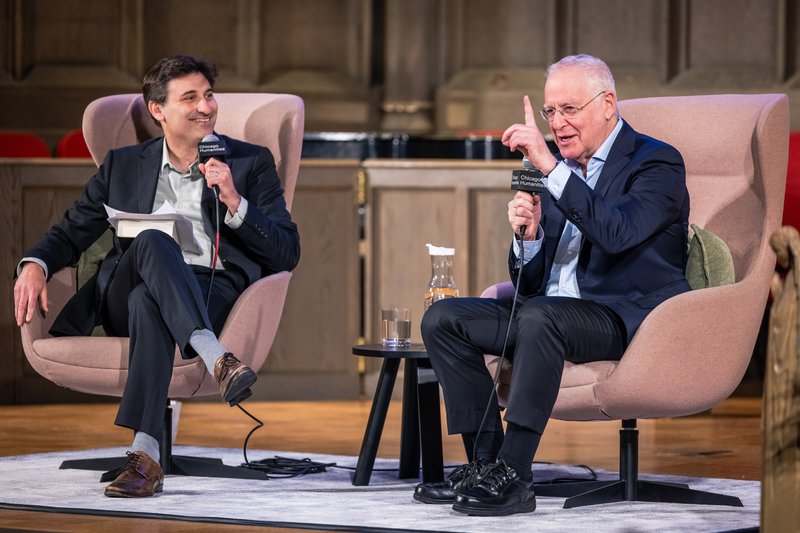
Ron Chernow and Mark Bazer on stage at the First United Methodist Church at the Chicago Humanities Spring Festival in May 2025.
Live event programmed by Mark Bazer
Live event produced by Jesse Swanson
Live event stage managed by Rebecca Dose
Live event produced and mixed by Dan Glomski
Production assistance by Aaron Stephenson / Micquela Washington
Podcast edited and mixed by Katherine Kermgard
Voiceover by Anthony Fleming III
Become a Member
Being a member of the Chicago Humanities Festival is especially meaningful during this unprecedented and challenging time. Your support keeps CHF alive as we adapt to our new digital format, and ensures our programming is free, accessible, and open to anyone online.
Make a Donation
Member and donor support drives 100% of our free digital programming. These inspiring and vital conversations are possible because of people like you. Thank you!