Lin-Manuel Miranda Shares the Secrets to Making Great Art
.
S3E5: Lin-Manuel Miranda
Apple Podcasts • Spotify • Pandora • Overcast • Pocket Casts
This one’s for the theater kids! Lin-Manuel Miranda comes to you live from Chicago’s 3,563-seat Civic Opera House in this exhilarating conversation from our archives. He joins Chicago Tribune theater critic Chris Jones to chat Hamilton, songwriting, and all things Puerto Rico.
Read the Transcript
[Theme music plays]
[Cassette player clicks open]
ALISA ROSENTHAL: Hey what’s going on, welcome back to Chicago Humanities Tapes - the spot for the biggest names and brightest minds from the Chicago Humanities live spring and fall festivals direct to you. We are on the very precipice of our live Spring 2024 events, you aren’t going to want to miss them. Coming up in April, May, and June you can catch amazing speakers spanning, quite frankly, all of the humanities: Kara Swisher in conversation with the incredible Brené Brown, talks from Marina Abramović, Jen Psaki, Miranda July, Reggie Watts, and so much more. Head to chicagohumanities.org to snag those tickets before they sell out. Today, we’re blessed by an appearance from the patron saint of theater himself, Lin-Manuel Miranda. In this conversation from 2016, he shares his wealth of musical knowledge and cultural insight with the Chicago Tribune’s Chris Jones, in a conversation that is just as relevant today. Fresh off his own run in Hamilton, he was very much thinking about his recent projects of composing the musical version of Bring it On and contributing music to Stud’s Terkel’s Working. The film version of In The Heights was still a ways away on the horizon. The way he lifts up his collaborators, plus his passion for life, music, and all things Puerto Rico, makes this chat timeless. This is Lin-Manuel Miranda as interviewed by Chris Jones at the Civic Opera House at the Chicago Humanities Fall Festival in 2016.
[Theme music plays]
[Raucous audience applause and cheering]
CHRIS JONES: Wow.
LIN-MANUEL MIRANDA: Yeah.CHRIS JONES: Are you feeling the love?
LIN-MANUEL MIRANDA: I am indeed.AUDIENCE MEMBER: We love you!
LIN-MANUEL MIRANDA: I love you.
CHRIS JONES: These tickets sold out in 10 minutes flat. It's just two guys. Really one guy with a microphone. And yet here everybody is. So how are you doing with all of that, Lin-Manuel?
LIN-MANUEL MIRANDA: Pretty good. Um, you know, it's it's. I you know, I'm an open book. I wore my Sunday in the Park with George socks. I'm going to take my my shoes off because I tell the truth more when my shoes are off. Let's do this.
CHRIS JONES: So when when Alexander Hamilton, the subject of this little musical that got a lot of attention around here. So when he was ten, his father basically walked out on him right? When he was 12 his mother died of a fever in the bed right next to him. He was adopted by his cousin who then killed himself. And I think during that same year, the same couple of years, like his aunt, his uncle, his grandmother also died. And essentially he got all of his possessions seized and then he became an orphan. So he's a teenager and he's an orphan and he's desolate. And in a matter of it feels like weeks or months, he was one of the founding fathers. So what do you what do you see in that story? I mean, how did he possibly pull that off?
LIN-MANUEL MIRANDA: I think the the moment I realized this thing was a musical was towards the end of the second chapter, Ron Chernow posts one of the first writings we have of Hamilton. He's about 14 years old. All of what you've listed has already happened. And he writes a letter to his friend Ned Stevens, and he says, and I'm paraphrasing because it's been a while since I read it, "I may be said to be building castles in the air, and I hope you won't think less of me. But we have seen such schemes successful when the projector is constant. I shall conclude by saying that I wish there was a war." And that's that's the best musical theater character you can hope for. That's. That's Molly Brown saying, "I don't believe in down. I'm going up." That's Pippin saying, "I want my corner of the sky." That's Tony saying you know, “Something's coming." It's that drive, that irrepressible drive. "We have seen such schemes successful when the projector is constant," that kind of idealism -
CHRIS JONES: Say that again.
LIN-MANUEL MIRANDA: We have seen such schemes - the life he imagines for himself - successful when the projector of that fantasy is constant. So I'm not going to stop until I get the thing I'm imagining in my head. And then what undercuts it is the next sentence. "I shall conclude by saying that I wish there was a war" which is the most adolescent thing ever written. It's also but it's also it also speaks to his awareness of his situation. He's broke and he's from nowhere. And the only way to rise when you're in that position is through military glory. So he's also showing intense smarts and cynicism about where he is. So I was like, I know this guy. I want to ride with this guy and I want to see what happens.
CHRIS JONES: So he died too early to prevent other people from trashing his reputation, including Thomas Jefferson.
LIN-MANUEL MIRANDA: Well, he is succeeded - the next four presidents do not have a ton of love for Hamilton, right? There's Adams, who he wrote a screed against while he was in office. Then comes Jefferson - his best friend - said no one ever. Then Madison, his other best friend who actually was friends with him for a time, but then sort of fell into political disagreements with him. Then John Quincy Adams, the son of the guy he talked smack about. So that's that's four people in charge of the country who who don't want to see this guy remembered well. So it's not a you know, it drives home the lesson, which is it's not even about what you do in your life. It's about who survives you. And you can have done incredible things in your life and career. But if those who survive you don't tell your story. It's like it never happened.CHRIS JONES: So how do you ensure that those who survive you tell your story. Or can you not worry about it?
LIN-MANUEL MIRANDA: You can't worry about it. I. I can't worry about it. I don't think you can either. You will have your writings. You will have your incredible reviews. You will have the things you've done and you know the take away you know, we end Hamilton with Hamilton's extraordinary wife, Eliza, who lives another half century, who does incredible things in her own right and dedicates herself to to his legacy. And and and it's and it's even more tragic in real life. She's pushing her kids to write the definitive biography on her husband. She passes away before that project is done, so she never lives to see that happen. One of her sons does eventually write the biography, but she doesn't live to see it. So we also are survived by the people who love us and tell stories about us and and keep our our love alive. I think about it every time I see one of Roger Ebert's wife's tweets. I am. Yeah. I was I was a film nerd before I was a theater nerd. And I would read the entire book, the entire book of reviews every year when it was updated every year. I could I could recite his no tar review of North by Rob Reiner, which is one of the best written destructions of a movie I've ever read. And and that's how we are survived by the people who love us and tell our stories.
CHRIS JONES: I think when you watch Hamilton, though, you get this sense. I don't know how you were all feeling when you were like in traffic or whatever on the train on the way down here. You sometimes we all sometimes wonder we have a finite amount of time and we don't know how long that amount of time is. And some people, including you, I might add, seem incredibly good at packing in a lot of things. And Hamilton too. Right? It's sort of he's almost like the model of how to do a lot quickly. And really, if you don't know when you're going to die, it makes sense that you would do a lot quickly, right?
LIN-MANUEL MIRANDA: Yeah. And by the way, we all don't know when we're going to die. So it becomes about how do you respond to that news? How often are you aware of that fact? And I think Hamilton and Burr were both people who are acutely aware of it and responded to it in different ways. And so in constructing their relationship, we look to models, but there isn't really one. It's not Val Jean and Javert. It's not a pursuer and a pursued. It's not Salieri and Mozart because they're equally brilliant men. It's not one envious of the other's genius. It's one envious of the other's temperament. You can't change your temperament. I feel like I've been Burr in life in terms of temperament as often as I've been Hamilton.
CHRIS JONES: Meaning what? How would you describe your temperament?
LIN-MANUEL MIRANDA: Meaning - I'm on year one of writing Hamilton, and I'm watching colleagues win Tonys and win awards, and I'm just starting my next project. And you have to go, Well, I'm alive. I'm breathing air another day. I'm just going to get as much writing done today as I can and waiting for it and basically waiting for the right opportunity for things to happen. And I think we're all a mix of both, right? Hamilton doesn't wait for anything. Hamilton is like, we've got to go. We've got to go. We've got to go. And Burr's like, Wait, I want to reserve the right to change my mind if shit goes sideways. One of the biggest sort of history, what ifs I wrote into the show and it was interesting because, you know, I was always working with Ron Chernow and sending him what I wrote and some of the stuff he'd he'd write back right away, No, that's not how it happened. And some of the stuff he didn't bat an eye at. And it's it's a scene in "Nonstop" where Hamilton invites Burr to help him write the Federalist Papers. That never happened. Hamilton did consult other people who didn't participate, Governor Morris being one among them. But I wrote that because I wanted, I needed to underline the point of, they're coming up at the same time. They're both lawyers. They're both in similar positions in society. But one goes out on a limb and writes this thing to help convince people that the Constitution's the best way to do things. And one is like, No, we don't know that this is going to work. I'll be over here. Good luck to you. And so that was that historical what if was sort of a great way to underline their differences prior to the end of the act.
CHRIS JONES: You famously say sometimes that you get your best ideas on vacation, right? You got your idea for Hamilton while you were on vacation from In the Heights, right? So what kind of vacations do you have? You lie on the beach and you go, “Where’s my…” How do we get that kind of vacation now?
LIN-MANUEL MIRANDA: If you're looking for your next project on vacation, you're not really on vacation, right?
CHRIS JONES: Are you, in fact, addicted to being on stage? I mean, could you walk away from all this and be happy?
LIN-MANUEL MIRANDA: Yeah, but, you know.
CHRIS JONES: You said yes?
LIN-MANUEL MIRANDA: I know I said yes, but.
CHRIS JONES: It's a big question! It's a big question!LIN-MANUEL MIRANDA: The opposite of Second City. I didn't say yes, and I said yes, but. You need both. Again, back to opposing muscle groups. I feel filled up when I get to perform "Hamilton." "Hamilton" is a 14 course meal of a role. I don't think I'm done with the role, although I'm certainly done with it for now. Right. I'll be back. When there was all the hoopla over me leaving, I just kept flash forwarding to like, you know, me being Ted Neeley or Yul Brynner and like, people being like, Oh my God, he's doing it again. He's back as Hamilton in the 19th national tour. Because I watched the show, and as much as I love watching it and as much as I'm proud of it, there's a part of me that wants to be on stage with it always, that doesn't go away.
CHRIS JONES: So you grew up on the northern tip of Manhattan, right. And Inwood. And there's that line in "In the Heights" was always my favorite line, which is I think it's Nina, right where she says, I thought I lived at the top of the world and paraphrasing to the author, when the - just covering myself for a sec. I thought I lived at the top of the world where my, where my will was a subway line. Did you?
LIN-MANUEL MIRANDA: Yeah that was the subway map, yeah.
CHRIS JONES: Thank you. Subway map. Is that how you felt?LIN-MANUEL MIRANDA: That's how I felt. My world was prescribed by the New York City subway map, and there used to be a little arrow in the corner is a reverse arrow that looked like a black Pac-Man. And I used to pretend that the Pac-Man was eating train lines, and local local were regular and then, like, express lines that were the white circle were power pellets. That was my my map of the world. And we lived at the top of it, particularly in the old maps where the Bronx was not as sharply defined as it is now, which was above us. But yeah, that's that's a very autobiographical line.
CHRIS JONES: And is I always every time I see "In the Heights," I seen it a lot of times, as you can imagine, the I always wonder where you are in that show. And I think, okay, well, he's partly he's partly Nina, he's partly Usnavi where you know, where where is he in the show? Are you I'm guessing you're all over that show, right?
LIN-MANUEL MIRANDA: Quiara and I are all of them. We are all of them. And it really is a love letter to our families and our neighborhoods growing up. She North Philly, me, northern Manhattan. And and there is also I mean, there's love letters, literal love letters to our family. Like there's a line about my cuca came into the salon, you know, Quiara has an Aunt Cuca. The main characters, Kevin, Camila and Daniella are the names of my three cousins who live in Puerto Rico. So it was a love letter to our families. But in terms of where we find ourselves, we are all over it. Quiara, in many ways was a ringleader growing up, and she would hold readings and Latino poet readings in the bookshops in Northern Philly. And I'm just as much a Nina as she is as an Usnavi. You know, I I went to school in the richest zip code in the country on the Upper East Side, but I spoke Spanish at home, and all my friends in the neighborhood spoke Spanish. And I remember that drift. I remember feeling like I was drifting away from my neighborhood, even as I lived in it, as I sort of assimilated more in the culture of my school.
CHRIS JONES: Do you still live in that neighborhood?
LIN-MANUEL MIRANDA: Yeah, I lived well I moved all the way downtown to 180s, and from 200th Street.
CHRIS JONES: How do you feel about that question now? If you were feeling that when you were writing "In the Heights," I mean, I remember you then. We we met a few times when you were not like this, so it must be more acute now, that feeling of drifting away from your neighborhood.
LIN-MANUEL MIRANDA: No, I actually on the contrary, I feel like my neighborhood is sort of the last place where people still kind of knew me when, and I can mark the passage of time by seeing the kids who grew up there with their kids. That's like a real world experience that I wouldn't trade for the world. I mean, I wrote a whole show about how I don't want to leave my neighborhood. And and so I love that, you know, one of the one of the best moments I ever had was I remember my my dog was still a puppy. This is like 2011. And I was I had to go into a store, but the store didn't allow dogs. And I was struggling with tying her up because she was a puppy and really ornery. And this construction dude who was sitting on the curb outside said, "Relax, Usnavi, I'll hold til you get back." And that was like, Oh my God, this is what I've always wanted. It's just like the guy on the corner saying Usnavi, it's cool. I'll hold your dog til you get back. And that is success. And that is that is all I've ever wanted out of fame. Everything else has been extra.
CHRIS JONES: So all you've ever wanted out of fame is a construction worker to hold your puppy and you're good.
LIN-MANUEL MIRANDA: It's just like being known in the neighborhood and being able to say hi to everyone.
CHRIS JONES: The royalties. Not all of that. We don't care about that. It's all about the construction work. Yeah. While you were living there, you would spend a week in the summer, right, in Puerto Rico with your grandparents. Is that - a month?
LIN-MANUEL MIRANDA: Yeah.
CHRIS JONES: Okay, what was that like? So you went from as a young person, you went from Manhattan to that. So what was that like? What were the sense memories, like what what what happened to you when you landed on the island?
LIN-MANUEL MIRANDA: It's an excellent recipe for making a writer. If you make if you make your kid just a little out of place everywhere he goes. It's a great way to become a writer because I was the kid who went to the fancy school in my neighborhood. I was the only one of the only Puerto Rican kids in my class at school. And then I'd get sent to Puerto Rico, where I was the like gringo with the like, whack job Spanish accent, you know who - my accent -
CHRIS JONES: Did the actually say that when you came like walking down the street.
LIN-MANUEL MIRANDA: Kids my age would be like, You talk weird. We're going this way. And so my friends, and I think this is why Abuela's such a prominent character in the show, all of my friends were my grandparents' friends. They were they were viejitas who made limber and and would take care of me and watch shows with me. I couldn't make friends my age in Puerto Rico. And so the the other thing that's but but I also had such a profound connection to the island. I think when you grow up in New York, you see the roles prescribed for Latinos both on stage and in movies and in real life as we are the janitors, we are the nannies, we are the ones who take care of you and do the jobs no one else wants to do. And then you go to Puerto Rico, where we're also doctors and lawyers and firemen, and we do all the other jobs. And I can't tell you how much that does for your sense of self-worth. It is. Oh, it's like it's like the little girl in the Blind Melon bee video going to see all the other BS like she's out of place everywhere and then go, Oh we're all little in bee outfits over here. That's what it felt like going to Puerto Rico. And I also, you know, I feel like I have a connection with my family and connection with my roots. And also, you know what it was, if Nina's central question is I imagined what life would be if I'd grown up there, if my parents had stayed there instead of here. That was my glimpse of it. Every year for a month.
CHRIS JONES: When you were there. Did you write?
LIN-MANUEL MIRANDA: Yeah.
CHRIS JONES: What did you write?
LIN-MANUEL MIRANDA: I wrote letters to my friends. I made movies. My my grandfather was the general manager of the local credit union, and he would borrow the surveillance camera and I would make movies with the surveillance camera. So I have movies, and in between the movies, you see footage of people online at the bank. Because those were the tapes I was taping over. So I made lots of films and my grandfather would bring home friends to be in the movies with me. A lot of animated movies of G.I. Joe.
CHRIS JONES: Where are these movies, man? You got to get these.
LIN-MANUEL MIRANDA: My Twitter followers know I have them, and I've been digitizing them slowly and they're terrible. But but they were you know, they were how they were how a lonely kid keeps busy in Puerto Rico. And I also wrote a lot of letters to my friends. I was a a really good pen pal in the summers, even in high school.
CHRIS JONES: When were you happiest: when you were leaving New York and going to Puerto Rico or when you were coming back?
LIN-MANUEL MIRANDA: Oh, that's a good question. I, I was always happy to come home. You know, again, I'm a homebody. New York is my island at the end of the day. But at the same time, you know, it's not just being in Puerto Rico, it's being with your grandparents. Any of you who were lucky enough to have lived by their grandparents. You get spoiled rotten. I ate Starbursts for dinner. We'd go to there's the biggest mall in Puerto Rico is in San Juan, and it was called Plaza Las Américas. And they had a thing called Time Out, which was the arcade and the highlight of Puerto Rico, you know, people who don't know anything about Puerto Rico go like, so were you taking in wonderful culture and going to the beaches and learning about your roots? I was like, no, I was eating Starbursts and playing video games all day. It was the best.
CHRIS JONES: So you've been hanging with the Puerto Rican community here in Chicago, right? What do you what do you wish the people of Chicago knew about Puerto Rico that they don't presently know?
LIN-MANUEL MIRANDA: Well, the lights have been off for two days. They're just coming back. You know, I don't think there's anything I can tell them that they don't already know. One of the things that's been wonderful about this trip, it's my first time in Humboldt Park yesterday. Incredible. Incredible. And as we were going there, my father, who is, you know, been in in politics and advocacy all my life, he said, I'm going to do a great impression of my father right now, "Lin-Manuel. The Puerto Ricans in Chicago did what New Yorkers could never manage to do. They said, This is our block. And they bought up all the businesses and this is their block forever. And there's a flag that marks the beginning of Division Street, and there's a flag that marks the end." And when you go through that town and you see that street and you see all of the businesses have names that are towns in Puerto Rico, you know, it's very weird to come to a city you've never been to before and feel instantly at home on the street. And that's how I felt in Humboldt Park.
CHRIS JONES: So you started writing Hamilton when you were at Wesleyan, right? And many of the people are people with whom you started working when you were 18, 19 years old. So is the lesson for everybody here stick with your you like the people you know when you're 18 because those people are your best collaborators.
LIN-MANUEL MIRANDA: Ha! The the lesson actually is if you find collaborative partners who believe in making the same stuff as you hang on to them, it is very rare. I had the great good fortune of meeting Tommy Kail the week after I graduated college. We actually didn't meet at Wesleyan. In fact, at Wesleyan, he just knew me by reputation as the pissant freshman who was borrowing his lights from his production for my 20 minute production of a musical I'd written. So he was like, Who is this freshman stealing my lights? And we met the week after I graduated. Mutual friends had given him a CD and copy of my script for "In the Heights," the college version, the 80 minute one act. And the first three things he said to me were. Well, "In the Heights" is a really good song, but it introduces your world. But it's the third song it should be first. Usnavi is a really interesting character. He's only in the third scene. He's only in three scenes in the thing. It would be great if he could be the narrator, and that way all the stories filtered through his bodega and he can be the storyteller of the thing. And at that speed. And I thought, This guy's a lot smarter than me. And two, I had two years distance from the show. I put the show up my sophomore year and I thought, This guy's going to make my show a lot better than it would be if it were just me by myself. And and that's a really important thing to be able to recognize, is to find the people who can make your work better. I will never play piano. I will never have the musical gifts of Alex Lacamoire. He is he's just got an incredible ear. It's like he was sent from heaven to help me work. You know, he's Cuban. He's got every montuno pattern in his brain. But at the same time, he studied under Stephen Schwartz and was the associate conductor of "Wicked" when I met him. So it was like he had the exact skillset I needed. So, you know, I felt very lucky that I found collaborators I trusted and and, you know, working with those people as because we have a shorthand now.
CHRIS JONES: So I remember talking to you when they hired you, they were updating Studs Terkel's "Working," - consummate Chicago story, and Studs had always written about blue collar professions. And you were hired if I think if I get this right, to write about working in McDonald's, which I believe you really did, correct?
LIN-MANUEL MIRANDA: Yeah, that was my first paying job.
CHRIS JONES: So that was kind of a moment when you had "Working," a show about working that was sort of you were there to sort of say, this is what working is now. It's not just about being a grave digger or a bookbinder or something. It's about fast food.
LIN-MANUEL MIRANDA: Well, well, actually, to be honest, when Stephen approached me, it wasn't with anything - Stephen Schwartz - It wasn't with anything particularly in mind. It was just, Gordon Greenberg's directing a new production. I think there's room for new songs in here. We'd love for you to do something. And so I listened to it. It's a great score. It's got some of the best songwriters alive who've contributed songs, Mickey Grant and Craig Carnelia and James Taylor, the late great Mary Rodgers. And they, he said, What do you think you could contribute? And I said, My first instinct is there's not really a "my first job" song. What's your first job? And my first job was at McDonald's.
CHRIS JONES: On the counter? Or you were making the burger. So what were you doing?
LIN-MANUEL MIRANDA: I had several shifts.
CHRIS JONES: Did you flip around?
LIN-MANUEL MIRANDA: I did, I did the counter from 10 a.m. to 2 p.m. So I was the one you yelled at when you were too late for breakfast. But can I just get an Egg McMuffin? I see it. I see it there behind the thing. Can you just give me that one? I'm sorry. It's. It's 11:10. We're serving lunch now. But the best thing about the job was we were the rare McDonald's that did delivery. And with delivery, you make tips. And when you're making $4.25 an hour, tips are huge. So that's what my song is about. It's about the drudgery of the counter, which really like gave me anxiety.
CHRIS JONES: What were your anxieties working at McDonald's?
LIN-MANUEL MIRANDA: Oh, I mean, I caught a counterfeiter once. Speaking of speaking of dead presidents, I caught a $20 bill with Washington's face on it. During the lunch rush. Said, "This president is not supposed to be on the twenty." But you know, the anxiety of just, you know, getting it wrong and having your register not add up. At the end of the day, it had to add up within $2 otherwise your pay was docked. So, you know, that's stressful. But delivery was free delivery. You're walking around, you're in your outfit. I was 14, so I'd see like girls in summer school and I'd be like, "Hey, how are you?" I wasn't really. And I smelled like burgers. But that was that was the freeing part of the job. And so that song was about that.
CHRIS JONES: So then I then I encountered you working on a musical called "Bring It On," "Bring It On," a version, a version of the movie, the 2000 movie with Kirsten Dunst, which I remember seeing in Atlanta, actually. And the thing about that, that particular musical, it was interesting because you were using cheerleading, but there was some interesting, unconventional, I think, rhythmic kind of things that you were doing that I'm thinking maybe informed the musical that followed in a little bit.
LIN-MANUEL MIRANDA: Absolutely. You know. When I was a child, dreaming of a life in musical theater, "Bring It On" was never a thing I aspired to. And yet. And yet Andy Blankenbuehler approached me. He said, I don't have the rights to the first movie. I have the rights to the title. And I said, I'm not interested in doing an adaptation of a movie. And he said, It's not an adaptation of any of the movies. Jeff Whitty has an idea. And as soon as he said, Jeff Whitty has an idea, I was interested because Jeff Whitty is an incredible writer. He wrote the book to "Avenue Q." He's one of the funniest writers we have in the theater. And he said, I want to do "All About Eve" with cheerleaders. And I said, Oh, that's interesting. I said, But I don't know that I could write the whole score. He said, I don't want you to write the whole score. I want you to write it with Tom Kitt. And I went, Oh. And it underlines a very important point, which is: we write musicals and one out of five shows that reaches Broadway makes its money back. That's a four out of five failure rate in terms of seeing a return on your investment. So what is the lesson you take away from that? You cannot do something because you think it will make money. You cannot do it because, you know, it's just it's a bad investment. You have to do it because you believe in it and you have to do it because you love it or you have to do it because you believe you will learn from it. Now, I knew I wanted to be in the room when Andy Blankenbuehler was choreographing cheerleaders. I wanted to see what an Andy Blankenbuehler cheerleading routine would look like. So to that end, one of the things I learned very quickly was that Andy had the whole show in his head already. Even though we hadn't written the songs and we hadn't written the book, he saw a rise and a fall and the energy shifts of it. And he would say to me things like, When they come in, it's got to have a rhythm of koo-kada-KAH-kada-koo-KAH-koo-KAH and I would go and "koo koo koo KAH, koo koo koo KAH koo KAH." I'd literally copy the tempo. He yelled at me. I'd write backwards from the beat and the rhythm he had in his head. And then I played for him. He go, Oh, that beat is great. Where did you get that? And I like the the the kid in the drug ads from the eighties would go, "YOU ALRIGHT? I got it from watching you!".
CHRIS JONES: How did how did you use that in -.
LIN-MANUEL MIRANDA: That's a deep cut. Kids don't know what I'm talking about.
CHRIS JONES: How did you use that in "Hamilton?" So what have cheerleaders got to do with how to musically, rhythmically?
LIN-MANUEL MIRANDA: The biggest lesson we got from "Bring It On" was, you know, if you ever see a cheerleading routine and please do, go turn on ESPN, they're the craziest things you'll ever see in your life. It's like teenagers, but somehow even more caffeinated. And the music is this incredible dance, electronic music. It's it's it's it's it's. How do you write lyrics over that? How do you tell a story over that kind of energy? And so what we kind of had to do by trial and error was write the kind of song that would not feel out of place in a real cheerleading routine, but also told the story of what these cheerleaders were going through in real time. And so it was a lot of, and this is logistical, but it helped us a lot. How much do you pre-record and how much do you play live? And we prerecorded a lot on "Bring It On" and found that the sound was always an issue. Mixing live instruments and prerecorded instruments is always sort of a weird wash. And so by the time we'd come to "Hamilton," Alex said, I knew exactly I know exactly how I want to arrange this. This is a rock band with a string quartet, and we're going to play all of the sounds, even if it's a sound I made in a demo and it was a loop I found in Logic or Final Cut. There's a drummer on a pad playing it live. So even in "Satisfy" the bnts-tika-TAH-titi-boomboomboom-BAH-TITI-KAH-KAH-KAH There's a drummer playing that live. It's not a prerecorded beat. Everything's played live. The only prerecorded thing in our whole show is the collage that accompanies the "Satisfied" rewind. When "Satisfied" presses rewind, all the all the players put down their violins and cellos for a second, and we play this thing that Nevin Steinberg worked for days on. And if there were justice in the world, there would be a sound design Tony, and he would have a Tony for it. That sort of rewinds the previous 10 minutes on stage and then takes us back to the beginning of a love story.
CHRIS JONES: So we some of you filled out cards Here's my suggestion. My suggestion is we do a lot of people's questioning. We do it fast, you up for that? What advice would you give to young actors aspiring to revolutionize Broadway?
LIN-MANUEL MIRANDA: Start by getting the job. That's the glib answer. The real answer is you have to treat auditioning like the job, treat auditioning as as the thing you're preparing for and the thing you're going to learn from, so that getting the job is gravy and then get another job that pays the rent until then.
CHRIS JONES: If you could have breakfast with one person in the world alive or dead, who would it be and why?
LIN-MANUEL MIRANDA: Jesus in a large group of people. I hear he was a very dynamic guy. And if we need seconds, I know he'd provide.
CHRIS JONES: If you were to write another musical about a historical if you were to write another musical about a historical figure, who would it be? Eleanor Roosevelt. Queen Elizabeth. Anybody?
LIN-MANUEL MIRANDA: Really covering your ass with the third one. Yeah of those two, Eleanor Roosevelt is by far more interesting to me. You know, incredible, powerful husband. She also is incredibly powerful in her own right. She's got that apartment with the lady in New York. She's got her girlfriend on the side. She's got a side chick. There's a musical there.
CHRIS JONES: When you were doing "Hamilton," what was the single funniest, a.k.a., weirdest thing that happened during that - this is a good question - process of Hamilton?
LIN-MANUEL MIRANDA: There was a day when Seth Stewart sat on a chair like any other day, and it splintered underneath him so hard. I was actually on the second level, you know, it's a two level set and I it was like out of a cartoon. He went and sat in that chair and he's just supposed to be watching a cabinet battle and the thing exploded like it was rigged. And I will cherish that memory of of Seth Stewart as over teakettle for the rest of my life.
CHRIS JONES: Do you have any advice for a young playwright who has been advised to get a real job and only do his writing on the side?
LIN-MANUEL MIRANDA: It's good advice. Only only in that it's practical. But here's the thing. You have to do what you love. If we weren't sitting here and we weren't talking, I would still be writing musicals. I would just be writing musicals as a substitute teacher at Hunter College High School. So pay your rent, cover your nut, you know, get health insurance. But at the same time, do what you love and don't let anyone stop you.
CHRIS JONES: If you could play any other role in "Hamilton," what would that role be?
LIN-MANUEL MIRANDA: Angelica.
CHRIS JONES: Angelica.
LIN-MANUEL MIRANDA: It's the best song in the show.CHRIS JONES: Any chance of you playing it?
LIN-MANUEL MIRANDA: Not in Tommy's version. The outfits don't fit me, but hey, somewhere down the line, someone will let me.
CHRIS JONES: Okay. It has been evident that smart people will come to the "Hamilton" Lin-Manuel Miranda event. It has been evident that you are one of those people whose brain is constantly working and constantly thinking. How do you shut down your brain and just relax every once in a while? How do you do that? Great question.
LIN-MANUEL MIRANDA: It is a great question. I. I again, music saves my life. My family saves my life a lot. My wife's the most extraordinary person I know. And she doesn't she doesn't care what idea's in my head if the trash is an out and if if Sebastian needs a diaper change and you need that, you need the people who keep you honest and keep you grounded. And you know, this entire time that Hamilton's been happening and the world has taken notice of it. We've been raising a child together, and that keeps you humble. And it's the hardest video game you've ever played. The second you're good at swaddling doesn't need swaddling. The second you can mix formula with one hand, onto solids. The second you've got the crawling figured out, onto walking. It's like it never lets you get comfortable ever. He's growing faster than I can possibly imagine. And you want to slow down time and you want to cherish it. And, and so that's that's the great humbler of my life.
CHRIS JONES: What song are you currently obsessed with?LIN-MANUEL MIRANDA: Oh, there's a song on Watsky's new album called "Don't Be Nice." Um, there's Watsky right there. And it's. He changes the meter, like midway through the song, and it's thrilling. That's all I'll say. Go download it.
CHRIS JONES: What was your favorite part of filming "Drunk History?" And can you share any insights about the upcoming "Hamilton" episode?
LIN-MANUEL MIRANDA: My favorite part was that it even happened. I'm a huge fan of that show, and the fun of it was it was actually I don't remember a ton about the filming.
CHRIS JONES: Which is kind of the point.
LIN-MANUEL MIRANDA: I'm as curious to see it as the rest of you. But I got calls from a lot of friends the next day saying, Do you even remember talking to me? I said, Vaguely. What did I say? I remember Jonathan Groff. I face timed Jonathan Groff.
CHRIS JONES: When you're casting actors in a show, what do you look for in the people who try out?
LIN-MANUEL MIRANDA: That you can sing and act and dance, number one. But. But I'll tell you something really important that Tommy looks for, and he really looks for a positive energy. It's not unlike when Lorne Michaels is sussing out sort of cast members for Saturday Night Live. He has this thing like, you've got to know that you're going to be around this person at three in the morning in a building when it's dark and lonely and everything is to be okay. So he tries to cast good people. So if you're talented, but the energy in the audition room is one of entitlement, or you're not all there or there's just there's something going on, Tommy is going to be wary about casting you. He wants to cast people with great energy who are collaborators, who know they tell the story. Tommy knows he goes away at a certain point and it's the theater unlike any other medium. The actors are in charge of telling the story night to night, it's the most empowering thing you can have. So we cast people we want to spend eight times a week with.
CHRIS JONES: Sarah Newcom asks you this question. Would you ever consider casting a disabled person in Hamilton?
LIN-MANUEL MIRANDA: Absolutely.
CHRIS JONES: Do you think Hamilton would have made a great president?
LIN-MANUEL MIRANDA: I don't know. There are certainly issues of temperament.
CHRIS JONES: He would not be unique there.
LIN-MANUEL MIRANDA: I think I think I think the presidency is a revealer of who you are. You don't become less yourself. You become more yourself. George Washington was very obsessed with his legacy. He calcified over the course of his eight years, he became more statuesque and more aware of the burden of history as first president. I think you become more yourself and so that the things you look for are temperament. So think about who has the best temperament before you vote please.
CHRIS JONES: If you could use the discography of one hip hop artist to create a new jukebox musical, who would you pick?
LIN-MANUEL MIRANDA: Great question. I don't know that I want to reveal the answer to that. What if I want to really do it? I can tell you some that would be great. Biggie has some of the best storytelling in hip hop. Eminem has more characters than any other rapper. Jay-Z's arc is, I mean, both business moguls and kids, teenagers listen to that because it is the most aspirational music you could listen to. So those are three great candidates right there. And they by by virtue of the careers of the artists involved there is there's a there's an arc. There's an arc of a rise and a fall and a rise again. So those are three off the top of my head.
CHRIS JONES: Are you going to the Chance concert tomorrow night?
LIN-MANUEL MIRANDA: I can't.
CHRIS JONES: Got a show to do?
LIN-MANUEL MIRANDA: No, I'm going home. I'm going home to New York for the weekend. And I'll be back on on Monday. You know, I. That's I have a babysitter during the days of the week. And when I'm home, it's my kid time on the weekends. So I'm going home to be with my kid and then I'll be back on Monday. You don't have to applaud that, you're supposed to be home with your kids!
CHRIS JONES: If New York is the greatest city in the world, is Chicago the second greatest city in the world?
LIN-MANUEL MIRANDA: Can I say something? So I did like 300 interviews for you guys yesterday, and every reporter asked me, "Why did you bring Hamilton to Chicago? Why is that the next stop?" What's with your complex? And I would say to them, Guys, you're Chicago, like you're home of Laurie Metcalf and Jessie Mueller and Steppenwolf and a million a million a million brilliant theater practitioners. Where else would we go? So I know you call yourselves the second city, but you're pretty fricking fantastic. That's all I'm going to say.
CHRIS JONES: Well, I would say this that right now, Lin-Manuel, Chicago is your town. Ladies and gentlemen, Lin-Manuel Miranda.
[Audience applause]
[Theme music plays]
ALISA ROSENTHAL: That was Lin-Manuel Miranda and Chris Jones at the Lyric Opera House in 2016. Chicago Humanities Tapes is produced and hosted by me, Alisa Rosenthal, with the Chicago Humanities team to thank for excellent programming and production of the live event. We’ll be back in two weeks with a new, never-before-heard interview just for listeners of the podcast! Hip hop historian “The Notorious PhD” is in the studio, aka the University of Southern California’s Dr. Todd Boyd, giving us American history told through the lens of hip hop culture, from his new book “Rapper’s Deluxe: How Hip Hop Made the World.”
DR. TODD BOYD: I tell a story about Obama on the campaign trail. And, you know, there's a moment when he brushes his shoulders off like the Jay-Z song says, and this is a presidential candidate, you know, you wouldn't expect, John McCain, his opponent, to even know what that was. So it's very cool to see Obama do this. People like to talk about Bill Clinton playing the saxophone on Arsenio Hall, but I think there was something much more authentic about what Obama did when he brushed his shoulders off in reference to his critics.
ALISA ROSENTHAL: Be sure to hit subscribe so you’ll be the first to know when that episode airs. While you’re there, give us a rating, share with your friends, and check out our killer backlog of programs. Thanks for listening and as always, stay human.
[Theme music ends]
[Cassette player clicks closed]
SHOW NOTES
Watch the full conversation here.
CW: Light profanity.
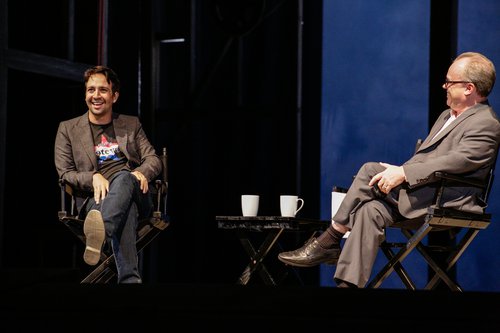
Lin-Manuel Miranda ( L ) and Chris Jones ( R ) at the Civic Opera House at the Chicago Humanities Fall Festival in 2016.
Recommended Listening

- Podcast
- May 16, 2023
Jessica Lange Captures Truth in Photos

- Podcast
- May 2, 2023
Marvel's Simu Liu on Acting, Abercrombie, and Family

- Podcast
- February 20, 2024
Throwing Poems into Lake Michigan with Sandra Cisneros
Become a Member
Being a member of the Chicago Humanities Festival is especially meaningful during this unprecedented and challenging time. Your support keeps CHF alive as we adapt to our new digital format, and ensures our programming is free, accessible, and open to anyone online.
Make a Donation
Member and donor support drives 100% of our free digital programming. These inspiring and vital conversations are possible because of people like you. Thank you!