Greta Johnsen’s Love Letter to Podcasting, Public Radio, and Finding Your People
Exclusive Interview
S3E16: Greta Johnsen
Apple Podcasts • Spotify • Overcast • Pocket Casts
Public radio and podcasting icon Greta Johnsen brings her consummate hypewoman energy to the Chicago Humanities Tapes studio. Topics include community building from her WBEZ podcast Nerdette days, her newsletter era, and being the co-host of The Official Game of Thrones Podcast. She chats with host Alisa Rosenthal on her love of curating as they discuss her upcoming Fall 2024 Chicago Humanities events.
Read the Transcript
[Theme music plays]
[Cassette tape player clicks open]
ALISA ROSENTHAL: Hey all what’s going on, thanks for checking out Chicago Humanities Tapes - the audio extension of the live Chicago Humanities Spring and Fall Festivals. I’m your host and program curator Alisa Rosenthal, and today I’m joined in the studio by another host and curator, Greta Johnsen!
You know Greta Johnsen as the co-host of HBO's Official Game of Thrones Podcast, where she’s currently covering House of the Dragon, her popular newsletter GRETAGRAM that’s just delightful, and from her years running the WBEZ interview podcast Nerdette, which was unfortunately canceled in May 2024 due to budget cuts. I’ve linked to all the good stuff she’s got going on in the show notes, so definitely check that out.
She’s been a standout interviewer for many live Chicago Humanities events over the years, and used her superpower tastemaking skills and guest curated three fantastic live events for us coming up in Fall 2024 - you can catch her interviewing Bridget Everett and Jeff Hiller of HBO’s Somebody Somewhere, chef Abra Berens, and Badass Cross Stitch’s Shannon Downey. Tickets for all of those are on sale now, available at chicagohumanities.org.
But wait! We also have tickets available for a bunch of other names you’re not going to want to miss check ‘em out - Malcolm Gladwell, Kate McKinnon, Ta-Nehisi Coates, R.L. Stine, and Randy Rainbow, just to name a few! Head to chicagohumanities.org for that hookup.
Without further ado, here’s my chat with Greta Johnsen.
[Theme music plays]
ALISA ROSENTHAL: All right. Shall we do an interview?
GRETA JOHNSEN: Let's do it.
ALISA ROSENTHAL: Greta Johnsen. Hello.
GRETA JOHNSEN: Hello. I'm glad to be here.
ALISA ROSENTHAL: Happy to have you. It's boiling hot in Chicago.
GRETA JOHNSEN: Oh, my God, it's too much. No.
ALISA ROSENTHAL: Have you been outside yet today?
GRETA JOHNSEN: No, I mean, yes, I took the dog out. I'm, like, performing the duties that need to happen, but I think that's about it for me.
ALISA ROSENTHAL: No, it's it's brutal. Because here we are. It's like September. We're ready for it to be sweater weather.
GRETA JOHNSEN: Yes. Yeah, like I want to knit again. It's been too hot to knit for sure.
ALISA ROSENTHAL: Oh no truly. So I have a series of questions for you. One of which, I believe, are you from Alaska?
GRETA JOHNSEN: Yeah, I grew up there. Yes. So that's part of it for me. This time of year is like, I was just looking at the weather in Fairbanks in my hometown, and it's like the high is 50 degrees and it's raining and I'm like, oh, my, I'm so ready. My body is ready. You know, like, it should be the rainy season by now. But we still have so much more summer here in Chicago.
ALISA ROSENTHAL: I know. What are we in Fool's Autumn? Something like that.
GRETA JOHNSEN: I guess. But yeah, it's pretty funny living here, because I think a lot of people are very annoyed by me because I'm the person who's like, it's still not cold enough for socks. And they're like, who are you?
ALISA ROSENTHAL: You're the guy in cargo shorts. Well into November.
GRETA JOHNSEN: Yeah exactly. Yeah. The first day it's 35 degrees. I'm like, let's go.
ALISA ROSENTHAL: So what brought you to Chicago?
GRETA JOHNSEN: I moved to Chicago to go to graduate school at Medill, and I lucked out amazingly. Within like two months of starting school, I was also, part time anchor at WBEZ. I was anchoring weekends, which worked out -
ALISA ROSENTHAL: Amazing.
GRETA JOHNSEN: So well, yeah, it was great. I mean, I had never the biggest city I had ever lived in at that point was when I had studied abroad in France. It was like 300,000 people. And so a big like for me, coming to Chicago was just a big experiment. It was like, I have no idea if I will be able to function in a city. And I figured, you know, it's a one year grad program, which is amazing. And I thought that would be a kind of a nice safety net for, like, trying out existing in a place. And if I didn't like it, it was okay, because it was only a year and I kind of came and was like, well, you know, I'm sure eventually I'll have a panic attack. And 13 years later, here we are.
ALISA ROSENTHAL: Just one extended panic attack, which is living in Chicago.
GRETA JOHNSEN: Yeah, you get it.
ALISA ROSENTHAL: So what are some of the cultural vibe differences between Alaska and Illinois?
GRETA JOHNSEN: Oh, that's a great question. I honestly think so. Fairbanks is right in the middle of the state, so I often will call it kind of like the Midwest of Alaska.
ALISA ROSENTHAL: Yeah.
GRETA JOHNSEN: It's kind of like the Riverlands. And so I think actually Alaska has a lot in general Alaska, but especially Fairbanks has a lot in common with the Midwest. A lot of people who move to Alaska in the 80s came from places like Minnesota and Illinois and Wisconsin and Michigan. I think especially like it's always such a pleasure to get to visit northern Wisconsin or Minnesota or Michigan because they feel very similar texturally, even. And I think, you know, something I've always really appreciated about Chicago, especially given that it is a city of such global caliber, is that it's also like you can go out in your cargo shorts and nobody's going to be like, what are you doing in your cargo shorts? You know, like there's there's a real lack of pretension here. You can't just look at someone and judge like who they are, what their job is in a way that I really respect. I think also in Alaska, in addition to here, like people come here to work, you know, and like unions are really strong. People can make really decent livings as blue collar workers. There's, you know, a kind of like grittiness to it that I think is really cool and, like, deeply American in like, the best possible way, you know what I mean?
ALISA ROSENTHAL: Yeah. Yeah, I've thought that exact same thing, I think, when I was a theater major and then graduating was like, do I do New York, L.A. or Chicago.
GRETA JOHNSEN: Right.
ALISA ROSENTHAL: I'm from Evanston. So I was going to do Chicago. But.
GRETA JOHNSEN: Of course.
ALISA ROSENTHAL: You know, thinking about it in terms of like, yeah, you can you can work and you can make art and you can kind of pursue that passion. Yeah. So what brought you specifically to journalism?
GRETA JOHNSEN: Oh gosh, I was one of those kids who, like, I grew up listening to public radio. My parents had it on all the time. I thought Car Talk was super weird and then eventually delightful. I, I remember hearing This American Life in high school and being like, oh my god. And I think just there's something about I mean, you get it, like audio storytelling is like, I just don't think there's anything like it.
ALISA ROSENTHAL: Yeah.
GRETA JOHNSEN: So for me, it was actually less about journalism than it was about public radio, really. Though I will say I remember distinctly being in like, honors English class, I think it was 10th grade and learning about like, a after school journalism club thing that the district was offering. And I remember sitting there thinking like, oh, this is how I can get into everything. Like I remember feeling like I wasn't sure. Like I do really like science. I think math is pretty cool. I love reading books about a lot of different things. I was like, oh, it sort of like unlocked this box of like, I can keep dabbling in all of these different subjects and themes that I find really interesting because I could just do journalism. So yeah, doing that with public radio has just been such a joy for sure.
ALISA ROSENTHAL: Oh my gosh. Totally. And what's it been like watching, like growing with podcasting and watching podcasting explode and become its own industry?
GRETA JOHNSEN: I mean, it's been fascinating. It's funny, you know? So, yeah, I started Nerdette with my, co-host and co-creator Tricia Bobeda in 2011, which is like.
ALISA ROSENTHAL: Wow.
GRETA JOHNSEN: We were it's like yeah.
ALISA ROSENTHAL: Babies.
GRETA JOHNSEN: We're like old lady podcasters now. Yeah, it's changed so much. I mean, it's wild how much everything has changed. But, you know, there have been some consistencies too. I mean, I think in the end, what's really special about podcasting is that, you know, with the radio, you turn it on like it's probably just like always kind of on in your car or whatever. Like there's a fairly low barrier to entry, right. But with the podcast you do kind of have to seek it out.
ALISA ROSENTHAL: Yeah.
GRETA JOHNSEN: And I think that's really special because it means that, like, you can really find your people there. And I think that's really lovely.
ALISA ROSENTHAL: Yeah. How did Nerdette grow over the years?
GRETA JOHNSEN: Nerdette was always pretty steady. I mean, definitely initially, like I remember it was pretty wild to get to the point between like, oh, this is a number of like, I can do the math of how many friends and family members are listening to this right now.
ALISA ROSENTHAL: Yeah.
GRETA JOHNSEN: And then once it happened, a lot of it was super organic. You know, a lot of it was just like finding I mean, especially earlier on, people who just, like, had faith in us and were willing to be interviewed and who were game and then mentioning those names to other people as sort of like social pressure for like, well, they did it would, you know.
ALISA ROSENTHAL: It's the Chicago way!
GRETA JOHNSEN: And then just kind of hoping that more and more people would join the bandwagon, you know? So yeah, Nerdette's numbers were always like steady but loyal, which was really nice, you know, like it was never an explosively popular show, but people showed up every week and that was all we needed, which was really nice.
ALISA ROSENTHAL: Yeah. And I feel like you've really transferred that energy and that sense of community to your newsletter, which I love.
GRETA JOHNSEN: Oh, thank you.
ALISA ROSENTHAL: You got it. I was clicking through it on Substack and I clicked on, I think every link, I was like, this is so well curated.
GRETA JOHNSEN: Oh, that's super nice. I appreciate that. You know, it's it was a huge experiment. I was sort of like, oh, I'm about to lose my job. I don't know what's happening with Nerdette. I guess I should start my own newsletter. So it's been really sweet to see how many people have sort of like followed along and, and yeah, that idea of fostering community, I mean, that's really what I want is sort of like, how can I get out of the way and just like, have people get to hang out with each other. So it's it's been very fun to kind of like play with how that is going and see with like what can happen next. I'm very excited for that.
ALISA ROSENTHAL: Yeah. For those not in the know, could you explain what Substack is?
GRETA JOHNSEN: Oh can I, I don't even know if I can. I mean, it's, it's actually really amazing. I knew very little about it before I started my newsletter. It's a newsletter platform. And what's really cool about it is that you can actually monetize it in a way that has notoriously been very difficult for online content creators to actually make money. Right? It's like you can have 75,000 Instagram followers, and that doesn't mean you're actually bringing in cash at all. What's amazing about Substack is that you can, you know, you can buy all the content I'm making is totally free for anybody. So I'm not there are no paywalls. That's like a very important piece of it for me, having come up in public radio.
ALISA ROSENTHAL: Right, right, right.
GRETA JOHNSEN: But you can say like, hey, are you up for giving me five bucks a month? What about $75 a year or whatever it is?
ALISA ROSENTHAL: Yeah.
GRETA JOHNSEN: And so essentially, it actually is kind of like a pledge drive model that way, right? Where it's like, yeah, if you like this person whose stuff you're reading and you want to give them dollars, you can, you don't have to. It's all going to be there anyway. And, you know, people do different things with their paywalls, but essentially it's an email newsletter platform that like for a lot of people, actually provides them like annual incomes, which is amazing.
ALISA ROSENTHAL: Yeah. Yeah. And I'll put a link in the show notes for anyone who wants to subscribe or click through all the links like I did and bought way too much stuff.
GRETA JOHNSEN: Did you really buy something?
ALISA ROSENTHAL: Well, I'm debating the sleep mask.
GRETA JOHNSEN: Yes. You know, I've had a couple friends say that I also, I had lunch with a friend yesterday who's like, I bought the white noise machine and I love it. Yes.
ALISA ROSENTHAL: So I'm really fascinated by this, this, like, idea of curating. And what I mean is, like, my mom owned a restaurant, back in the day, and still to this day is like I was just born knowing what people wanted to eat. And I feel like -
GRETA JOHNSEN: I want to hang out with your mom.
ALISA ROSENTHAL: Dude. Yes you do. She's listening. So shout out Leslie.
GRETA JOHNSEN: Hi, Leslie!
ALISA ROSENTHAL: And, so I feel like as I was looking through your Substack and listening to Nerdette, you're really able to be a tastemaker and, like, understand what tastes are kind of in the culture right now, what a variety of people would find interesting. How how do you do that with pop culture?
GRETA JOHNSEN: Oh, that's such a great question. I think it's funny because, like, I really love the word curator. I would definitely bristle if you would use the word like influencer.
ALISA ROSENTHAL: Oh, sure sure, sure.
GRETA JOHNSEN: Which is like what is the line actually is also like a pretty interesting question. Curator I mean, I think the thing that I have always been really happy about with Nerdette and that I think people have responded to, is the fact that, like, there's just like there's more stuff out there than ever before, and it's really hard to figure out what's good and what you're going to like. And so when you do find someone whose tastes like align with yours just enough -
ALISA ROSENTHAL: Yeah.
GRETA JOHNSEN: It's really exciting because then you're like, oh, great, I can just go to this person or this website or whatever it is, you know? So.
ALISA ROSENTHAL: Yeah.
GRETA JOHNSEN: I think a lot of it is that my interests are probably just varied enough, that like, people are, you know, like, I would be happy to rewatch, Oh, Torchwood. I've been thinking a lot about rewatching Torchwood, which is like it came out probably, what, 11, 13 years ago or something.
ALISA ROSENTHAL: Yeah.
GRETA JOHNSEN: But, you know, it's like, I will watch that sci fi show from, you know, a dozen years ago. And I will also check out the, like, maybe kind of trashy legal thriller out now. You know, I do think a big thing that I have always tried to do is to varying degrees, I think about like, I don't I feel I think of myself less as a critic and more of an enthusiast. So what I really like to do is like flail and yell about the stuff I really love. I'm less likely to like, pick apart something that I didn't like.
ALISA ROSENTHAL: Yeah.
GRETA JOHNSEN: And that doesn't mean that I'm like, incapable of speaking critically about things, but I just think there's already so much snark and negativity and sort of like hipsterism out there.
ALISA ROSENTHAL: Yeah.
GRETA JOHNSEN: Like I really love being in and curating and fostering a space where people can just like, be really excited about this stuff they're excited about, you know.
ALISA ROSENTHAL: Yeah. Oh my gosh. Absolutely. And we are so lucky to have you at Chicago Humanities right now.
GRETA JOHNSEN: I'm so excited to be here.
ALISA ROSENTHAL: Because you are guest curating -
GRETA JOHNSEN: Yes!
ALISA ROSENTHAL: Three programs for us. All those tickets are on sale. You can check it out in the show notes. Can you tell us about these three programs? You have one in each month coming up in fall 2024, September, October, November.
GRETA JOHNSEN: I am so excited about these. It was so lovely to hear from Chicago Humanities Festival with this idea. I was like, oh my God. I'm so just like honored and delighted to be able to do something like this. And then I thought about it even more and I was like, oh my god, is this how I can just like, hang out with my friends whose work I really admire on stage? And it turns out it is, which I'm so excited about. So the September event is with Abra Berens, who, speaking of food, is just like an amazing magical food human. She's written three beautiful cookbooks Pulp, Grist, and Roughage, and she is a Michigan based farmer and chef. She works at Greener Farm, which is just like a beautiful, magical place. And she's also super sharp and thinks a lot about food systems and sustainability and coming together and what it even means to create restaurants in this day and age, especially on like the higher end and sort of like that, like, how do we nourish people? How do we foster conversation around the table? Like she's just asking all of these really great, big, interesting questions. So I am so excited to ask her those questions and just like, get into it in a conversation at Chop Shop.
ALISA ROSENTHAL: Yeah. That's right. So it's Chop Shop, which is a former, auto body shop, but now a butcher.
GRETA JOHNSEN: So cool.
ALISA ROSENTHAL: A stage in the back. Yeah. It's a pretty rock and roll venue.
GRETA JOHNSEN: Yeah.
ALISA ROSENTHAL: That's, right by Milwaukee, Damen, and North? Is that right?
GRETA JOHNSEN: Yeah. It's pretty much right on that corner. Yeah. Yes. That's where all of them are. And they're going to do for Abra. They're going to do like a themed dinner ahead of time with meals from her cookbooks, which is awesome. It's going to be gorgeous. So I'm just like, I'm so excited. It's going to be awesome.
ALISA ROSENTHAL: And then your, October one, feature some people from a show I deeply, deeply love.
GRETA JOHNSEN: Oh my god.
ALISA ROSENTHAL: Bridget Everett and Jeff Hiller of HBO's Somebody Somewhere.
GRETA JOHNSEN: Oh, I'm so glad to hear you're a fan, isn't it? It's such a beautiful show.
ALISA ROSENTHAL: It's lovely. It's a little slice of life. You can watch it on HBO. But it's just so sweet and understated and so deeply about friendship, which I feel like is like pretty unmined, especially in prestige TV.
GRETA JOHNSEN: Yes, yes. It's also so Midwestern. The texture of the show is really nice. I just think it's so refreshing. It's just like nobody's like they just look like normal people in a really exciting, wonderful way. So I am so and so those two, I will call them aspirational friends. I have not interviewed either of them before, but they just like they already feel like friends just from watching the show, you know?
ALISA ROSENTHAL: Right? Right. I'm so fascinated by depictions of friendship. Can you think of a piece of media like a book, a TV show, a film that, like mines friendship in a way that's always kind of stayed with you?
GRETA JOHNSEN: Oh, that's such a wonderful question. I mean, one of the first ones that comes to mind, honestly, is, My So-Called Life.
ALISA ROSENTHAL: Oh, yeah.
GRETA JOHNSEN: It's funny how that show imprinted on me so hard in some very toxic ways when it comes to like -
ALISA ROSENTHAL: He's a great leaner.
GRETA JOHNSEN: Jordan Catalinos, Catalanos of it all. Exactly. Yeah. Don't you love the way he leans? But it is really sweet thinking about, the, the friendships in that show, because that is really what drives a lot of it. And they're they're not perfect, right. But they really stick with each other. They'll hold each other to account. I think it's pretty beautiful. Yeah. What's another one? Oh, one. That was I mean, kind of recent, the last I mean, I don't. Booksmart. When did Booksmart come out? Yes.
ALISA ROSENTHAL: Yeah.
GRETA JOHNSEN: Ten years.
ALISA ROSENTHAL: Within ten years.
GRETA JOHNSEN: Yeah. Booksmart was one of those movies that I watched, and I was like, I don't know what kind of teenager I would have been if I had gotten to see that movie when I was in high school.
ALISA ROSENTHAL: Oh my gosh.
GRETA JOHNSEN: It was just so fun. And that's such a great. I mean, that's what that like the the extras. No, none of the other people in that movie really matter. It's about those two girls, you know.
ALISA ROSENTHAL: It's so cute.
GRETA JOHNSEN: Yeah, perfect.
ALISA ROSENTHAL: I am desperately trying to remember the name - Life Partners. There's this cute movie called, did you ever see this movie?
GRETA JOHNSEN: I don't think so.
ALISA ROSENTHAL: Leighton Meester and Gillian Jacobs and Adam Brody. And it is one I'm like, wow, I dude right? This movie kind of came and went, what year is this? 2014. Such a sweet depiction of female friendship. The true romance is female friendship.
GRETA JOHNSEN: I mean, it's really beautiful.
ALISA ROSENTHAL: And then you've got a third event for us November 4th with Shannon Downey.
GRETA JOHNSEN: Yes. This is the day before the election. So, you know, you got any like, weird antsy feelings come hang out. Who knows what the world's going to look like that day? I am so excited about this. My friend Shannon is on Instagram as Badass Cross Stitch, and she is a craftivist. And she is a badass. And she wrote a book, which I am just like it's been. I, you know, I've been friends with her for several years. I first got to know her as she was like just starting to write it and work on it. So it's been so cool to sort of like get to check in with her along the way. I actually blurbed the book, which I am so proud of. And yeah, we're going to hang out. She's going to talk all about how you can, like, we don't all have to just sit around and be really frustrated with how the world is. There's a lot of stuff that we can be doing, whether that is through craftivism or anything else. So this is like a really exciting, like motivational positive, like good momentum forward book. And I can't wait for people to read it. And I can't wait to talk to Shannon about it. And then we're going to do like a happy hour hang situation afterwards where like you can bring a crafting project if you want and like.
ALISA ROSENTHAL: Amazing.
GRETA JOHNSEN: Knit and drink. And I like Shannon and I both really want people to like interact with each other also as part of this event and like get to know other folks and, you know, start building some communities of their own and doing some schemes. So I think that's going to be a really fun one too.
ALISA ROSENTHAL: That's awesome. I was so excited when I saw that there was a bring your craft project, right?
GRETA JOHNSEN: I'm really excited about that too. Yeah.
ALISA ROSENTHAL: We did Crafternoon in college.
GRETA JOHNSEN: Yes.
ALISA ROSENTHAL: Me and my buds.
GRETA JOHNSEN: I'm excited. Bring it back. Yeah, yeah.
ALISA ROSENTHAL: And I've noticed that you are an avid knitter.
GRETA JOHNSEN: Yes.
ALISA ROSENTHAL: Am. And how do you, how do you keep a craft discipline?
GRETA JOHNSEN: Hoo. That's such a good question. I mean, I think maybe I don't. Maybe I do. I think for me, a lot of like hobbies I have, I really love that they're screen free, you know. And so like whether it's even just listening to audiobooks or cooking or doing craft stuff, that's what I like about them. And I think a lot of it is seasonal, honestly, like knitting. I'm just not going to do it when it's 85 degrees out. Like, I don't want to touch wool right now, you know? And that's okay. I think like many things, probably with the discipline, it's like part of the discipline is being okay with it when it's not happening and knowing you'll get back to it eventually, you know? And that's where I'm at with knitting right now. But once it cools down a little, I can't wait to pick this sweater back up that I've been working on.
ALISA ROSENTHAL: Ooh, yeah, I think that's a really good way to put it. I randomly got into watercolor.
GRETA JOHNSEN: Oh, that's so nice, that's so cute.
ALISA ROSENTHAL: A couple of months ago. Nice tiny little book.
GRETA JOHNSEN: That's so cute.
ALISA ROSENTHAL: And there was like a week where every day I would excitedly, like, open up Pinterest and pick a tutorial and do it.
GRETA JOHNSEN: Fun.
ALISA ROSENTHAL: And then and now it's just, it's it's next to my couch and it's sitting there and it's been there for a couple of months, and that's okay. And I know that when inspiration strikes, I can pick it back up.
GRETA JOHNSEN: Totally. And it is smart to have it kind of out. I've heard that's like you. And you sort of want it in your way a little bit so that you don't totally forget about it.
ALISA ROSENTHAL: That is true. I used to teach guitar and ukulele and the -
GRETA JOHNSEN: Oh, yeah.
ALISA ROSENTHAL: Top piece of advice I would give anybody is keep your instrument out where you can see it.
GRETA JOHNSEN: Yeah.
ALISA ROSENTHAL: Not in a bag alley. Just.
GRETA JOHNSEN: Yeah.
ALISA ROSENTHAL: So, grabable.
GRETA JOHNSEN: Exactly.
ALISA ROSENTHAL: Yeah. Okay. I am dying to ask you about Game of Thrones and House of the Dragon. You have spent a lot of time with, with this franchise, and I am curious, what have you learned from engaging with so much Game of Thrones?
GRETA JOHNSEN: Hoo wow. That's such a great question. No one has asked me that.
ALISA ROSENTHAL: Thank you. I was like, I'm interviewing an interviewer, I gotta, I got to be prepared.
GRETA JOHNSEN: Gosh, what have I learned from Game of Thrones? I mean, so many things. I think this is probably really tacky. And I'm actually going to quote Peter Sagal very reluctantly, but here we are. Peter and I, along with Tricia Bobeda recap Game of Thrones with Nerdette for several years. It was very fun. And I think it was towards the end of Game of Thrones, which, you know, was a pretty controversial season. Peter said something about like, well, it's about the friends we made along the way. And I do really love that. I think about that a lot. I think that's a really good one. I don't know. I mean, what I will say is especially fun about, like, hosting the co-hosting the official podcast for HBO is like, getting to talk to the cast and crew is so much fun. And, like, I think what I have always really loved with Nerdette too is just getting to talk to people who are, like, really good at their very specific jobs and like, really just enthusiastic and passionate about what they do. And you know, when that's like the armorer for Game of Thrones. Like, that's so freaking cool. You know, so it's just been such a joy, which is kind of surprising for such an intense show. But it really is so much fun, which is great. Thank goodness. Right.
ALISA ROSENTHAL: Well, I think that's all I've got. We're so looking forward to having you, for three live events coming up, I'll link to, tickets to all of those, so you can grab them before they sell out.
GRETA JOHNSEN: This was so much fun. Thank you for having me.
ALISA ROSENTHAL: Yes. Of course. All right. We'll see you soon.
GRETA JOHNSEN: Yay!
[Theme music plays]
For more information on Greta Johnsen, the upcoming events she’s moderating, and tickets to Fall 2024 events, check out the show notes or head to chicagohumanities.org.
Chicago Humanities Tapes is produced, edited, and hosted by me, Alisa Rosenthal, with story editing and copywriting assistance from the team at Chicago Humanities.
Episodes typically drop every other Tuesday wherever you get your podcasts, but! You’ll only have to wait one week for the next episode, with a special episode dropping next week featuring our first ever Artist in Residence, Alberto Aguilar. I swung by his house / studio for an exclusive interview. You’re not going to want to miss it.
ALBERTO AGUILAR: We are in my house in Forest Park, Illinois. At the dining room table.
ALISA ROSENTHAL: And what can you tell me about this table?
ALBERTO AGUILAR: It's a table that's made out of writing tables, from Chicago Public Schools that were closed down in 2013, 14. It's made out of different tables. At the bottom, you can see there's some legs from some of the tables that almost look like cow udders. And there's also like an inscribed story on the surface of the table that's meant to be read by guests to a dinner party.
ALISA ROSENTHAL: Thanks for listening, and if you like what you hear and want to hear more of it, give us a rating, leave a review, and share out your favorite episode. We’ll see you next week, but in the meantime, stay human.
[Theme music plays]
[Cassette tape player clicks closed]
SHOW NOTES
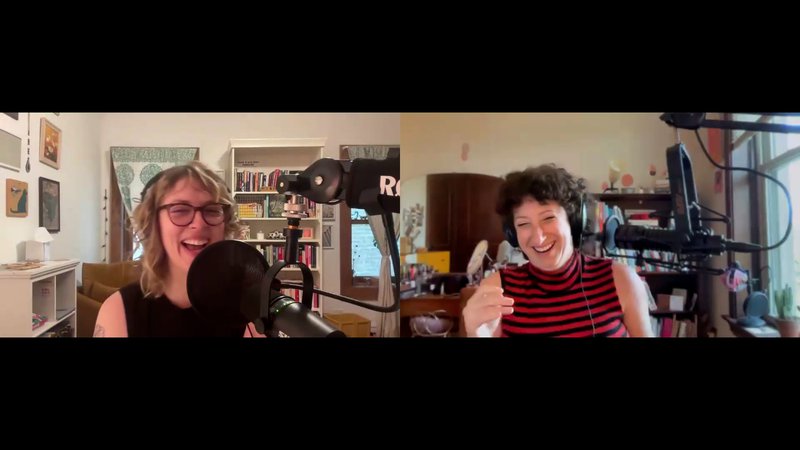
Greta Johnsen ( L ) and Alisa Rosenthal ( R ) chat over Zoom.
Read:
Listen:
The Official Game of Thrones Podcast: House of the Dragon
Edited and mixed by Alisa Rosenthal
Podcast story editing by Alexandra Quinn
Copy assistance from David Vish and Katherine Kermgard
Recommended Listening
- Podcast
- June 11, 2024
Inside Cartoons: The New Yorker, DIY Black Punk Zines, and More
- Podcast
- October 10, 2023
Ed Begley Jr. Steps into the Energy Efficient Spotlight
- Podcast
- April 3, 2024
Getting Schooled in Hip Hop with the Notorious Ph.D.
Become a Member
Being a member of the Chicago Humanities Festival is especially meaningful during this unprecedented and challenging time. Your support keeps CHF alive as we adapt to our new digital format, and ensures our programming is free, accessible, and open to anyone online.
Make a Donation
Member and donor support drives 100% of our free digital programming. These inspiring and vital conversations are possible because of people like you. Thank you!