From “Do the Right Thing” to “Black Panther,” Costuming Black History with Ruth E. Carter
S3E12: Ruth E. Carter
Apple Podcasts • Spotify • Overcast • Pocket Casts
The inspiring Oscar winning costume designer Ruth E. Carter looks back on her career as depicted in Art of Ruth E. Carter: Costuming Black History and the Afrofuture, from Do the Right Thing to Black Panther in conversation with Jacqueline Stewart, the Director and President of the Academy Museum of Motion Pictures in Los Angeles.
This episode originally aired on September 12, 2023.
Read the Transcript
[Theme music plays]
ALISA ROSENTHAL: Hey all, welcome back to Chicago Humanities Tapes, the audio arm of the Chicago Humanities live Spring and Fall Festivals. I’m Alisa Rosenthal. Today, the Oscar winning costume designer Ruth E. Carter - best known for costume designing Black Panther, and a multitude of Spike Lee films, and collaborating with Steven Spielberg and Ava Duvernay. For more information, head to chicagohumanities.org.
Ruth E. Carter made history as the first Black person to win an Academy Award for Costume Design and earned Marvel Studios their first Oscar recognition. She’s received Academy Award nominations for Malcolm X and Amistad, and received an Emmy nomination for her work on the miniseries reboot of Roots. Her other films include Do the Right Thing, What’s Love Got to Do With It, and Selma. Now, Costume designer Ruth E. Carter, in conversation with the Director and President of the Academy Museum of Motion Pictures in Los Angeles Jacqueline Stewart.
[Theme music plays]
[Applause]
RUTH E. CARTER: Hey everybody.
JACQUELINE STEWART: I mean it’s mind-blowing, the work that you have done. Just incredible.
RUTH E. CARTER: I've always been a storyteller. So if you sit at lunch with me, I'm going to tell you a story about some movie that had some incredible experience, experience. You know, just going to Egypt with Spike Lee and recreating Malcolm X's hajj in the middle of the desert. I mean, we couldn't go into the holy city of Mecca because the whole crew was not Muslim, but so we recreated it in another part of the desert. And here I am, 30 years old, in the middle of Egypt with, you know, on a Spike Lee joint. You know, it doesn't get much better than that. So I wanted to tell people about those experiences that happened on my journey before I forgot them.
JACQUELINE STEWART: Fair enough. So some people might think a costume designer is somebody who's interested in fashion. Are they kind of making a connection between fashion and costume design? And one of the things I've been learning from you, because Ruth is very active with the Academy Museum with the Academy of Motion Picture Arts and Sciences, and not only as the only Black woman who's won two Oscars. Let's just pause there.
RUTH E. CARTER: Thank you.
JACQUELINE STEWART: Incredible. But also, Ruth is a governor of the Academy, so she's part of the leadership of the Academy representing the costume designers branch.
RUTH E. CARTER: Very important.
JACQUELINE STEWART: And it's really important for people to recognize what costume design is. And so maybe you could talk about how you came to it because you came to it through theater.
RUTH E. CARTER: I came to it through theater, yes. And through theater I learned how to break down a script and to find a character's arc and to come up with a color palette. And, you know, the the the pace of of a of a piece. You really do experience that in theater. You go from start to finish. And, you know, there's this timing and there's this pace. You know, when you work with a theater director, you're you're dissecting not only the relationships of the actors on stage, but you're also examining, like the impact of the pace of a piece. And so I brought that into my film world, creating character arcs for the film characters. And, you know, I used to want to be an actress at one point. A thespian to the core. Yeah. I took my sophomore yearbook picture with the comedy tragedy mask. Yeah, I was I was one of those.
JACQUELINE STEWART: So this is at Hampton Hampton University? Yes.
RUTH E. CARTER: Yeah, yeah, yeah. So I had a whole like, you know, I had a whole I was one of those kids that could spend a lot of time in their room, like, create and stuff. And so I never wasn't, you know, people think that, you know, I got into this because I like fashion and I had dolls. And there certainly are a lot of costume designers that are, you know, successful and their origin story was fashion, you know, but mine wasn't. I just liked storytelling. I loved to read prose. Lorraine Hansberry, Sonia Sanchez, Nikki Giovanni, James Baldwin. I could read those works and I could see those characters. Those characters represented my my neighborhood or my past. And I thought they were incredible. And so I went into this wanting to work for companies and also act in some of these classic plays. So I was Beneatha in A Raisin in the Sun. I was Alberta in Sty of the Blind Pig. You know, I landed some roles and I got to understand the journey of the actor. So I feel like becoming a costume designer made sense for me because at home as a kid, I was creating stuff I was drawing. I have brothers is a long story. I'm sorry.
JACQUELINE STEWART: It's ok.
RUTH E. CARTER: I have brothers who are artists, visual artists. And so I was drawing and I was creating stuff in my room. And then I went to college and I was acting and understanding the actors journey of, you know, embodying a character. And so now I get to play all the characters. I get a script and I get to do an arc for every single one of them and and create their world.
JACQUELINE STEWART: That’s a beautiful, beautiful way to think about it. So let's talk about how you met Spike and what you learned through the process of working with him on so many projects.
RUTH E. CARTER: Yeah, I was in Los Angeles. I was working in South Central L.A. for a little dance company. I was doing their costumes and they were performing in the dance studio so people all over L.A. would come to see their performance. One, which was very popular, was to the music of Stevie Wonder and people in the music in the film industry, TV industry were coming. They were trying to figure out how to take this performance to television, you know, And I was their costume designer. And if you're in theater, you know that every performance you're there when you're the costume designer, you're also the wardrobe person. You're also, you know, doing the laundry. You're doing everything. And Spike Lee came with my friend Robbie Reed, who I went to Hampton with, and she was casting and I was talking to a friend about, you know, I'm in Los Angeles and I can't seem to get any theater work. But, you know, L.A. is not the place you would be looking for theater work, really. And so Spike Lee started talking to me after the show. We all hung out. We're all peers. We all hung out. And he was like, you know, go to USC or UCLA to the film studies department and sign up to do a student thesis film. He said, You'll be on a set, just like a Hollywood movie set with all the same equipment, and you'll get some experience doing that. And I thought, Why would I do that? I'm a thespian. I'm in the theater, you know? And what I did, I tried it. And on Saturdays I was volunteering on a senior thesis project at USC. And I thought, you know, there's two people sitting on the porch. I can barely hear them. Like this medium is odd compared to the English Cat or, you know, all of the classics I was doing in theater, but I thought it was something I could do. And Spike invited me to a screening of She's Gotta Have It. And I went to the screening. It was shot in black and white, and Nola Darling was walking down the middle of Fulton Mall in Brooklyn, and she had on a a regular top and a pair of shorts. Here I had been making bucket boots and doublets. I thought, I can do this.
JACQUELINE STEWART: Uh huh.
RUTH E. CARTER: And one morning, very early, before the sun came up, my phone rang. I answered, Hello? And the person said, Ruth. I said, Yes. Ruth? Yes. This is the man of your dreams. I said, Denzel. And they said, No, this is Spike. I want you to do my next film, School Daze. And that's how we got started.
JACQUELINE STEWART: Amazing. Amazing. Wow. So you got your first Oscar nomination for Malcolm X.
RUTH E. CARTER: I went by myself. I, we, we had shot the whole film in New York, you know, in the middle of the winter. And then when it was time to go to Egypt, you know, we ran out of money we the bond company came in on Malcolm X. You might have read about how Bill Cosby and Janet Jackson and people put money together for us to finish the film. And that was the part where we went to Egypt and Spike said, Ruth, you're the only one in your department that's going. And I was like, What? And I picked up an Egyptian crew. They were incredible. And I had this experience with them there in the desert.
JACQUELINE STEWART: Wow.
RUTH E. CARTER: That's why I wrote a book.
JACQUELINE STEWART: I mean.
RUTH E. CARTER: Oh, B.A.P.S. So Halle Halle Halle wears this rubber catsuit, right? So I read Robert Townsend's script, and I saw the scene where there's a bidet and I thought, Wow, wait a minute, water is squirting everywhere in the bathroom. So she should have on like, some rubber suit that she can't really get her balance in. So that was the start of that costume, just to just to make it even funnier.
JACQUELINE STEWART: I love it. I love it. I love it. Okay. So one of the things we can say looking across your work is that you have covered some of the major periods of Black history. Slavery, period. Also the civil rights era. And so it would be great to hear you talk about just your your background as a researcher because there is so much extensive research that you need to do in order to make these characters feel authentic to the time period.
RUTH E. CARTER: Well, I fell in love with the African-American history. I really wanted to see representation and I wanted to see. I worked at Colonial Williamsburg. I was an actress on the street. And I recreated the life of two real people that lived in in Colonial Williamsburg.
JACQUELINE STEWART: Wait, so you're saying you were one of the actors when you would go to Colonial Williamsburg and tourists come.
RUTH E. CARTER: Yeah you see the the Living History?
JACQUELINE STEWART: So you were portraying one of these historical figures?
RUTH E. CARTER: Yes, I was a free one woman was free. Her name was Betty Wallace and she was a seamstress. And she made the dresses for the Jefferson, the the, you know, the big people. And then the other character was Ginny, and she was a tavern maid. And she was behind a tavern in a garden. And you're you're assigned historians at Williamsburg. And the historian help you do the research on the character, and then you portray this character. And so as I was reading about my characters, I was like, wait, you know what? She's never going to be able to buy the freedom of her children selling these dresses. The. I was like, Wait, I have to tell the real story here. And as Ginny, the tavern maid, I was like, Oh, no, she didn't have shoes. She can't wear shoes. And I was wrapping my hair in a rag every day. And I was like, She's only going to be in the garden because she's probably cooking nonstop. You know? And so when the cook when the you know, this is a long story again, but when the guests came around, they would find me in the garden picking beans. And then I would do my monologue and I would tell them about this girl who worked for a tavern. Can you imagine? And those stories and more just really connected me to the humanity and the struggle and the triumphs of of my community, of the Black community. And also, I really wanted to tell the truth. I really wanted to be one of those people who could dig deep into the research and pull out the things that I think would be intriguing for the viewers to know about. And so that continued with Roots. And I have so many stories with Roots, with Selma. You know, Martin Luther King, David Oyelowo played Martin Luther King in Selma. And I made his collars a little bit tighter because King had this little bit of flesh that hung over the top of his collars. And I wanted David to sort of have that have that as well. So I tightened up the neck of his shirts. Yeah. And that, you know, part of like Dolemite, even just realizing that you're telling sometimes a story that you've lived, you know. I was a teenager in the seventies and I remember all of the nuances of the seventies, the Nik-Nik shirts and and the matador pants and the not only like the platform shoes and the bell and the bellbottoms. I remembered everything about it and I wanted it to totally come to life. So when you watch Dolemite and you see those scenes in the crowd, you know, that is all a part of the research.
JACQUELINE STEWART: You know, one thing I hope you can talk about is your work with actors, because so many of them talk about how the very act of putting on the costumes is so important for their process. And so how did you develop that skill of working with the actors to really bring out the character?
RUTH E. CARTER: Yeah, well, you know, I also took a course in psychology in college that came in very handy working with actors, and sometimes it's a reverse psychology, if you know what I mean.
JACQUELINE STEWART: I it.
RUTH E. CARTER: And but because I was an actor, I have a lot of empathy for them because I know that, you know, through fear, sometimes they can also dive into their character. And sometimes that manifests itself as, you know, I this doesn't feel right. I don't feel like this is it. You know, I feel their pain. And so I slowly get them integrated into the costume. And we have a consultation first, Mahershala Ali has said to me, you know, the my fitting is my first rehearsal rehearsal. Hmm. Yeah. Jeffrey Wright, he played he was in Shaft, the second one with Sam Jackson, and he was like this, you know, drug kingpin. And he really wanted to feel that. He wanted the costume to feel right on his body. So it wasn't a matter of like the article of clothing. It had to also make him feel like the character. And and, you know, with Angela Bassett, you know, I consider the fitting room like a transformation room. It's it's loaded with, like, the things that I like and the things that I think may not work, but put it in here anyway. And and we have all kinds of things around. So when they come in, they we are we're doing this initial break in period of just trying things on to see when we nail it. And Angela, you know, you can see her mind ticking, you know, and she puts on the queen's costume. And, you know, usually it's in a muslin, It's not really finished. And you see her kind of looking at herself. You know, she's not saying much or wondering if you've done the right thing. And, you know, I'm circling around her like some, you know, warrior or something. But it's a transformation and it's a and it's the time that I really feel like people don't know, like the work that goes into like the multiple fittings and the multiple layers that it takes to create these characters. Even Chadwick Boseman, we put on one of his Black Panther costumes. I don't know if you remember a black coat that had embroidery down the front. And when we first made it and I said, There's something wrong with this Chad, I don't know what he said. It feels like the Commodores, that's what's wrong with it. I said, That's it. It's the Commodores, you know? And you can't take yourself so seriously that you know, you're crushed by that. You go, you know, he's helping you. You know, it's a collaborative process.
JACQUELINE STEWART: Yes. Well, speaking of Chadwick. So let's talk about how you began to approach the Black Panther project, because these are preexisting characters. There's already some iconography, obviously, from the comics, from some other appearances and films. How did you try to bring in your collaboration with Ryan Coogler? A different approach.
RUTH E. CARTER: The first suit suit was seen in he was introduced in Captain America Civil War. You might remember that scene. He walks in with Florence Kasumba and we see the suit and it was put in Captain America Civil War at the last minute. So they built that suit really quickly. And in Black Panther One, we were going to see both suits in the beginning in the in the Royal Talon Fighter. We see him in the Civil War suit. So I wanted to see that suit in my office. I wanted to really see what went into a superhero suit because, you know, I had never done a superhero film before. And I brought it into my office and they put it on a mannequin. And I was like ehh, you know, Velcro, really? And and I said, bring Chadwick in. Let's have him put the suit on. You know, that's one way getting Chadwick in your office, right?
JACQUELINE STEWART: Not bad.
RUTH E. CARTER: Yeah. So Chad came in, he put on the suit. He started doing all of these stretches, you know, to kind of get himself into it. And he took the helmets and he put it on, and I was like, Oh, my God, the panther lives.
JACQUELINE STEWART: Mm.
RUTH E. CARTER: It was majestic. It was unbelievable. And then he said, Yeah, but, you know, in this helmet, you know, we made it fast. I can't breathe out of my nose. I was like, What? I can't lift my arm above this. I was like, No. And I said, Well, that's the first thing we're going to do, is we're going to recreate a suit that, you know, for your film. And we made the helmet so that the front of the the the there's a little trapdoor in the front of the helmet that comes off that he wore. He wore it with the little trapdoor off for most of the film so he could breathe. And then in post, they put it back on. So you never see it without it. And then for the suit, we learn the hard way. Every time he came to set he would blow his pants. And I was like, This is not a good look for the Black Panther. And we got a girl from the Boston Ballet to come down and to re cut the suit with the proper gusset for all of the moves that he had to make.
JACQUELINE STEWART: Amazing, amazing. So, let's look at some of your research and design process.
RUTH E. CARTER: Yeah, the Mining Tribes. You know you've all heard of vibranium, right? Yeah, it doesn't exist. But the Mining Tribe, they mined all the vibranium. And one of the things that we presented to Marvel were these tribal illustrations. And I think there's a few here. Yeah, these are the miners. And we wanted to show, you know, a different way of them moving forward because we we wanted to honor the tribes. You see the tribal elders in the front, in the mining tribes. It's a woman. And then we also wanted to show how they were a forward thinking, a nation of forward, forward, forward in technology. That's the whole part of Afro future. So there's modern. There's maybe another one here. Nope. Oh, okay. So yeah, And then we did we incorporated technology 3D printing. So this is the isicholo, which is the South African married woman's hat that was worn by Queen Ramondo.
JACQUELINE STEWART: Wow. So taking the philosophy of the characters. Yeah. And then building that into the actual process of making the costume is incredible. And your costumes also have to be able to work with in tandem with CGI. I mean, you might imagine that for some of these details, they could have just done it on the computer. Like, why was it important for Ryan for you to go to this level of detail?
RUTH E. CARTER: Yeah, I think James Cameron gave costumes a bad name. Sorry. Because you know those mocaps. Sure. Everybody knows what those are. The mocap suits. Um, there was a rumor in the beginning of Wakanda Forever that came to me and someone said, Oh, don't worry about doing any of the costumes for the underwater people, because they're just all they need is mocap suits, and they'll create the costumes in post. And I thought I was crushed because here we have this whole society that's based on Mayan culture. And I was, you know, into the research of it all. And so I went to VFX visual effects, the head of visual effects, Jeff Bauman, who was also nominated on this, and I said, Are you seriously going to make all of these looks in post? He was like, No way. He said, Ruth, you do you. And then we will we will follow that. So we made all of these costumes practical. All of these costumes were molded and made. Yeah, it's a lot.
JACQUELINE STEWART: It is a lot. And just hearing you talk about this, the historical research that you do. And, of course, you know, in your book, you talk about the Afro future. This was an opportunity for you to also think about indigenous futurism.
RUTH E. CARTER: Yeah. Mesoamerica. And we had to have a, um, a historian with us at all times. It was not unlike my experience at Colonial Williamsburg, you know, working with a historian and going back to them and asking them questions. And they were, you know, very open to it. Now, a name was headpiece was crafted and was not shown to the historian until it was, until it was at this stage. And he said it was the wrong era, that we were showing an image of something that was predating when we should be in post classic. It was very classic. And I was like, What? So we remade it. Wow. In a week. Just the front, the nose. So it's the feathered serpent. And when you see the feathered serpent and what kind of forever it has, the it's it lands, right and pulls classic.
JACQUELINE STEWART: So we have time for some questions if you're open.
RUTH E. CARTER: How many of you saw Black Panther One. Right. And how many of you have seen the Panthers series? More than once. So you must have questions. Good.
AUDIENCE MEMBER 1: Hi, I'm Marquisha. And what I would like to know is how you how do you stay focused? Project after project?
RUTH E. CARTER: Well, uh, um, someone told me once, Ruth, when you're focused, nobody can beat you. And I never forgot that. And so even, you know, what takes you out of your focus is to not be immersed in the project. So even within the project where you're getting a thousand questions a day and you have several of the components happening at all times, I have support. I have a team there that supports me and schedules schedules me time, you know, schedules time where if I need to delve into answers through research, I have time allotted for it. And it's very strict. I didn't think I would be that that artist. But the more that even when I do my own art, I realize that the only way that you can produce something of this magnitude is to give it its due time and focus. And that's every day, every day, hours and hours every day. So what suffers, I guess, is my private life, you know? Like, oh, God, who's going to do the dishes? There's nobody around. You know, just little things like that. You know, I talked about over Christmas holiday, we we shaved 150 blankets, you know, So the thing about movies is, though, it's a it's a very finite amount of time. You know, you have a three month prep usually and a three month shoot. So it's six months of your life that you're going to do something. Hopefully, that represents you as an artist, represents your style, your signature, your voice. So you really want to delve in and give it that focus. But I, you know, and I also I breathe, I do yoga, you know, I give myself 45 minutes in the morning of meditation.
JACQUELINE STEWART: Well.
RUTH E. CARTER: Not every morning. It’s honest.
AUDIENCE MEMBER 2: So you basically created the foundation for what is Black Hollywood with Denzel, Laurence Fishburne. You know, all those people kind of grew up and became the stars and royalty. And then at the end, you're with Ryan Coogler, who was at the at the edge of this spirit of what the new black Hollywood is. And with Marvel, where the budget has totally sort of opened up. Can you talk about your experience or the difference between dealing with Spike and then dealing with Ryan, who was sort of more of a up and coming director? What was the difference in your experience?
RUTH E. CARTER: Yeah, thank you for your question. You know, I felt quite fortunate to have had the experience like I have had with both of those directors of 15 films with Spike Lee and the Black Panther series with Ryan Coogler. But when I went into the Marvel offices, you know, it's like the CIA, you know, they blow air in your eye and all kind of stuff. I went in there and I had amassed all of these images, like on a drop box, you know, And you cannot open a drop box at Marvel Studios. You know, they have like a firewall. And and Ryan is sitting in front of me and Nate Moore, the other executive, is sitting beside him and I'm on my laptop and I'm trying to pay attention. You know, this is an important interview and I can't open the drop box. And Ryan says to me, Ruth, I'm really glad you're here. I was a little boy when I went to see Malcolm X. I went with my dad and I sat on his lap. And he said, and I remember it was that there was an energy in the audience waiting, anticipating this film about Malcolm X and families were there, you know, kids were there. And he said, and I remembered the costumes. So I felt like I had interviewed for Black Panther when he was a little boy. But the fact that we as filmmakers at 40 Acres and a mule were saying, which was Spike's credo, representation is important. Uplift the race. That was from W.E.B. Dubois. He was saying things to us. We don't we do not see ourselves in front of or behind the camera. We have to do films that represent a new generation, a new era of filmmakers. And then look, here comes Ryan Coogler. So I was in the sweet spot. I was able to hear from his mouth that he grew up watching not only, you know, my films, but our films as as he admired Spike Lee.
JACQUELINE STEWART: Ruth, you have given us so many lessons today. I'm so grateful. Thank you.
RUTH E. CARTER: Thank you.
[Applause]
[Theme music plays]
ALISA ROSENTHAL: That was Ruth E. Carter with Jacqueline Stewart recorded live at Chicago’s historic Music Box Theatre in Spring 2023. Head to the show notes at chicagohumanities.org for a link to check out her absolutely stunning coffee table book. The images of her costumes and the writing of the history surrounding them are all gorgeous.
Chicago Humanities Tapes is produced and hosted by me, Alisa Rosenthal, with help from the awesome staff over at Chicago Humanities. Shout out to the wonderful staff who are programming these live events and making them sound super crisp. For more than 30 years, Chicago Humanities has created experiences through culture, creativity, and connection. Check out chicagohumanities.org for more information on becoming a member so you’ll be the first to know about upcoming events and other insider perks. You can also check out our backlog of episodes, available wherever you stream your podcasts. We’ll be back in two weeks with a brand new episode for you. But in the meantime, stay human.
[Theme music fades out]
[Cassette tape player clicks closed]
SHOW NOTES
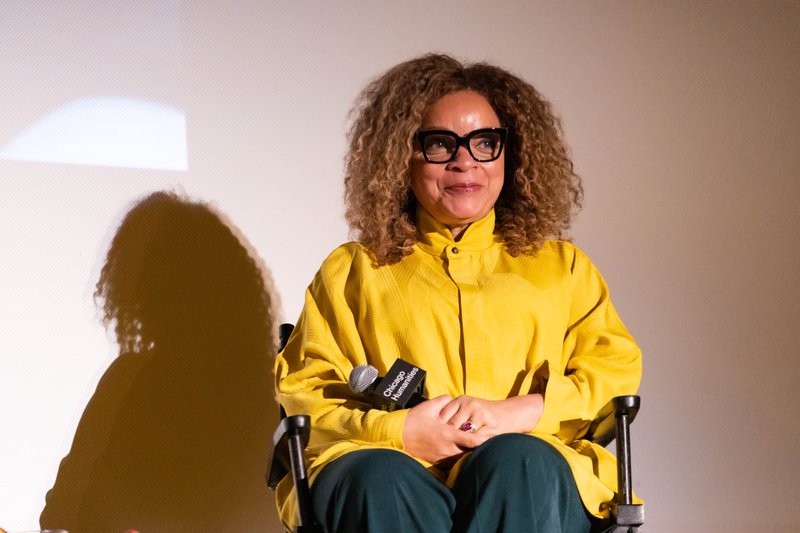
Ruth E. Carter at the Music Box Theatre as part of the Chicago Humanities 2023 Spring Festival.
Ruth E. Carter, Art of Ruth E. Carter: Costuming Black History and the Afrofuture, from Do the Right Thing to Black Panther
Recommended Listening
- Podcast
- May 14, 2024
Martin Luther King Jr. by Chicago’s 2024 Pulitzer Prize Winner Jonathan Eig

- Podcast
- April 30, 2024
Mini Tapes: Guidance from the Afterlife
- Podcast
- Nov. 7, 2023
Life Advice from Your Film Dads: Harold Ramis (2009), John Waters (2022)
Become a Member
Being a member of Chicago Humanities is especially meaningful during this unprecedented and challenging time. Your support keeps CHF alive as we adapt to our new digital format, and ensures our programming is free, accessible, and open to anyone online.
Make a Donation
Member and donor support drives 100% of our free digital programming. These inspiring and vital conversations are possible because of people like you. Thank you!