Frank Bruni Invites You to His Buffet of Grievances
S3E15: Frank Bruni
Apple Podcasts • Spotify • Overcast • Pocket Casts
Frank Costanza of Seinfeld made “the airing of grievances” into a holiday. Renowned New York Times columnist Frank Bruni has elevated it to an art. Bruni brings his signature thoughtfulness to examining America’s obsession with the joy of taking offense. Joined by Interfaith America’s Eboo Patel, topics include Fox News, the success of LGBTQIA+ activism, and how unity is essential to a well-functioning society.
Read the Transcript
FRANK COSTANZA: The tradition of Festivus begins with the airing of grievances. I got a lot of problems with you people!
[Theme music plays]
[Cassette tape player clicks open]
ALISA ROSENTHAL: Hey all what’s going on, this is Chicago Humanities Tapes, the audio version of the best of the live Chicago Humanities Spring and Fall Festivals. I’m Alisa Rosenthal, and today, we’re bringing you prominent New York Times columnist Frank Bruni on his new book The Age of Grievance. He explores just what feels so good… and bad… about grievances big and small, political and petty - and what this means for us as we all share differences in a society that could use some unity.
A full professor at Duke University in the school of public policy, Bruni has served roles as diverse as op-ed columnist, White House correspondent, Rome bureau chief, and chief restaurant critic. He chats with Eboo Patel, founder and president of Interfaith America who served on President Obama’s Inaugural Faith Council.
For more information on our speakers, head to the show notes, or check out chicagohumanities.org, where you’ll also find ticket information on our upcoming live Fall 2024 events. We’ve just announced tickets to our upcoming neighborhood days - coming to Pilsen, we have incredible voices like celebrity stylist Law Roach (who styles Zendaya among many others), a day of interactive events with Chicago Humanities’ artist in residence Alberto Aguilar, and poet aja monet at Thalia Hall. And at the University of Illinois Chicago, Connie Chung, Erik Larson, and so much more. Tickets are on sale to members beginning August 20th and to general public August 22nd, so head to chicagohumanities.org for more info on becoming a member.
This is Frank Bruni with Eboo Patel, live at the Chicago History Museum at the Chicago Humanities Spring Festival in April 2024.
EBOO PATEL: Frank, welcome to Chicago.
FRANK BRUNI: I'm delighted to be here. Thank you. Thank you for doing this.
EBOO PATEL: I've been following your Twitter, and I see you've already made it to some of our best restaurants.
FRANK BRUNI: I went to Monteverde last night. Yeah.
EBOO PATEL: Lucky you. Lucky you.
FRANK BRUNI: Great place. Yeah, I know, very lucky me. Yeah.
EBOO PATEL: Good for you. So I have to say, you had. You had a very special place here. I don't know if I'll feed you as well, the Chicago History Museum, but this is this is quite an institution. I always recommend people who come into the city come to this place. And I have to say that it's particularly special to, to me because my organization back then, it was called Interfaith Youth Core. We held our first real program in this room back in 2003, 2004. So so we're back, by the way. It's a lot fuller now than it was back then. Just to let you know. So Frank and I had a moment backstage, where I was saying to him, you know, I've been reading you for... And then we both decided not to guess the number of years. But it's been a long -
FRANK BRUNI: Let's just say a couple.
EBOO PATEL: That's right.
FRANK BRUNI: And make me feel young. Not old. Yeah.
EBOO PATEL: Well, let's not make you feel old, but let's say that you have represented a viewpoint of sanity for a very long time in American Letters, and we appreciate that. Generosity and sanity.
FRANK BRUNI: Thank you.
EBOO PATEL: I also want to say special thanks to you for writing the book Where You Go is Not Who You'll Be because my two wonderful boys are not far from college age. And I'm hoping that you save me a lot of money, because there's a lot to be said for flagship state institutions.
FRANK BRUNI: Yes, I agree. Big fan of them.
EBOO PATEL: So I love the book The Age of Grievance. Thank you. And one of the things, as I was reading the book for a second time this past weekend, and it is that good to read it twice. It is that good. One of the things that that, that that struck me was, you know, there's all of this conversation about how the left and right lived not only in two different planets, but two different galaxies. But you have found the bridge. Everybody's always complaining.
FRANK BRUNI: Everybody's aggrieved. Yeah.
EBOO PATEL: Everybody's always complaining. So.
FRANK BRUNI: I'm a force. I'm a force for unity.
EBOO PATEL: Right. Exactly. One of the things I love about the beginning of the book is this set of ridiculous, often inaccurate grievances. And I just thought it might be fun to begin with the question, which grievance, one from the left, one from the right, do you think is like, the most ridiculous? Like the biggest eye roll, like eyes rolling out of your head kind of eyeroll?
FRANK BRUNI: I have a sadly, there's so many grievances, such a buffet of grievances to choose from. I like my food metaphors. I'm just going to give you two that come to mind. I'm going to I'm going to mention the one that starts the book, which is from the right, which is, there was a moment in time, a couple of days when Fox News was going crazy with this notion that when there was a shortage of formula for infants in the country, the Biden administration was giving it out for free to migrants at the border, to people who'd been detained, having crossed the border. And Fox News went to town on this for several days, and they showed these images of these supposedly. So there's a box of formula, you know, stockpiled at the border for for them, not for you, not for real Americans, but for those interlopers. And if you just, and I can't take credit for this, somebody CNN did it, if you just zoomed in on the cartons, it showed that they actually weren't infant formula. It was powdered milk for children between the ages of one and three that was not in short supply. But on Fox News, it was just so tempting, in this age of grievance of ours, to turn this into an us versus them narrative, to turn this into a story of how you're being deprived because somebody else is getting something that they don't deserve. And it's so emblematic of the way these debates, debates is not the right word for them, but the way these things play out. [61.7s] That's one from the right. And like I said, there's a buffet to choose from. From the left, this isn't in the book, it happened more recently, but I teach a course at Duke called The Age of Grievance. I've taught it twice now. And a student came in shortly after the eclipse and said, Professor Bruni, you've told us to keep our eyes peeled for the sorts of ridiculous grievances that pop up in contemporary society. And I think I have one for you. And I said, what is it? And she showed me a tweet in which someone said that the eclipse was just another example of how people who don't plan ahead are marginalized because there's a shortage of glasses, and it's not fair. [28.7s] You know we're all we're all laughing, but I mean, and we'll get into this. But it's a serious thing. There's this there's this itch in modern society to look at any set of circumstances and to try to see where you've been wronged, whom you should be angry at, what you should want to do to punish them. So these I mean, these are funny stories, but they're emblematic in a way that's really, really scary.
EBOO PATEL: Yeah. I want to get to why this is a problem later. Right. But as as I read that, I was like, am I in the fiction section because because this could not have happened, but actually it did happen, right? And in any normal circumstance or any normal household, in fact, we went through this, our household, right, like the night before the eclipse. We're like thinking, okay, we need to get eclipse glasses, the eclipse glasses, and and, my wife's like, we should have planned ahead. Like, that is the normal response to not having eclipse glasses.
FRANK BRUNI: But you were not aggrieved by it.
EBOO PATEL: I - no! It was our fault!
FRANK BRUNI: You did not take to Twitter.
EBOO PATEL: That's right.
FRANK BRUNI: That's called that's a that's called maturity. Right.
EBOO PATEL: So I mean, one of the, one of the things about reading this book and you and you articulate this well, you know, like, listen, we're also a nation that has been built and improved by the articulation of grievances. The grievance over the tea tax in 1776. The grievance over the ugly, deepest sin in American life: slavery. Right. The grievance over the absence of women's suffrage, the grievance over Jim Crow. So tell me, as you were writing the book and kind of thinking it through. What category in your mind, like what distinguished grievances that ought to be addressed through the articulation of the grievance. Right. Like, there's no analogy of like, well, I should have planned ahead.
FRANK BRUNI: Right.
EBOO PATEL: Right. Vis a vis women's suffrage or Jim Crow. And and, it is your fault for buying -
FRANK BRUNI: The tea tax would have been fine if I just budgeted for it.
EBOO PATEL: Right. Exactly right. So do you actually have different terms in mind?
FRANK BRUNI: Well, yeah. I mean, it's interesting because as you're talking so the word grievance used to have, not such negative connotations. In fact, the First Amendment has the word grievances right in it. And it's mentioned as like something you are entitled to have it redressed, you know, like there's a you you should be able to seek redress from grievances and all of that. I don't think today we would call any of the things you called grievances grievances, because now the word has a negative connotation that is exactly in sync with how how complaints have kind of metastasized and proliferated and how we're losing sight of what is a righteous cause and what is just kind of a petty inconvenience. So I think now, like, if you, if you just kind of watch for the next week, every time you see the word grievance in the news and you would see it more than you think, it's almost always written with an air of disapproval for someone who's finding a way to complain about something that perhaps doesn't warrant the complaint. [36.8s] But what you're talking about, I think in today's parlance, we would call causes, right? And yeah, we're a nation born of grievance. And if you are, there are so many situations and you mentioned some of the biggest ones in history where people have been treated horribly, have been the victims of unacceptable injustice and have said, wait a minute, I won't stand for this. You shouldn't, you know, I shouldn't be put through this. Here's what I want done. Here's what you should want done for for me and for the country as a matter of morality and conscience. And those are really important. I think we're in a place now where it's hard for people to hear the legitimate causes, the legitimate requests for for correction of injustice, because there's just such bedlam and such cacophony in the public square, and everything is so jumbled and mingled together. You know, the, the, the people without eclipse glasses being marginalized as late planners, you know, is being jumbled together with much, much more serious stuff.
EBOO PATEL: So. So in your mind, how do you think about, let's call them legitimate causes. Actually, I'd love your term for it. Right? Is the term cause cause versus grievance? Like like build us. Build us some categories here. Things that are worth us making kind of a public complaint about or a public address about versus thing where it's like, plan ahead.
FRANK BRUNI: So, I mean, we need obviously we need to continue having discussions. Call it a cause, whatever. We still live in an era of racial injustice. No no right minded person can say that we have reached a golden age of equal opportunity for people, regardless of their skin color, regardless of their ethnicity, regardless of their religion. We're still working toward that, toward the more perfect union and all of that. What concerns me is when people, like, attach some of those matters of injustice to the wrong set of circumstances. It gives a way for people who want to resist change to just tune them out. [30.1s] I'll give you I'll give you an example. It's a minor one, but again, it's emblematic. I remember when Brittney Griner was unjustly imprisoned in Russia. Right? That was ridiculous. And, and and there needed to be, more than a fuss about getting her freed and all that. I read a number of columns, in the, you know, by left wing writers, left wing press, and saw a lot on social media where people were claiming that she was languishing in a Russian prison because nobody in Washington or in America cared about her or was sensitive to the situation because she was a woman, because she was lesbian and because she was Black, right? Now. Do I think we need to do better by women, by Black people, and by LGBTQ+ people in this country? I do. Do I think Brittney Griner was, forget, forgotten for those reasons? No. We knew more about her as a political prisoner because she was a celebrity, then we knew about Paul Whalen, who'd been there, I think, for five years, who's still in a Moscow prison, but wasn't a celebrity. And his name only came out in conjunction with hers. There were grievance entrepreneurs, and that's a big part of the problem who just take their lens of like, where am I seeing sexism? Where am I seeing racism? And then they see it in places and in instances where it actually doesn't exist. And the problem with that is it's sort of like the boy who cried wolf. If you if you claim you see sexism, racism, homophobia, Islamophobia in circumstances where a right might or a reasonable person says, no, that doesn't attach there. It makes them think, okay, these complaints are overblown across the board. Let's just turn them out. Yeah.
EBOO PATEL: So I want to spend a moment on this. By the way, "grievance entrepreneur," is that in the book or did you make it you because it's very good. Like just as a fellow writer I just want to like underscore excellent phrase.
FRANK BRUNI: So I lose track. I think it's in the book, but I know that one of the assignments this semester was to write about a grievance entrepreneur. So it's in the syllabus if it's not in the book.
EBOO PATEL: Okay. But it's got but it's yours.
FRANK BRUNI: Yes. It's mine. Yeah yeah.
EBOO PATEL: All right. We're going to attach it to FRANK BRUNI:.
FRANK BRUNI: Some which I will, I will I will lay proud claim to the title.
EBOO PATEL: Excellent. So, I want to just kind of sit in this question of like, why is this bad? Why is this bad? Right? And one of the things that it kind of strikes me is I talk about this with, with my, my family is, is there's so much attention right now within kind of grievance spaces and the problem of Islamophobia. Islamophobia is a problem. Of course it's a problem, right? But Islamophobia is not what makes me Muslim. Islam is what makes me Muslim, right? And there is a problem if you are constantly asking young Muslims, how have you been affected by Islamophobia and never asking them, how have you been inspired by Islam? [30.7s] Yeah, right. You're like missing the most important thing. And it kind of feels like we have we have we are more interested in the forces that are victimizing people, rather than the way identity is viewed as a source of pride. And frankly, in the vast majority of homes, people's identities are viewed as a source of pride.
FRANK BRUNI: Yes, yes. So you've just named one of the reasons this is a problem, because it inverts that. Also, if you are encouraged by the culture or if you go out into the public square and it's constantly about, here is my identity group. And here's what's not happening from my identity group, and here's how I've been aggrieved and here's what I'm owed. You're also erecting all of these boundaries and lines of division between you and everybody else. We are spending less and less time talking about the collective good, because we're so enraptured with what each group is going through and what that group is owed and what it's demanding. And it's, it's it needs to be proportional. If it feels too often these days, like, every interest group is positioned and competing against the other, and that sends a message that's antithetical in some ways to pluralism, to the civic good, to the collective good. I just don't hear many people talking about, well, in this situation, what's best for the country, what's best for the largest number of people, what's most moral for the largest number of people, I hear. You know, look at how the media covers a politician who's coming out like when a campaign starts. I always read the story, like how this group is likely to feel about this politician, what this politician is or isn't saying to this group. The message of that is that we're all divided up and we're all looking for different things when I think most of us are looking ultimately for the same thing. And I just think it can be a very divisive, divisive force.
EBOO PATEL: John Hyde calls this common humanity, approaches versus common enemy approaches.
FRANK BRUNI: Right.
EBOO PATEL: One of the things I think that that one reason that this way of thinking is negative. But let's stay on this for a minute is because you lose perspective, right? So there are 8 billion people in the world. Half of them live on less than $7 a day. 1.5 billion people live with parasitic worms. This is your colleague Nick Kristof, who writes on this. Right.
FRANK BRUNI: And for a minute, I'm like the segue from parasitic worms to Nick Kristof was feeling a little bit like what?
EBOO PATEL: But it doesn't surprise you at all that he would he would bring that to the fore right?
FRANK BRUNI: No Nick is Nick is Nick is a national treasure.
EBOO PATEL: But I, you know, I remember, my own kind of age of grievance and age was, you know, I mean, like, in terms of being late adolescent, early 20s. And I am in a taxi cab with my dad in, in Bombay, India. And at the time I was a graduate student at Oxford, and I was feeling very out of place. And so I like, dressed it up with all these fancy terms, right? Like, you know, this is the heart of the colonial enterprise and it doesn't know what to do when the empire strikes back. Being an Indian student at Oxford, being super fancy, like I'm pulling out Spivak and Said, you would have been very impressed, right?
FRANK BRUNI: I'm impressed. As I sit here.
EBOO PATEL: Thank you, I have, and my dad gives me this look. And then he points out the window to one of, like, the 500 leprous beggar children on the street. And he's like, if you're oppressed, what word do you have for that kid?
FRANK BRUNI: That's right. We've cheapened the word oppression. We've cheapened the idea of oppression. And, you know, you were talking before about how to distinguish between a legitimate grievance or a righteous grievance. I think the more interesting distinction is how you render your complaint. Right. What is a kind of constructive way and not a divisive way to do it? And what's the opposite? One thing I write about in the book, of the many things I'm not aggrieved by in my lifetime, I have seen this country change so profoundly and in such a positive direction when it comes to the treatment and the acceptance of LGBTQ+ people. When I was a teenager and I realized I was gay, if you had told me, that in my lifetime I would see same sex marriage, marriage equality, coast to coast, you know, etc. I would have said, that's crazy. And for a long time, that was nowhere in the foreground of the gay rights movement, because it was seen as like, utopian and ridiculous. Obviously we got there. And if you go back and you look at how that happened, one of the big ways that happened is the main conversation, the tenor of that wasn't "here's how hideously wronged we are, here's how evil you are for depriving us of this." It was "we really want in on what you have. We want to join this tradition. We so respect the values of this institution. We're so like you in the sort of commitments we want to make, you know, and in this sort of sacred sacredness with which you want to imbue that, that we would like to join this that was" I mean, there were all sorts of voices and not all of them said that. But if you go back and you look at what the main argument was, the preponderance of conversations, that's what it was. And it kept in beautiful harmony. This this request by one group and the whole society and the collective good. And, and I think that's an example of how to again, grievances is a tough word these days, but how to press a grievance in a way that rights an injustice that makes us all better and that never loses sight of the collective good and doesn't demonize people. Right.
EBOO PATEL: Yeah.
FRANK BRUNI: No one was saying, here's how bad you are for not allowing this. They were saying, here's how much better you could be. I wish we would have more conversations when we're addressing the variety of injustices in our country in that vein and in that tone.
EBOO PATEL: So let's pause here for a second, because I was actually I was an undergraduate at, when the, movement for gay marriage was gaining traction. So Andrew Sullivan writes his book in the late 1980s on this. I'm an undergraduate at the University of Illinois in the early to mid 1990s, and I actually heard lots of accusations against gay marriage from my very progressive and gay -
FRANK BRUNI: Yeah that's right.
EBOO PATEL: Hetero patriarchy, etc. etc.. So the way that. The way lots of other things I can barely pronounce. But I said I said with utter confidence at the time, I'm sure. So I, I want to, kind of dance with you on this a little bit. So what do you make of Stonewall? What do you make of what do you make of Act Up? What do you make of of the range of, frankly highly romanticized, very kind of in-your-face pushes that lots of people say laid the foundation for the, as you put it in your recent New York Times op ed piece, the ability to ask, quote unquote, politely rather than to shout in people's faces for something that, you know, frankly, just is quite sensible, which is everybody should have access to the institution of marriage.
FRANK BRUNI: Yeah. No, I mean, I think Act Up, and I knew a lot of people in Act Up, had a lot of friends who were participating in it. I think it did it did actually did some good because there were a lot of people who didn't even know what AIDS was until they saw those protests. I'm not sure, you know, we can't kind of, like, measure this thing over time. I'm not sure if some of what they did at times was not bringing things forward. But I'll tell you, like, I want to focus on the positive here. I want to I want us to not be aggrieved. No, but I'll tell you what I think you know, and this is this is maybe a controversial statement among among some gay historians and gay activists. I'll tell you what I think did more good than Act Up: the AIDS Quilt. The AIDS Quilt. When when you had people all around the country memorializing people who had died. Right. And then when you had that all strung together and you had it covering the Washington Mall, a) this sort of like, for lack of a better word, the language of that visual, which is now like they just mixed two metaphors or mixed a bunch of stuff. But I mean, that was there's something about the idiom of the AIDS Quilt that I think spoke to Americans across region, across religion, across class. It was a visual demonstration of the toll that this had taken. It was homespun in a really beautiful way. You know, I think there's a lesson in that.
EBOO PATEL: So, I'm going to demonstrate this for you. So I grew up 25, 25 miles due west of here in a town called Glen Ellyn, Illinois. When I was growing up in the 1980s and early 1990s. It was not the most cosmopolitan place. I was always embarrassed about, you know, my grandmother's sari, and playing smear the queer was, like, common on the playground. Okay. I get to the University of Illinois in 1993, and the university brings the AIDS Quilt. And I remember just happening to walk through the Illini Union and happening to stop into Illini Room A and looking at these panels and like 11 panels in, I am weeping and I am like, deeply embarrassed about the things that I said, frequently growing up. It changed my life.
FRANK BRUNI: Each of those panels not only showed you someone whose life was lost, but it told you how many people loved that person.
EBOO PATEL: Yeah.
FRANK BRUNI: Right. And how many people were diminished. I'm going to cry now. How many people were diminished by that person's death.
EBOO PATEL: That was the same year that "Philadelphia" came out. And Springsteen writes the song. Right. And Neil Young writes and and it was I remember this is 35 years ago. And it was deeply, deeply moving to me. And it was because somebody reached out and took my hand instead of put a fist in my face. [6.8s]
FRANK BRUNI: And if Philadelphia came out today, there might be boycotts of it because Tom Hanks, a straight actor, was playing a gay man. No, that's not that's also not a joke! Not a joke.
EBOO PATEL: That is. Yeah. If you are looking for grievance, you are not finding other things. "Philadelphia" requires you to sit through the movie as an inquiry, not as a judgment.
FRANK BRUNI: Yeah, we're into condemnation, we're not into grace.
EBOO PATEL: Yeah, and you just learn less, right? You connect less and you learn less.
FRANK BRUNI: I live I live in a family, with a range of political views. I have, I have relatives who not only voted for Trump in 2016, but who voted for him in 2020. And please forgive me. I don't mean to make this political, but I don't want to know what they're doing in 2024. I like to digest my food at the Thanksgiving table. But my point is, what we're able to do as a family, is see each other in multidimensional ways, to see each other as larger than just politics, to understand that everybody around us, has has aspects that resonate with us that we approve of and others that we don't. And life is complicated and human beings are complex. And I know so many families talk about this a lot in my in my class at Duke this semester, the Age of Grievance class. So many families find a way to extend grace to one another, and to see each other in the kind of, in the most nuanced way, and in the most forgiving light. The family of America seems unable to do that right now. And that's what I would like our conversation here, that's what I would like my book to nudge people a little toward. I'm not saying let go of your principles. I'm not saying don't fight for your principles. I'm not saying, you know, make your values a negotiable thing or whatever. But as you kind of navigate the public square, just hold on to a measure of grace.
EBOO PATEL: That's it. So I want to, I love this, I want to stay here for a second. So. So one of the things we like saying it at Interfaith America is the only way to have a diverse democracy is to be able to disagree on some things and work together on other things. And one of the things that I used to say when I was younger and aggrieved, and I hear a lot of people saying right now is, well, everything is political. I need to make, a political statement about everything. And I think to myself, sometimes I'm like, is everything political, really?
FRANK BRUNI: I mean, if everything is political, it's an exhausting way to live. But it's also exactly the kind of thinking, that paralyzes our Congress and means we don't get kind of basic things done that really an overwhelming majority of people agree about. No one wants to give the other side a win. It's all tribalism. And it's all like, yeah, I may agree with you on this, but if I join forces with you on this, you're going to get a win, you know? And that's not going to be good for my team. So forget about the merits of the issue. Let's just let's just kind of approach this in a completely competitive and tribal way. That is antithetical to making basic progress, as a country, and we're trapped in it. And, I mean, you see it in our politics for about ten, 15 years, and and I don't have the timeline perfectly, but it hasn't been that long that there have been a lot of discussions about negative partisanship, a term that, you know, in widespread use is not that old. We're beyond negative partisanship to something I think of now as apocalyptic partisanship. Right. If you look at so many of the most bitterly fought political campaigns, whatever else the candidate is saying, he or she or they are saying first and foremost that my opponent is evil, my opponent is going to be the end of the world. You must vote for me because you must vote against that person, right? If you end up if both sides in a political campaign are saying that person is the end of days, that person is the end of us. Vote for me simply as a hedge, an obstacle against that person. Then if that person wins, how does he, she or they govern? Right. Because you're not saying, like what happened to the era when I mean, go back to 2000, this is how much we've changed. Can you imagine anybody in today's climate doing what Al Gore did in 2000, and saying at a certain point, okay, this fight has gone on long enough. I and my side my side still think we probably won the state of Florida. We won the popular vote. But at this point in time, the country needs to move on. And he did that with grace. And he didn't spend the next several years relitigating it or saying, woe is me. He went on and made other positive contributions to society. Contrast that with a certain person who legitimately lost the presidential election in 2020.
EBOO PATEL: Well, I mean. John McCain in 2008. Right? Like, go back and watch that concession speech as he opens by saying this country just did something remarkable.
FRANK BRUNI: Or better yet, and this is this is in the book, I think it's certainly, it's a it's a bit of footage I played my students this semester. Go back and look at that famous moment when John McCain was doing a rally right in 2000, in 2008, and someone said, you know, about about Obama. He's not he's not a family man. He's he's a Muslim. He's this, that, whatever. And John McCain stopped and said, no, ma'am, no, he's a good family man. He loves his country. We have differences of opinion. I think I would be a better president. But he's a good man. That's another moment like Al Gore's concession that I think it's hard to imagine playing out the same way today.
EBOO PATEL: That used to be normal, right? That that's like that's like I mean, one of my favorite moments in American life is when, basketball players hug each other after the game is over, when football players hug each other after the game is over. Right. You have gone at each other for for hours, in, in very physical ways. And now you're congratulating. I love that right. You cannot have a diverse democracy with that without that kind of ethos. So, Frank, who do you have lines of people you're not talking to? You're talking to Cousin Al at the Thanksgiving table, right? Who who might have voted for Donald Trump? So I like to say, I'm not buying a brownie from the KKK bake sale, but I'm talking to everybody else, right? Do you do you have lines? Do you have lines?
FRANK BRUNI: I mean, yeah, I, you know, I mean, it's like when you talk about free speech on campus, I would not invite someone, who is a committed and florid and outspoken, white separatist neo-Nazi to campus. I would not I would not seek out a conversation with that person because it's pointless. If that person were in front of me, and that person say, like, had a heart attack and needed help, would I help that person? Yeah, because I'm a human being, you know, it's a gesture of humanity. I don't I don't think we can talk to everyone, but I think we can talk to most people. And I think we're better served by talking to them. Because you just never. You just never know what somebody is going to do. And when somebody is going to surprise you. I mean, look, recently, it's a it's an isolated instance. Maybe it won't be. I hope it won't be. But look, recently what happened in Congress with Mike Johnson, I think I think four months prior, nobody would have expected that. They wouldn't have written him off. Doesn't mean he's a good man necessarily. I mean, I don't like those terms, so forget that it doesn't change. No, no, I know good and bad, but it doesn't change the fact, it doesn't change the fact that he played an assertive role in trying to overturn the legitimate results of the 2020 election. That's there, that's in the history books, and that's not okay. But we're better served if we're being kind of practical by trying to coax the best out of him now, by celebrating when he's done something that we think that we think is a triumph of principle and the collective good over something else, rather than kind of saying no, we've determined that he's a demon. He's on the other side. It is just condemnation and damnation for him. Every sentence, every second henceforth, that's not a practical way to go forward.
EBOO PATEL: Yeah. So, you know, one of the things, even though I am not super interested in like how how well the KKK bakes, let let us say, right, I have I have a lot of admiration for people -
FRANK BRUNI: I didn't know they were big bakers.
EBOO PATEL: I I'm going to get the most out of this metaphor I think, you know, when when George Wallace, one of those, the racist one, when he had a heart attack. Who visited him in the hospital? Shirley Chisholm. Right. Like, I think those are beautiful. I have a lot of admiration. I mean, I think there is something heroic and to be admired that I am not interested in being in that position on the regular. But there is a reason, and frankly, this is in a lots of religious traditions. It's one of the things that we love the most at Interfaith America is stories of people who exhibit generosity in the face of hatred.
FRANK BRUNI: And what would I get to do today versus then if if an analogous situation happened today and a Shirley Chisholm of today did that, would be buried on Twitter, you know, would literally just kind of be be hatred shoveled on her over and over again because she had consorted with the enemy.
EBOO PATEL: Yeah. Well, I mean, you know, one thinks one thinks of Jesus, right? Like, what does Jesus do? Jesus forgives. What is Gandhi do in the moment in which he is shot? He forgives. What does the Prophet Muhammad do when a woman is throwing trash at him, she takes sick, she takes ill, and he goes and visits her. In other words, the cosmic stories in our narratives, right? The kind of the ones that have lasted for thousands and thousands of years are the people who have crossed even the most challenging line so.
FRANK BRUNI: We've gone from leading by example to leading by excoriation. That was my attempt it off the cuff alliteration.
EBOO PATEL: It's excellent. Excellent, excellent. Okay. Are there structural reasons for the age of grievance?
FRANK BRUNI: I mean, there are a number, but the one of the biggest ones is what we just mentioned, social media, and the kind of change in media entirely. So when I was growing up, back in the Paleolithic era, you know, you had like foreign and this was not ideal for a bunch of reasons, which I'm not going to get into because we have limited time. But, you know, if you wanted TV news at night, your choices were ABC, NBC, CBS and maybe PBS, depending on your market, you know? And there was a there was a newscast that was an attempt to kind of say, okay, here are the here's the variety of the basket of things that we all need to know, the kind of talking points we all need to have. And for a period of time, for a long period of time, it was governed by the Fairness Doctrine. They had to present two sides, etc. It meant that we had a more or less shared truth. You know, we had a script that all of us knew what it was, even if we kind of read from it in different ways or privileged certain lines over the others. Now we live, whether it's the cable dial or whether it's the way you set up your social media feeds or whether it's what you, you know, bookmark. Now we live in an era where you, you curate your information, your news, your facts in an individual way. It is human nature to tend to do that even without meaning to, in a way that simply kind of validates and thus kind of reinforces and amplifies whatever your existing views are with everybody consuming individual different news, with everybody being influenced in these totally different ways. We can't have the conversations we used to because we don't we're not proceeding from the same place, right? Everybody lives in this boutique, bespoke reality, and that's an enormous part of the problem.
EBOO PATEL: And the incentive is to say something outrageous because there will be an audience for it. I mean, one of my favorite parts of your story of, I feel oppressed because other people bought up all the eclipse glasses was how many likes that tweet got?
FRANK BRUNI: Yeah, thousands. Yeah. And by the way, I think the tweet may have been satiric and it was, no seriously. And it was and it was a reflection of the era we live in that people took it seriously. You know.
EBOO PATEL: Yeah. Right. Right. Okay. So open up the can of worms here. College campuses. Legitimate grievance, not legitimate grievance. Legitimate grievance. Articulate illegitimately. What do you what do you make of the last week?
FRANK BRUNI: I'm going to give you a really frustrating answer. Which is, I think and we we don't say this enough in our, in our public conversations because everyone feels compelled to take a side and defend the side and, and, and articulate that side with the most florid language possible. This is a really, really tough situation. Because it is hard to say to students who are watching what's happening in Gaza and are feeling heartsick and feeling politically activated, but it's really hard to say to them, like, you need to be quiet. You need to shut up. We're going to, like, sweep you away. On the other hand, you can't have any number of the students, shouting viciously anti-Semitic things, making Jewish students and Jewish faculty on campuses feel, feel endangered and vilified. That's not okay. That this is a really hard one to adjudicate because I care about free speech. I care about academic freedom. I don't want to tell young people, I don't want to be politically engaged. And yet, if you've got people in your midst saying "October 7th every day," that's not okay. Because if they were saying the equivalent about another minority group, it just would not be allowed to go on. I do not have an easy fix for this one, because there are legitimate frustrations and complaints on both sides. And it's very hard to come up with a solution that respects everybody's individual liberty and keeps everybody safe and respected.
EBOO PATEL: So my family and I were having this conversation, a couple of nights ago, and I quoted to them, one of one of the, one of the people who was in the op ed world with you some decades back. One of my favorite lines in American Letters, William Raspberry, saying, the smartest people I know believe both sides of the issue. The smartest people I know believe both sides of the issue.
FRANK BRUNI: But one of the problems with the age of grievance, is as soon as you say something like what you just said, you're guilty of both sides-ism, right? Or you're creating a false equivalence, or you're just namby pamby and you kind of don't know what you think. I mean, I think ambiguity is a good word. I think ambivalence can be a good word. I think uncertainty is fine. I think I say to my students all the time, like to a lot of things they ask, it's really complicated or we're still trying. We have more questions about that than answers. We're in a society. Social media is one of the incentives. But there are others where like, everybody wants to rush to a position because that shows strength, apparently. And then the problem is, once you rush to a position, then you start defending it and curating the news and all your information to support it, because nobody wants to say I was wrong or I was hasty.
EBOO PATEL: This is one of the subtle dangers of social media, right? I remember, kind of styling myself as a politically radical activist when I was 18 years old. And then many months after I stopped being that person internally, I had to keep on wearing the mask because I created a character of myself.
FRANK BRUNI: Yeah.
EBOO PATEL: But that was in the age before social media.
FRANK BRUNI: Right.
EBOO PATEL: So in other words, I only created that character to a few dozen people, and I still felt like I had to wear that mask. Right. So what happens if like, you have 500 and.
FRANK BRUNI: Now your character would be called a brand, you created that brand for yourself.
EBOO PATEL: Oh, yeah. Yeah. I didn't have a brand. I was just, I was just 18 and dumb. Right? It wasn't a brand. I mean, you know, I just read, I just read this, the, the fame a mask, or a public reputation as a mask that eats away at your face. Right? But, like, try telling that to a 60 year old with the social media account that you are creating an image of yourself that you might not want to live up to in a year. So maybe you should tone it down.
FRANK BRUNI: That's right. Yeah, social media is very unforgiving.
EBOO PATEL: Cesspool on Mars.
FRANK BRUNI: I sense, and I would like you to close by answering this. I'm sensing a turning. I don't think it's going to happen tomorrow, but I. I meet and speak with so many people who are so exhausted by the intensity of our partisanship, by the magnitude of our polarization. And I do think that if such a person could get through the primaries, I think that person could be very powerful in a general election. And I would also say, just so we're being very accurate here, if you go back to 2020, if you look at that whole Democratic field and we take age out of the equation, Joe Biden was actually his message was much more moderate and much more unifying than some of the Democrats, whom he beat for the nomination. I think that's a kind of whatever you think of his presidency since then. I think it's a reassuring signal, and it's a reassuring taking of the public temperature. And I think it does suggest there's an appetite for what you've talked about. What do you think?
EBOO PATEL: Yeah. So I'll actually close with a, a, a story that, that we're intimate with in Chicago, which is about Obama. But but before I do that, let me just say thank you for being here.
FRANK BRUNI: Thank you.
EBOO PATEL: Like, we. There's a great line by Rumi, the great Muslim poet about about the, holiness of of of shedding light and not generating heat. And that's what you do. That's what you do. And it's a it's very important. It's very important. So thank you. So so so, you know, I came back to Chicago, I went to grad school in England. I came back to Chicago in late 2001. I'm trying to start this organization, back then called Interfaith Youth Core, now called Interfaith America. And I'm making a list of, of, like, the important Chicagoans to go see that could, you know, can help me start this organization. So, you know, Cardinal George is on the list, and Mayor Daley is on the list, and John Rowe is on the list. And somebody mentions to me, hey, you want to, like, try to get a meeting with this guy Barack Obama, right? This is like December 2001. So I look Barack Obama up. I'm like the most recent data point about this guy is he got trounced by 30 points in a congressional race. So he made he wound up as number 47 on my list of people to see in Chicago. That's December 2001. Okay, so when he runs for the Senate, in 2000, the seat in 2004, the, the first poll, the name recognition poll, not even the approval rate poll, the name recognition poll for Obama was an asterisk. That's how many people recognized his name. Okay. And we in Chicago watch the rise of somebody who is principally about bringing people together. Right. Do you remember that? We're not red and blue America, right? That, right. And one of my favorite Obama stories is, after he wins the presidency, WTTW, and if there's applause for that, please, it's important to have a treasure like that in the city. WTTW does does a local kind of the rise of Obama special. And they ask Will Burns. Will Burns was in Obama's state senate office and was part of his early Senate campaign, but didn't go with him, you know, into the into the general election, etcetera. They they asked this guy who knew Obama when he was in his early political phase, "What were you doing that night in 2004 when Barack Obama was giving that famous DNC speech?" Right. The the, the red and blue speech. Right. And Will Burns says, I was sitting in my one bedroom apartment in Hyde Park mouthing the words along with him. Because I seen him give that speech a thousand times before. And the thing I love about the story is that Barack Obama was always Barack Obama, whether he was in a Southside church in 2000 talking to 15 people. And my wife and I actually went to an early fundraiser for Obama. There were 30 people there. My wife's a civil rights attorney, Obama talked to her for ten minutes right in 2002. Right. And we watch not just an individual, but the message of hope and unity and coming together. And we're better together. We watch it go from very, very niche to absolutely a social norm. And it can happen again. And why not in this city? Thank you for prodding us in that direction.
FRANK BRUNI: Thank you very much. Thank you all.
ALISA ROSENTHAL: That was Frank Bruni and Eboo Patel, live at the Chicago History Museum, at the Chicago Humanities Spring Festival in April 2024.
Head to the show notes for more information on Bruni’s book The Age of Grievance, as well as links to more info on Eboo Patel and the other works mentioned.
Chicago Humanities Tapes is produced and hosted by me, Alisa Rosenthal, with help from the team at Chicago Humanities for the programming and production of the live events. Head to chicagohumanities.org for more information on how to catch your favorite speaker in person the next time they’re in town. New episodes of Chicago Humanities Tapes drop first thing every other Tuesday morning wherever you get your podcasts. Big shout out to all of those who are giving us ratings on Apple, Spotify, Overcast, Pocket Casts… it’s a huge help. If you like what you hear, leave us a review, share your favorite episode with your friends, and scroll through our incredible backlog of programs to discover a gem that might surprise you. We’ll be back in two weeks with an exclusive in-studio interview with podcaster and writer Greta Johnsen, so in the meantime, stay human.
SHOW NOTES
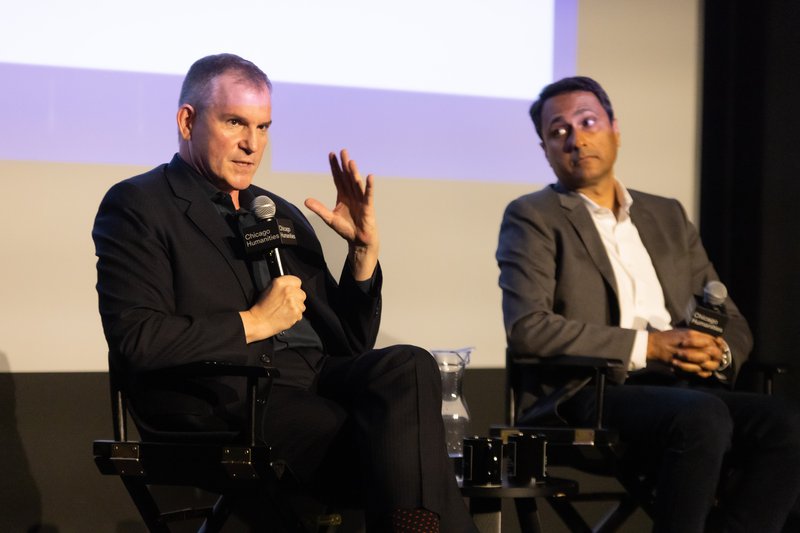
Frank Bruni ( L ) and Eboo Patel ( R ) on stage at the Chicago History Museum at the Chicago Humanities Spring Festival in 2024.
Read:
Frank Bruni, The Age of Grievance
Frank Bruni, Where You Go Is Not Who You'll Be: An Antidote to the College Admissions Mania
David E. Campbell and Robert D. Putnam, American Grace: How Religion Divides and Unites Us
Listen:
Interfaith America with Eboo Patel
Explore:
The AIDS Memorial Quilt
Live event programmed by Michael Green
Live event produced by Jesse Swanson
Live event stage managed by Nikki Konomos
Live event mixed by Margaret McCarthy
Production assistance by Bucky Emmerling and Josh Harlow
Podcast edited and mixed by Alisa Rosenthal
Podcast story editing by Alexandra Quinn
Podcast copy assistance from David Vish and Katherine Kermgard
Recommended Listening
- Podcast
- April 18, 2023
Is the Public Still Persuadable? with Anand Giridharadas
- Podcast
- March 5, 2024
Rachel Maddow on History, Now, and What’s Next
- Podcast
- July 23, 2024
Roxane Gay Totally Called It
Become a Member
Being a member of the Chicago Humanities Festival is especially meaningful during this unprecedented and challenging time. Your support keeps CHF alive as we adapt to our new digital format, and ensures our programming is free, accessible, and open to anyone online.
Make a Donation
Member and donor support drives 100% of our free digital programming. These inspiring and vital conversations are possible because of people like you. Thank you!