Getting Schooled in Hip Hop with the Notorious Ph.D.
Exclusive Interview
S3E5: Dr. Todd Boyd aka the Notorious Ph.D.
Apple Podcasts • Spotify • Pandora • Overcast • Pocket Casts
Dr. Todd Boyd aka the Notorious Ph.D. is in the Chicago Humanities Tapes studio today, joining host Alisa Rosenthal for an exclusive conversation on how hip hop influenced everything in American pop culture from the ‘70s to today, including film, TV, fashion, and politics.
Read the Transcript
[Theme music plays]
DR. TODD BOYD: You know, I call Scarface the canonical text of hip hop. If you had a graduate student go and tabulate the number of references to Scarface in hip hop, it would be a long list.
[Cassette player clicks open]
[Theme music plays]
ALISA ROSENTHAL: Hey welcome back. Thanks for tuning into Chicago Humanities Tapes - the audio arm of the live Chicago Humanities Spring and Fall Festivals. Seeing as it is, in fact, spring in Chicago – or so we keep telling ourselves – our Spring Festival is currently underway! We’re bringing you a ton of just incredible live programming, which means we’ll have great new stuff for the podcast coming up too. I’m Alisa Rosenthal, and I’m here to bring you the best of the biggest names and brightest minds of our live festival.
Today’s episode is a total treat – we have an original interview with the University of Southern California’s Dr. Todd Boyd, aka the Notorious Ph.D., coming to you live from the Chicago Humanities Tapes studio. You can check out his gorgeous new book now, it is out on bookshelves and it’s called Rapper’s Deluxe: How Hip Hop Made the World. And you can check him out live in Chicago as part of our Spring Festival coming up on Saturday, May 4th. Head to chicagohumanities.org for more info and to snag those tickets.
May the 4th isn’t just a day for Star Wars fans, it’s also one of Chicago Humanities’ popular “neighborhood days” this year. We’ll be taking over Chicago’s historic Bridgeport neighborhood, for a full day filled with music, art, politics, social justice, and much more. Think of it as like Lollapalooza for stimulating conversations. You can catch programs running the gamut of topics, ranging from former South Carolina State Representative and CNN Political Analyst Bakari Sellers and graphic novelist, filmmaker, and tattooist James Spoone. Plus, two event discussions and an art exhibition focused on incarceration with our friends at PNAP: the Prison + Neighborhood Arts/Education Project.
Bridgeport, located on Chicago’s South Side, is one of the most diverse of our 77 neighborhoods, with a history that really sums up a lot about Chicago in that there’s a lot of social progress as well as discrimination that’s still being reckoned with today. It’s been the home to five Chicago mayors, and locals know it as the spot to catch the White Sox.
The neighborhood has been in the news lately with the reopening of the historic Ramova Theatre. A former movie theater built in 1929, the 1300 seat theater closed its doors in the ‘80s, until it was purchased by Emily and Tyler Nevius in 2021 from the City of Chicago for $1 – in total disrepair. Its investors now include Chicago icons Chance the Rapper, Jennifer Hudson, and Quincy Jones, and it reopened in late 2023 with the theater restored and with a bar and grill.
We’re pleased to be hosting Dr. Todd Boyd at the Ramova Theatre on May 4th, so you can check it out in person, and we hope to see you there.
Please enjoy this conversation I had with Dr. Boyd about his new book, as well as a bit of a heated debate about Chicago vs. Detroit, and some really great music.
[Theme music plays]
ALISA ROSENTHAL: All right, Dr. Todd Boyd, thank you so much for joining us, audibly at Chicago today.
DR. TODD BOYD: Thank you for having me.
ALISA ROSENTHAL: So my first question is who is the Notorious Ph.D.?
DR. TODD BOYD: We don't have enough time. You know, the LA times did a feature on me, a while ago now, back in 2003, I think it was. And, the title of the article was Notorious Ph.D. It fit. You know, I always like Notorious B.I.G.
ALISA ROSENTHAL: Right.
DR. TODD BOYD: And I was a bit notorious during those days myself. So it fit and, you know, I just ran with it. It's funny because I get the sense from some people that they feel like I crowned myself Notorious Ph.D. But when I was growing up, you couldn't give yourself a nickname. Somebody else had to do it. So that came from the LA Times, but it it stuck. And, you know, here I am.
ALISA ROSENTHAL: And in your book, you certainly have the bonafides. You speak about being an MC at the University of Florida.
DR. TODD BOYD: Yeah. The University of Florida is maybe, not, shining in the most glamorous light these days thanks to some of the political decisions of the governor. But when I was, in college in the early 80s, you know, a long time ago, I used to, be an emcee. In the early days of hip hop, at the time, the job of the emcee was to move the crowd. You know, a few years after that, when, say, Rakim came on the scene and added a certain poetic perspective, to the, spitting of lyrics, as it were. The game changed, and now MC's were expected to have bars. You know, when I was doing it, it was different. And, so I'm from that early era. I didn't make the transition. I have no bars for you other than, you know, my own Notorious Ph.D. bars. But, you know, I was always invested in the culture. This was. You know, a time when Michael Jackson's Thriller had just come out. Prince 1999 had just come out. Everybody I knew was listening to one or both of those records. And I've always wanted to be different. You know, when I was coming up, you would run to the other side of the room, just not to be associated with everybody else. And so they were listening to Michael and Prince, and I was bumpin Grandmaster Flash and Run-D.M.C.. So, those are my days as a MC, long before I went to graduate school and, started doing this work as a professor. But it certainly grows out of my interest and passion and, participation in the culture from that perspective.
ALISA ROSENTHAL: I, too, am a University of Iowa alum. Go, Hawkeyes!
DR. TODD BOYD: That's great. That's great. They've been getting a lot of attention because of Caitlin Clark lately, which is.
ALISA ROSENTHAL: Basketball. Yeah.
DR. TODD BOYD: Cool, because, not too many things happen in Iowa. Travis Scott. So.
ALISA ROSENTHAL: Now talking about academics, if there was a thesis statement to Rapper's Deluxe, what would it be?
DR. TODD BOYD: A thesis statement, is an interesting way to put it. I've I've thought of this, you know, as a 50 year history of hip hop as a cultural movement. You know, a lot of people, when they hear hip hop, they think of the music, and the music, certainly, you know, important. But, it's more than that. And I think if it were only just the music, we wouldn't be talking about it 50 years later. So it's how the culture developed, and the connections from music to film and art and sports and fashion and politics and language and so many other things over an extended period of time. I mean, we're talking about, you know, half a century. And as I have been saying to people, there are no 50 year trends or 50 year fads. Trends and fads and cycles come and go much quicker. But hip hop's been around for 50 years, and, it's, affected and influenced a lot of different things, beyond where it initially started. So I wrote some of the book that way.
ALISA ROSENTHAL: Yeah, I love that. I think, my favorite aspect of the book was using hip hop as a way to look at American history, Black American history, and, different facets of culture and subculture and counterculture, the way you hit fashion, sports. I'm excited to get into all of it.
DR. TODD BOYD: I mean, you know, when I think about it, it touches all those different things, in various ways. You know, there's always been a fashion component, you know, hip hop has always been affected by and responded to the politics of the day. Someone said to me, never seen a hip hop book that included Angela Davis. And I'm like, you know, she's, to me, part of this evolution. You know, we talk about presidents from Ronald Reagan to Bill Clinton to hip hop helping to elect Barack Obama. You know, when you think about the way people talk, I mean, so much of a lot of people's conversation these days, far removed from the culture, is inspired by hip hop, and they don't even know it. You know, so many things people say these days came from, say, hip hop, but it's filtered through the culture in such a way that, you know, you have, you know, conservative right wing politicians, saying things that come from hip hop and they have no idea that that's where it came from it's gotten to be so popular. So I was interested in that, movement and, interested in how it connects to history. You mentioned Black history. Certainly, to me, it's American history. And it's an interesting way to look at the last 50 years of American history through a lens that doesn't normally, get, you know, thought of, in this way.
ALISA ROSENTHAL: Yeah. And I found as I was reading the book that it, has so much energy and vibrancy and large sections of it are just so fun. Was it intentional to go for that vibe?
DR. TODD BOYD: I mean, I don't know that I, consciously thought, I want this to be fun. I think what comes through and that's a, you know, compliment. So thank you. I think what comes through is the fact that it's fun for me. You know, I run into a lot of people and they want to, you know, talk about all the negative things that they could attach to hip hop. And, you know, there's certainly things about hip hop that, continue to, demand attention in that way. But I came out of the culture. You know, I love the culture. It's who I am. So when I'm talking about, you know, certain artists to certain albums, I'm talking about things that I like. When I talk about, you know. Gucci sneakers from the 1980s and Fila sneakers. You know, kind of at the moment, Air Jordans are coming out. I'm talking about things that were in my closet, things that, you know, I myself wear, things that I have a great appreciation for. I'm relating the debates that I've had with, you know, friends and, so, you know, it's personal and I try to articulate that through, the perspective of history, sort of critical analysis, but sometimes just describing it, you know, I'm sort of sharing with the reader or I hope to share with the reader of my own interests, my own passion. And, you know, some things are funny and, it's kind of cool to remember them. I hope all that comes through, when people read the book.
ALISA ROSENTHAL: Yeah, I would say it definitely does. And I think you do a wonderful job of holding some decisions individuals make that are less than savory, while also understanding the significance that they've contributed to the culture. So it makes it, a really thoughtful read, like you've got us.
DR. TODD BOYD: Thank you. I mean, I. I found myself, not wanting to kind of, you know recollect all of the sort of talking points that tend to get connected with hip hop. I wanted to do something beyond that. And, you know, I think there's certainly individuals who have done some amazing things, and some of those individuals have made some questionable choices or done some other things that were problematic. And two things can exist at once. I mean, you can be, you know, a significant, groundbreaking figure, and you could also do some things that, you know, need to be criticized. And that's not a contradiction. So I wanted to be able to do that, say, you can't just dismiss this person because, you know, they said or did something you didn't like. But at the same time, you can't ignore that certain things also come into the equation as well. And sometimes that's a delicate balance. And I hope, I hope that, I managed to achieve the right balance in doing that.
ALISA ROSENTHAL: If that's not, America, I don't know what is.
DR. TODD BOYD: Yeah. I mean, you know, so much of what, passes for discourse these days. Conversation. You know, it's either or. And, things are often more complicated in that the either or is maybe sometimes a bit too simplistic. So I wanted to go beyond that.
ALISA ROSENTHAL: Yeah. You did such a lovely job of assembling stories and anecdotes and pieces of pop culture history that I didn't know about. I really found interesting the story of Sylvia Robinson. If you wouldn't mind speaking a little of who she was.
DR. TODD BOYD: Well, Sylvia Robinson is the godmother. Not to be confused, with Griselda Blanco, the recent Netflix series. But, you know, Sylvia was an R&B singer. And even before doing R&B. I think I mentioned in the book, you know, Mickey and Sylvia, song called “Love Is Strange.”
ALISA ROSENTHAL: “Babe, oh oh oh.”
DR. TODD BOYD: There you go, which is very prominent in, Martin Scorsese's film Casino. That's Sylvia. And, you know, in the early ‘70s, I remember watching Sylvia perform on Soul Train, when she was going by the name Sylvia singing “Pillow Talk.” You know, one of her big hits. By the late ‘70s. She wants to, you know, capture the experience of a, you know, rap music event on record. It was experiential, but it hadn't been sort of captured on a record. And, you know, she's the force behind it. Subsequently starting Sugarhill Records. You know, her son, as the story goes, is in a pizza parlor, and he hears, you know, some guys kind of rapping along to a song and, you know, next thing you know, they're in the studio recording they've never recorded before as a group. The lyrics are from, you know, Grandmaster Caz's rhyme book. This is the group ultimately known as, you know, the Sugarhill Gang. And of course, their song is “Rapper's Delight.” You know, I mean, this was not a group. It was sort of put together for the purpose of making this record. But of course, the record would be, you know, a huge hit and really introduce the world to the genre of hip hop. So Sylvia, to me is very prominent in that regard. And I think her place in the culture is something that should be routinely acknowledged and celebrated because, you know, this was a Black woman at the forefront of, bringing the culture to the masses. Previously, you know, unless you were in New York and in those communities when the culture was underground, you didn't experience it. You couldn't experience. But because of Sylvia, you know, you were able to experience it wherever you were. You could hear it on the radio, you could buy the record. And that's the foundation, you know, that would, you know, build the culture going forward. So I think Sylvia's hugely important.
ALISA ROSENTHAL: Absolutely. We already see how aspects of American pop culture are feeling like hip hop. Your deep love of film comes through, and I also have a deep love of film which made the book very fun to read. So I thought it was really interesting how you dedicated a chapter to Blaxploitation and the centering of fringe art movements, and how that felt like hip hop, or how that would later become more like hip hop.
DR. TODD BOYD: Well, I think Blaxploitation and many of the things that I talk about in the book's first chapter in the ’70s. These were all, you know, cultural examples that were out in the open while hip hop was underground. Hip hop was developing. And in future generations, future decades, we could see the influence of Blaxploitation on the development of hip hop. But in the mid, in the early to mid 1970s, I mean, Blaxploitation, is it. You know, one of the stories I tell, of course, at the beginning of the book is the famous sort of origin story of D.J. Kool Herc throwing this party in the South Bronx. You know, the party has become kind of this mythical legend, this origin story of hip hop. And in doing my research, I found out that the same week you know, the number one movie at the box office is Pam Grier's film Coffy. Which, if you think about it, is really kind of fascinating because, you know, this is the number one film at the box office and hip hop's underground. But of course, when you get to the ‘90s, you know, you have a rapper like Foxy Brown who, appropriates her name from another Pam Grier film, and of course, Tarantino's film Jackie Brown, which stars Pam Grier, you know, two decades later. And so, you know, movies like Superfly and The Mack, you know, these were all really influential in terms of, you know, the development of gangster rap in the late 1980’s. And so Blaxploitation, you know, which has gotten, I think, a bad rap, a lot of people don't even know what it is. They use that term and apply it to anything. But Blaxploitation is less of a genre and more of an era. And so I felt I needed to include that as well as a lot of other examples of the culture from the ‘70s that were above ground and visible while hip hop was developing underground.
ALISA ROSENTHAL: You mentioned Scarface. We look at the films of Quentin Tarantino, and then we look at The Wire. Really significant pieces of media in the culture. How are those hip hop?
DR. TODD BOYD: Well, you know, I call Scarface the canonical text of hip hop. You know, in the mid ‘80s, this was such an influential, influential film. And even beyond, of course. I mean, you know, if you had a graduate student go and tabulate the number of references to Scarface in hip hop, it would be a long list. You know, including a rapper, Brad Jordan from Houston, otherwise known as Scarface. So, I mean, that movie was, you know, hugely influential and certainly was influential to me. As well as, you know, numerous other rappers and hip hop figures. You know, and so you can't really talk about hip hop in the ‘80s without talking about Scarface. And certainly the development of, gangster rap in a lot of ways is fueled by the sort of image imagery you get, in a film like, Scarface. The Wire, you know, I mean, in the 2000s, when you get into that chapter, I mean, just a groundbreaking example of, you know, television. Watching The Wire, you know, of course, is is become kind of a sign of good taste these days I think, you know, people tell you they love The Wire. It's kind of a way of saying, you know, I have really good taste in the culture I consume. Because.
ALISA ROSENTHAL: It comes up on first dates all the time.
DR. TODD BOYD: You know, it's it's it's, you know, people who watched it, it's hard not to feel that way. It was such a, incredible, you know, piece of material. And a lot of the elements in The Wire, of course, you know, you heard people rapping about before the series even started it. Urban, street culture, drug culture. So all these things, you know, you heard about in hip hop, some of these things happened prior to hip hop expanding at some point. There's maybe even a bit of cross-pollination between the two. You know, I mean, Scarface comes out in '83. You know, there has been discussion for years that they should sort of recut it and do it with a hip hop soundtrack. And Brian DePalma doesn't like that idea, which I think is sort of annoying because hip hop made that film in a lot of ways. It hadn't performed as desired at the box office. But, you know, this is the era of VHS tapes. And, you know, I think a lot of people in hip hop culture discovered this film on VHS and, and kind of made it a hit even after it had not been a hit necessarily at the box office. So it demonstrates the influence and power of a community of people to make something relevant that maybe hadn't succeeded, as was anticipated when it was released.
ALISA ROSENTHAL: I really love how the book is broken into decades. You're really just moving through time, and the ‘90s really feels like the centerpiece of the book.
DR. TODD BOYD: You know, I've been telling people, the ‘70s chapter, which is chapter one, was the most fun to write, and the ‘90s, which is chapter three, was the longest, and hardest to write because just so much happened in the ‘90s, I mean, everything just, you know, the culture really exploded. And there's just so much to touch on. You know, from the early part of the decade when hip hop is still sort of making its way into the mainstream. You know, around the time of the Rodney King riots and, you know, sort of historical event like this, but also just as the music is expanding exponentially and you're getting these new artists and these new groups, you know, Public Enemy, Chuck D, you know, Ice Cube going solo and bringing a political component, and then later Dr. Dre and Snoop, you know, adding to that sort of West Coast transformation of the culture, before Nas and Wu-Tang and Biggie Smalls come along. And of course, you know, Tupac's in the mix as well. But you also get, you know, a series of movies like Malcolm X and Boyz n the Hood, Menace to Society. You know, during this particular time and, you know, these hip hop fashion lines like, you know, Fubu and, Cross Colours and other such things. Sean John. So there's just so many things happening in the 90s that by the time you get to the end of the ‘90s, you know, Lauryn Hill is racking up Grammy Awards, you know, which, people sort of see as a really significant moment now relative to recent conversations about, you know, hip hop's place at the Grammys. But I remember watching Lauryn Hill when she, you know, collected all those Grammys at night. And at one point she says, this is crazy because this is hip hop music, you know? And at that time, it was crazy. You know, now it's an issue in a different way. But at that time, it was crazy because hip hop hadn't always got the recognition and respect that it deserved. And so Lauryn is, is saying as she's racking up all these Grammy Awards, it's kind of amazing that, you know, hip hop had reached this point now of critical acclaim within the industry after such a difficult time, in its earlier manifestation. So the ‘90s is the longest chapter. It was the hardest to write, but it's it's such a important moment because by the end of the ‘90s, hip hop was at a very, very different place than it was when we started the book back in the early ‘70s.
ALISA ROSENTHAL: I really liked how you used award shows as the marker of progress and mainstreaming of the culture. So, for example, Lauryn Hill winning Grammys. And there was a lot of significance in the early 2000’s, specifically at the Oscars.
DR. TODD BOYD: Right? That was, 2002, 2002 Academy Awards, where Denzel Washington and Halle Berry, you know, both, won, Denzel for Training Day and Halle for Monster's Ball, Best Actor, Best Actress, you know, and Sidney Poitier received a lifetime achievement awards of sorts that evening. And so he was in the house, and, Denzel, of course, shouts him out at his acceptance speech. You know, considering back in the early 1960’s, Sidney Poitier was only the second African American to win an Academy Award. And here we are you know, all those years later, and Denzel was only the second African American to win the Academy Award for Best Actor, after Sidney Poitier. So you went from the early ‘60s to the early 2000’s, and even though more, you know, Black actors had won awards including, you know, Denzel, it was only the second time that a Black actor had won in the Best Actor category. And, Halle Berry was the first time a Black woman won in the Best Actress category. So, you know, it's a very historic moment, for sure. And when you look at Denzel's performance in Training Day, I mean, I think of Training Day as a as a hip hop film. You know, it's tied around the Rampart scandal in the history of the LAPD. Recent history during that time. But, you know, I mean, Dr. Dre, Snoop, are in the film, it's a sort of LA film, but not the traditional LA that people expect. It's, you know, East LA, South Central, and, you know, just to me very much a hip hop film. And, you know, if anybody, of course, remembers the film, Denzel's monologue at the end, you know, "King Kong," "23 hour lockdown," "shoot for." I mean, that's that's, to me, the essence of hip hop. That was, you know, sort of hip hop meets Shakespeare. So just a really important moment for him individually, for Halle Berry individually, but also, you know, the culture. And then a few years later, Three 6 Mafia, you know, shocked the world, when they won an Academy Award. You know, so things had changed, at least at that time in the Oscars in terms of what was being recognized. And I felt like hip hop had a great deal to do with it.
ALISA ROSENTHAL: Well, I've just got a couple more questions for you. I would be remiss if I didn't ask you about the Chicago connection within hip hop. Michael Jordan is a major figure in the book as well as Obama. What are the Chicago connections within hip hop culture?
DR. TODD BOYD: Well, you know, I can't answer that question without saying I'm from Detroit, so whatever else I say will be relative to the fact that, you know, much love to Chicago. But I can't talk about Chicago without at least acknowledging, Detroit. But.
ALISA ROSENTHAL: That's totally fair.
DR. TODD BOYD: You know, when, you think about Michael Jordan and his success, you know, once the Pistons got through dominating the NBA, Michael had his shot, but certainly, Air Jordans and the role of, you know, sneaker culture as well, I mean, you know, again, when we talk about figures who've been repeatedly referenced in hip hop, Michael Jordan is, at, you know, or near the top of that list for sure. He was iconic because of all his success. His sneakers are a huge part of, say, you know, the fashion of hip hop. You know, and I mean, again, you kind of have to respect what he accomplished. And of course, Obama, when you get to chapter four, you know, I tell a story about Obama on the campaign trail. And, you know, there's a moment when he brushes his shoulders off like the Jay-Z song says, and this is a presidential candidate, you know, you wouldn't expect, John McCain, his opponent, to even know what that was. So it's very cool to see Obama do this. People like to talk about Bill Clinton playing the saxophone on Arsenio Hall, but I think there was something much more authentic about what Obama did when he brushed his shoulders off in reference to his critics. And once Obama became president, of course, you know, he welcomed hip hop into the White House. I tell a story about his conversation during a meeting with Kendrick Lamar. Throughout the time, you know, Barack and Michelle Obama were in the White House. Hip hop was often represented, rappers, NBA players and others were welcomed into the White House. And I think it was cool to see figures from these aspects of culture interacting with the President and First Lady in a way that was very different, you know, than anything we'd ever seen. I mean, this is part of being the first Black president, but both Obama and Jordan, you know, are huge. And, you know, shout out to Chicago for that. Because, you know, we're talking about two of the most important figures in American history. And I would be remiss, if I didn't acknowledge this in spite of the fact that, you know, I'm from Detroit, and you have to point out the fact that much love to Chicago, but that competition between Chicago and Detroit didn't die.
ALISA ROSENTHAL: Again, totally fair.
DR. TODD BOYD: I've been in LA for so long now that, you know, I'm sort of referencing the historic Detroit. When I first moved to LA, one of the first people, ironically, I met was Verdine White of Earth, Wind & Fire, great you know, Chicago legend in his own right. I remember a conversation I had with Verdine, and he was saying, you know, Detroit and Chicago, if we're back home, there's that rivalry. But once you get out here to LA, you know, it's all good. It's love. It's like Midwest. So we're like cousins. So, you know, much love to Chicago. Because, you know, I've been in LA for a long time and I'm gonna always represent Detroit, but I appreciate the Chi very much. And what Chicago has contributed to hip hop culture and American culture is undeniable.
ALISA ROSENTHAL: I'm there with you. At the end of the day, we're just Midwesterners.
DR. TODD BOYD: At the at the end of the day.
ALISA ROSENTHAL: I really love the photos in this book. It's one of the, most exciting parts is just the number of photos, how beautiful the photos are, how well they are assembled. Was there anything notable in tracking down a particular photo?
DR. TODD BOYD: Well, you know, one of the things that was enjoyable about writing this book for me was the opportunity to not only write it, but to curate the images. And so in terms of the photos, you know, a lot of these things, you know, I have or had seen before had in mind, and then there were other instances where I maybe discovered something, you know, I mean, I had a lot of support. I had a great assistant, and I had, you know, great sort of editorial support. You know. There was a point when certain people, I guess we won't name them, were like, no, I don't want to be in the book, you know, and you never know with these things is, the actual person or is it, you know, their team? But then there were other cases, and I think this is one that stands out for me. I have a famous, vintage Nike poster as one of the images in the book. It is the great George Gervin. A photo of George Gervin sitting on blocks of ice. He was, of course, known as the Iceman. And I had this poster on my wall when I was in college. And I was speaking, you know, at the Nike campus in, in Oregon once, and I mentioned this, and when I got finished, someone gave me a autographed copy of that poster. But there's a point in the process of the book when the editor said to me, you know, we have cleared the Nike George Gervin poster and, you know, Mr. Gervin asked that I send this personal message to you. He said, thank thank Dr. Boyd for including me in his book. Now, George Gervin's from Detroit, number one, he's the Iceman. He's one of the most, you know, iconic figures in the history of the NBA. And as I say, I had that poster on my wall in college. And the poster itself is actually based on an Iceberg Slim album cover, which is also in the book. And maybe the origin for that, I think, is the Esquire magazine cover link to a James Baldwin article. So it's a really interesting series of connections. But in, in, sort of, you know, thinking about all that is the fact that George Gervin would send me this personal message. The Iceman sent me his personal message. That just meant the world to me.
ALISA ROSENTHAL: That's amazing. My last question for you is you use the term king a lot. Who's the king?
DR. TODD BOYD: Well, I think they're multiple kings. You know, I mean, that's a cool word because, you know, you could talk about LeBron James, King James, you know, I talk in the book about the Jean-Michel Basquiat painting Most Young Kings Get Their Heads Cut Off. And the sort of visibility of the crown in Basquiat's work. You know, I mean, I'd like to think I'm a king. You know, I pull my crown out every now and then to let people know. But, you know, back in the day, guys like Duke Ellington and Count Basie appropriated titles from, you know, European nobility as ways of distinguishing themself. And maybe more recently, the metaphor of king has come to serve the same purpose. In terms of this book? You know, it's my book. So I'm the king.
ALISA ROSENTHAL: Here, here. Dr. Todd Boyd, thank you so much for your time. I can't wait to see you at the Ramova Theater in Chicago. I'll be there. And, people are just going to love this book. Can't wait.
DR. TODD BOYD: Well, thank you, and I look forward to it myself. Thank you very much.
[Theme music plays]
ALISA ROSENTHAL: Chicago Humanities Tapes is produced and hosted by me, Alisa Rosenthal, with help from the great staff at Chicago Humanities. For more information on Dr. Todd Boyd, such as a link to tickets to his live event on May 4th with Open Mike Eagle and more information on his book Rapper’s Deluxe, head to chicagohumanities.org.
Since we’re in live festival season, we’ll be back with some shorter programming for podcast listeners over the next couple of weeks, so be on the lookout for these “Mini Tapes.” It’s going to be one great moment from one great program. Thanks for listening, and in the meantime, stay human.
[Theme music plays]
[Cassette player clicks closed]
SHOW NOTES
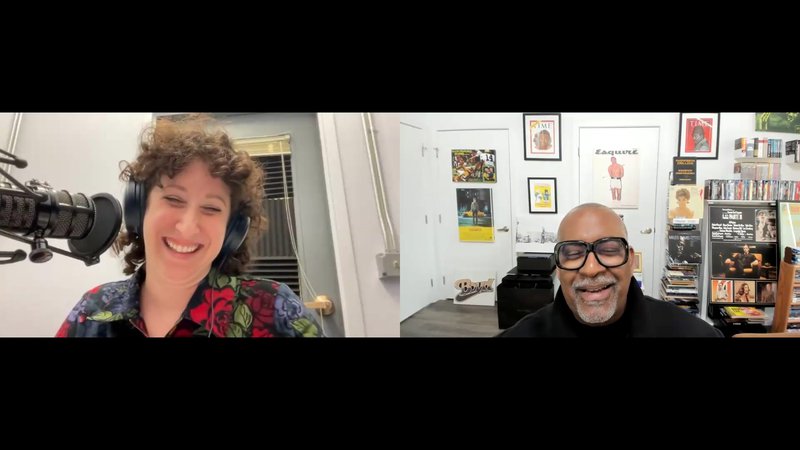
Alisa Rosenthal ( L ) and Dr. Todd Boyd ( R ) interview via Zoom.
Dr. Todd Boyd, Rapper’s Deluxe: How Hip Hop Made the World
Watch:
Sylvia sings “Pillow Talk” on Soul Train 1973
The Sugarhill Gang “Rapper’s Delight” 1979 music video
Lauryn Hill wins Album of the Year at the 1999 Grammys
Recommended Listening
- Podcast
- September 7, 2023
Stacey Abrams on Writing, Ruth E. Carter on Costume Design
- Podcast
- April 30, 2024
Mini Tapes: Guidance from the Afterlife
- Podcast
- May 30, 2023
Top Chef's Kwame Onwuachi on Authentic Cooking
Become a Member
Being a member of the Chicago Humanities Festival is especially meaningful during this unprecedented and challenging time. Your support keeps CHF alive as we adapt to our new digital format, and ensures our programming is free, accessible, and open to anyone online.
Make a Donation
Member and donor support drives 100% of our free digital programming. These inspiring and vital conversations are possible because of people like you. Thank you!