Bobby Berk on Queer Eye, Home Decorating, and Gay T-Rexes
S3E11: Bobby Berk
Apple Podcasts • Spotify • Overcast • Pocket Casts
Emmy-nominated design expert Bobby Berk swings by Chicago Humanities, in a program recorded just three weeks before his announcement of leaving the popular Netflix makeover show Queer Eye in October of 2023. He chats with Emmy-nominated host Matthew Rodrigues of NBC Chicago Today in a conversation filled with how to build habits in your home, decorating tips, and some behind-the-scenes Queer Eye drama.
Read the Transcript
[Theme music plays]
[Cassette tape play clicks open]
ALISA ROSENTHAL: Hey everyone what’s going on, you’re listening to Chicago Humanities Tapes. I’m your host Alisa Rosenthal, and this is the audio extension of the live Chicago Humanities Spring and Fall Festivals. We just wrapped up our amazing spring season, so be on the lookout for lots of great episodes coming your way. Make sure to hit subscribe wherever you get your podcasts to be the first to know about new episodes, and head to chicagohumanities.org for more information on our upcoming live events.
Today, we’re visited by Emmy-nominated design expert Bobby Berk, in a program recorded just three weeks before his announcement of leaving the popular Netflix makeover show Queer Eye in October of 2023. He chats with Emmy-nominated host and friend of Chicago Humanities Matthew Rodrigues of NBC Chicago Today in a conversation filled with loads of advice on decorating and habit tips for your own home, some deeply silly tangents, and a little bit of behind-the-scenes Queer Eye drama. Check it out.
BOBBY BERK: Hi, everybody. Thank you for coming.
MATTHEW RODRIGUES: Hi, everybody. Hi. Oh, hi. Very specific. Hello. Oh, my God. Patrick and Paolo. Hi. That's so great. Those are my friends. So listen, first question. It's for the audience out here. How many of you, when you go home, feel right at home? Raise your hands if you feel like your space is the space you want.
BOBBY BERK: Well, great. You guys can leave.
MATTHEW RODRIGUES: There we go. Ha ha ha.
BOBBY BERK: You got it.
MATTHEW RODRIGUES: You got it. You're good. Oh, So we're going to ask you to leave. And that no.
BOBBY BERK: All the rest of you guys are just. You hate your house. You guys can stay.
MATTHEW RODRIGUES: But isn't isn't that something we all want? We want to feel right.
BOBBY BERK: I know. We said you guys give us the little chairs, and I'm like, I'm just going to swivel the whole.
MATTHEW RODRIGUES: You can't give two gay guys a swivel chair.
BOBBY BERK: I have one. I have one in my office, and I'm always doing Zooms on and I'll watch an interview after. And the whole time I'm just like, I'm like, God, I've got to put a break on that.
MATTHEW RODRIGUES: I'm showing a lot of ankle here.
BOBBY BERK: Same.
MATTHEW RODRIGUES: Oh, okay. So when did. You first start feeling right at home?
BOBBY BERK: I mean.
MATTHEW RODRIGUES: In a deep sense of the word.
BOBBY BERK: Yesterday, I think. Yeah. You know, I think. Home is always such an evolving thing. You know, I wouldn't say that I do feel 100% right at home yet, you know, because I think that as your life evolves, as your life changes, as circumstances, relationships, jobs, you know, I think you're always needing to change that a bit. And that's what this book is about. We are we've been planning on doing a renovation to our house for the last three years, and we have not yet, which is why I say I don't fully feel right at home. Our house is really cool old midcentury. She had some really abusive relationships in the nineties and every time I look at those abusive relationships, it makes me sad. So I am not quite yet 100% right at home.
MATTHEW RODRIGUES: Now, why wouldn't you be able to have that going on, like having a renovation happen?
BOBBY BERK: Can imagine that. Like I do it.
MATTHEW RODRIGUES: Yeah.
BOBBY BERK: All day long. I just don't want to do it at home. It's like chefs. Don't necessarily want to cook when they get home. My friends that do hair like they're like, the last thing I want to do is. So, like, sometimes I just. Yeah, the last thing I want to do is my own home, because you're always like, Oh, I bet you change your house up. All the time.
MATTHEW RODRIGUES: Yeah.
BOBBY BERK: No, no. I put it together when we moved in and haven't really touched it since.
MATTHEW RODRIGUES: So where did the concept come from? Because I do love it. So it is really in-depth. It's very thoughtful and it is a book I never thought I'd want to sit and read a design book
BOBBY BERK: I'd like to consider it more as a self-help book than a design book. It's a self-help book that just happens to use design to help you improve your life. There's a story I talk about. I think even like the very first chapter of when I was little, I grew up in Missouri and not too far from here. And. Wow. No, like. "Woo!" like, usually when I say that somebody from somebody, there's nobody from Missouri here. Okay. Wow. And my mom had decorated my bedroom in all red, red curtains, red bedspread, red rum. And I just like as this five year old, six year old little kid, I couldn't articulate that, "oh, this red gives me anxiety." I just knew that it didn't make me feel good, like I was not at peace in that room. So my grandma and my aunts and uncles would all send me like $20 checks for my birthday. And I talked to my mom into letting me buy home decor for my birthday. You know?
MATTHEW RODRIGUES: And she didn't know you were gay?
BOBBY BERK: Yeah. No, she was still shocked. I was like -
MATTHEW RODRIGUES: My mom too.
BOBBY BERK: My daddy's like, "You. You were always surrounded by girls." I'm like girlfriends, Dad, not girlfriends. So I went out and I bought all blue, like, blue bedspread, blue rug, blue pillows. And I based it all around this, like, really cool dinosaur poster that I had found that with blues. And they're like, I totally.
MATTHEW RODRIGUES: So butch.
BOBBY BERK: I found that - yes - how much like. A dinosaur little little T-Rex.
MATTHEW RODRIGUES: T-Rex is totally gay.
BOBBY BERK: T-Rex he like tries to play butch, but then you see him run and you're like, I see you, girl.
MATTHEW RODRIGUES: That's why he's so mad. He's all bottled up.
BOBBY BERK: So back to the. Yeah. And so I just I, for some reason, felt that blue made me feel better. And it really does like color has such a power on our mental health. And then during COVID, we were all stuck in our homes and a lot of us really started to think about our homes and the way our homes made us feel and either good or bad. And, you know, people have been asking me to do a design book ever since the show came out. You know, all my castmates, like ran out there and did books the day our show came out. And everyone's like, where's yours? No no I just I always thought it was funny because I didn't do one for years later. And I always I will literally get photos from fans who will line up their books and then just circle a big empty circle at the end. It's like. Where's your book? I'm like, relax. Relax. I'm getting there. But I didn't want to do just a design book because all design books are great. You know, anything that cultivates design, I think, is amazing. But often design books really make you feel bad about your space. They make you feel inadequate about your space, right? Like, even as a designer, I look at them sometimes and I'm like, my space doesn't look like that. But luckily, I know that behind that camera is like a dozen people that made that space look perfect. Nobody lives like that. But I wanted to do a book that would actually help you figure out how to make your space work for you. So this book is about the first chapter is about finding what you love. And it's not about mid-century modern or farmhouse modern or it's not it's literally the first thing I say is let's normalize not asking people what their design aesthetic is. It's about what's your favorite movie? What's your favorite trip? This like finding out the things that you're passionate about because those are the things that you should tied into designing your home because those are the things that are really filling your cup.
MATTHEW RODRIGUES: And I love that you make it very easy for people because you have I even marked it off here cause I'm a I'm like Oprah. With my hair.
BOBBY BERK: You know, as I was sitting here, I was thinking to myself, God, I feel like I feel like I'm sitting here with Oprah.
MATTHEW RODRIGUES: Everybody look under your seat no, okay?
BOBBY BERK: You get a car and you get a car, right? You're giving them cars?
MATTHEW RODRIGUES: No, I was just going to give them a mint or something. But no, you have this interactive element of the book, which I always love in a book, because it makes you think it makes you become a part of the book. Was that important to you to make people feeling empowered?
BOBBY BERK: It was important to me because I didn't want this to be about my perspective on what I think is good design, because again, design is so relative, Design is so personal. You know, you might love that ugly purple credenza that your Aunt Gertrude left you because it really brings back this lovely, wonderful memory. And I think it's the ugliest thing I've ever seen. So it's all relative. So I really wanted to do some work pages in the book because I wanted it to be I wanted to really invoke thought from you about what makes you happy. The last time you felt safe, the something that reminds you of a loved one. Like things like that.
MATTHEW RODRIGUES: How do you not insult someone when you don't like what they're doing design-wise? You know, it's a fine line, right? Like, because you're saying, in one breath -
BOBBY BERK: "I love that for you!".
MATTHEW RODRIGUES: Right? Yeah, exactly. Yeah. But in one breath, you're saying, okay, I have the purple credenza, but in your head you're screaming and being like, "BURN IT."
BOBBY BERK: No, I've really. I've really don't. And I get actually kind of sad sometimes because I'll have friends that, like, never invite me over and I always, like, kind of take it personal. And then one day they're like, I don't want you to judge my house. And I'm like, I'm not coming over to judge your house. I'm coming over to hang out with you.
MATTHEW RODRIGUES: I'm coming over to judge you.
BOBBY BERK: Yeah, yeah. So the the only thing I will ever judge in someone's home is if it's dirty or if it's cluttered, because those are those are bad things. But like, your decor choices, those are yours. Your decor choices.
MATTHEW RODRIGUES: But I do picture you like Terminator walking into a room like "d-d-d- d-d-d-." Like, Looking, scanning.
BOBBY BERK: I do, I do. I just don't say anything. Yeah, yeah. Oh, I'm judging. Yeah, I'm just doing it in my in my head.
MATTHEW RODRIGUES: And then when you get a check, all of a sudden you start giving your opinion.
BOBBY BERK: So because then they're asking for it.
MATTHEW RODRIGUES: Right right. Design really has, it's really brought you along. It's brought you to some incredible places. I would like to go back a little bit to talk about your time in Missouri and you discovering yourself and taking - but you had a really hard time. Luckily things have turned around, but at one point you chose to leave your house and leave your parents at 15 years old. So why did you do that? And -
BOBBY BERK: Missouri.
MATTHEW RODRIGUES: Right? Right.
BOBBY BERK: Yeah. Yeah. But nobody was cheering for Missouri, including me. So, you know, I grew up in a very small, little conservative religious town. And every single day of my life, I wore a mask and not an N95 mask like a, you know, a fake mask. The idea was that they would love sports and girls. And, you know, there was nobody in the world that.
MATTHEW RODRIGUES: Were you that guy were you?
BOBBY BERK: I tried to be. Yeah. Yeah, I tried to be. And when you when there's not one person in the world that really knows you for who you are, it gets very lonely, you know, because you start to think, well, that nobody actually likes me for me. And if they did know me, they wouldn't like me. So, you know, which is why LGBTQ teens have the highest rate of suicide, because eventually you're just like, Well, no one cares, no one knows me. And that's kind of the point I was at.
MATTHEW RODRIGUES: Did you have a teacher or did you have one like aunt or you know, there's not anybody.
BOBBY BERK: Towards the very end. Yes. Which is what kind of helped me be like, Well, I can't keep living like this anymore. I need to be out. I couldn't come out in my town. One kid came out and the we call them the shit kickers. They're the cowboys that came to school with, like, cow poop on their boots. Yeah? No?
MATTHEW RODRIGUES: Yeah, We have a a lot of those.
BOBBY BERK: They ran him off the road. And, like, tried to kill him one night. And so I was like, Okay, well, I can't come out here, but I also can't not come out. And things weren't always so great at home. You know, I had very religious conservative parents and that kind of crap went down one night. And they used to always say, if you don't like the rules, there's a door. And then that night I was like. Okay, bye. And so at 15, I left and I.
MATTHEW RODRIGUES: Was, where did you where did you get that courage? Because that takes such courage. Is it just.
BOBBY BERK: Dumb blind stupidity.
MATTHEW RODRIGUES: Blind. Yeah.
BOBBY BERK: Yeah. I think that's been that actually should be the title of my next book that. I really, really should. Blind stupidity.
MATTHEW RODRIGUES: Yeah, that's the memoir.
BOBBY BERK: so at 15, left. I've couch surfed a lot on friends' sofas. I lived in my car. There was a couple of weeks off and on that I literally lived on the streets, but it was worth it because I was me. And, you know, I might not have been the best version of myself yet, but I was learning how to be.
MATTHEW RODRIGUES: When did you come out? When did you first. Yeah, during that time. So how did that go? Was it a certain person? Was it a kiss? Was it a, um. How do you define. How did you admit it to yourself? Or were you always saying, Well, okay, I'm gay, I'm gay, I can't tell anyone.
BOBBY BERK: I always knew I was different, but I didn't really you know. There was no. Ages me. There was no Internet, you know, there was no way to like Google feelings.
MATTHEW RODRIGUES: And how old are you?
BOBBY BERK: I know. Oh, my. Well, there was Internet, but it was just in the computer lab and the the school, you know, you didn't have access to go over and get on whatever you wanted. There was no smartphones, you know, you'd get caught. So I had started, you know, exploring online, like being like, oh, this is this is why I'm so awkward and I don't fit in with anybody else. And I think boys are cute. Oh, that's why. And so I - do you remember ICQ?
MATTHEW RODRIGUES: Oh someone felt it.
BOBBY BERK: Yeah, it was like a it was like precursor of AOL Instant Messenger because it was like this chat program. And I had met one person who was gay on there and they kind of like helped me work through it and come to terms with it and be okay with it and start to love myself, which is why I ended up moving to Denver after that, because that was the I knew one person in the world outside of Missouri and it was Jesse and in Denver.
MATTHEW RODRIGUES: And then when did design come into the picture? When did you say, Hey, I'm not only do I like this, but I'm good at it and I'm going to pursue it.
BOBBY BERK: Design's always been kind of therapy for me. Like I've again, I've always understood the power of making your home make you feel good. And even when I did not have the money to do much, I would my friends and I would have like decor swap parties where we'd bring stuff that we were bored with. They'd bring stuff they were bored with. Somebody would bring a bottle of vodka.
MATTHEW RODRIGUES: That's like the gayest thing. Ever, right? It's the gayest thing ever it's great, right?
BOBBY BERK: Um, and even, like, sometimes I lived in, like, some really, really, really scary apartments, but I would. I'd always, like, save up the money to get a can of paint. And I, you know, I'd paint it, I'd scrub it. I because I understood, like, I need to come home and I need to be able to recharge. And having a space make me feel good is very important.
MATTHEW RODRIGUES: When did you first get paid for it?
BOBBY BERK: Um. I haven't yet. No.
MATTHEW RODRIGUES: All of us are free.
BOBBY BERK: So I worked in I did a lot of retail. You know, I left high school by end of my sophomore year. And so I worked in a lot as I worked at a lot of Applebee's, too. Yeah, the Applebee's was always my fallback job. Any time I'd lose a job, I'd go back to Applebee's. They'd always take me. And so I I worked a lot of retail, and then I started working in, like, furniture retail stores. I worked at the Bombay Company, the Great Indoors, which it probably was. It was the Sears companies have probably started around here, right? Yeah. And then where else? Restoration Hardware. And so I started like being able to interact with people buying stuff and helping them pick stuff out. And I was like, Oh, I really, really like this. And then I worked at Bed Bath Beyond.
MATTHEW RODRIGUES: R.I.P., R.I.P..
BOBBY BERK: No, no. Anyways.
MATTHEW RODRIGUES: Dish.
BOBBY BERK: It's a tall tell like a good store. Good example of companies who don't treat their people well like they don't. You should treat your people well. Yeah, it wasn't just me, it was everybody. Yeah. Yeah. Anyways, um, and then after. Bed Bath Beyond, I went to work for a company called Portico. There actually used to be a Portico here if you guys remember. You're shaking your head. You remember it. Um, sadly, I was the one they sent to close the one here. That was my first trip to Chicago ever. Yeah, I know. That was my first experience in Chicago.
MATTHEW RODRIGUES: You had to fire everybody?
BOBBY BERK: Yes. Yeah. Oh. Anyways, but that was like this really pretty home furnishing store, if you guys remember. And I also built their eCommerce division and their eCommerce. And one day, like, the whole company just went belly up and went bankrupt and I was like, Oh crap, what am I going to do? So I cloned the database I had built for the eCommerce division and I registered bobbyberkhome.com and I put it all on bobbyberkhome.com and I was like, Maybe I'll sell a sofa or two while I look for another job. But I sold more than a few. I was one of the first online retailers for furniture out there, like Amazon was still just selling books. You know, this was in the early aughts. Um, uh. And that did well. So then I opened up my first store in Soho in New York and then Miami and then Atlanta and then L.A. And then I started focusing on design and licensing it and like helping our customers pick out things from the store and. Then the very first home I ever designed was with Builder Magazine. Heather, you here? There she is. With this lady here with her inner architect.
MATTHEW RODRIGUES: The magazine called you up and said.
BOBBY BERK: So she's not with the magazine. She's with the architecture firm that design the houses that then I decorated. But they called me and they're like, Hey. Builder Magazine called and they're like, we hired a PR firm to tell us who the most well-known millennial interior designer was. And they said it was you. And in my mind, I was like, That's funny because I'm not an interior designer. I'm a I'm a retailer. Like, I curate pretty things, but I definitely do not I don't know, CAD, you know, I don't know how to do electrical plans, but they're like, We want you to design the show homes for the International Builder Show. And I'm like, Yes. And I'm like, Of course I can do that, and the moment. I hang up the phone. I was like, Oh my God, I don't know how to do that. But I figured it out. And they I think they're pretty good success. And because of that, the builder that we were working with was like, Oh, we want you to design some more of our homes. And that was eight years ago. And just this year I signed a deal with them where now I'm like the spokesperson for their company. I'm designing all of their model communities pretty much nationwide from coast to coast. Thank you. So it was. It was. It's been something that organic. I always say I kind of fell into design, but I've always understood the power of design. Even since I was a little kid. I've always understood how transforming a space can make you feel. And that was that's what this book was about, is really helping you understand how change in your space can make you feel. And it's not just about spending a lot of money. If you have it, that's great. That definitely helps. But it can be literally just thinking about something that makes you happy. That could be a a rock that you found on the beach walking with your loved one, that when you look at it, it transports you to that wonderful memory. Those are the things that you need in your home. The items and the the scents, the smells that transport you to when you felt safe, when you felt loved, you know, that type of thing.
MATTHEW RODRIGUES: That's when you and you talk about all of that in this book. You even talk about grief, which I thought was a beautiful addition, and I wasn't expecting to see that. Did you have a particular story about that or was there a client you dealt with? Or.
BOBBY BERK: So if you guys remember the I forget what season it was a. Anyways, I think it was Kansas City, John Elrod and on Queer Eye, he had recently lost his wife to cancer. He had two little boys and they had decided to sell the home that they grew up in because it had hurt too much and start new and a new home. And so I got the honor of helping them set up their new home. And it was it was very it was touchy because there was a lot of things they brought with them that reminded them of her, which you want to keep those. But also it was just like a knife in the heart every time he would see them. And he was just like, you know, I don't I don't know how to move on, but also honor the memory of her. I don't ever want my sons to forget her, but I also I can't move on if I'm if I'm just confronted with things that remind me of her everywhere I walk in the home like I need. I need to be at peace. So I made this beautiful hope chest for them. And I put all the memories in there and we put like one room that had pictures of her. And so we wanted to really respect her memory and keep her memory, but also help them to be able to heal and move on. And so that was kind of what caused me to write that chapter. I brought my book home to my mom for the first time come a month and a half ago. My father passed about two months ago.
MATTHEW RODRIGUES: Oh, I'm sorry.
BOBBY BERK: And I had forgot that that chapter was even in there. And I set it down on the counter. And the next morning I came down and she was sitting there eating breakfast, reading that chapter, crying. I didn't really think when I wrote it how how close it would be to home. But it is really important, you know? Grief is a horrible, horrible thing, especially when you're you lose your spouse, you know, and every single thing in your home. My mom is going through that right now. She just turned 70 two days ago and she's never lived by herself in her life. And, you know, today even she was like, you know, I think I'm I think I'm going to donate some of his clothes, you know, And so she's slowly working through it, which I was actually kind of surprised. It was a little was like, I think. That's a little soon, but okay, you know, like, you do what you need to do. But yeah, that's why I wrote a chapter about grief, because again, this book isn't about, oh, this is my point of view on design.
BOBBY BERK: You know, this is about, like, teaching you the. The how how it really connects to your mental health. Yeah.
MATTHEW RODRIGUES: What is your relationship with your mom like now?
BOBBY BERK: My relationship was really good with my mom, and it was with my dad as well. Yeah. You know, for years it wasn't. It wasn't at all.
MATTHEW RODRIGUES: How did they take to you coming out? Like, when did you go back? And.
BOBBY BERK: We didn't speak for years.
MATTHEW RODRIGUES: After coming out or after you leaving?
BOBBY BERK: That was the same time of one in the same. Yeah. We didn't speak for years, you know, they had to work through, you know, a lot of times us as LGBTQ, like we've had our whole lives to kind of figure things out. And then when we tell our family, we expect them to instantly just be like, "Yay! I love you!" They need time too, you know, they need time to. And it's not about that to mourn the person that they thought you were and to learn how to love the person that you are now. And you know, they have a lot of dreams for their children and they're often the most straight or gay. You know, your parents dreams for you aren't always exactly what you want your dreams to be, you know? So I feel like it took them a few years to work through. And especially when you're dealing with those religious things that teach you, Oh, you you can't do you can't love your son. Your son's going to hell. This, you know, they had to work through that. So I don't I don't hold it against them. And in the end, like, I feel like my dad loved my husband Dewey more than me. And that's seriously my dad. My husband's name is Dewey. My dad calls him Doo Doo. And any time we'd be on facetime, he's like, "Where's Doo Doo?” I loved that.
MATTHEW RODRIGUES: Were you ever able to realize obviously it was about religion, but my parents were Catholic and I, over time, when they would talk to me about because they got very upset when I came out with them. To them, I realize it was just because they cared about me and they were just worried and they didn't know how to express it and they didn't have any gay people in their life. Did you find out what it was for them? Was it just you're going to burn in hell? Or was it more.
BOBBY BERK: It was mostly that. Yeah. And yeah, yeah, that's mostly the hell thing. Yeah. Yeah. I think that was the big one in their mind. Yeah. Um, but I also think like they were, they were worried for me as well that I would never find my place in the world. The world would never accept me. You know, this was the nineties, you know, we didn't have the original Fab Five out there blazing trails for us. You know, it wasn't until 2003 that my dads came on TV and, oh, they love it when I call 'em that. The very first at the right before our show came out, they had us do a dinner together on camera for People Magazine, and I referred to them as the OGs and Tom Filicia goes, "You know, this is hard enough without you calling us the old guys." And I was like, "Oh my God, no, that means original gangster" and he's like, "Oh, I love that."
MATTHEW RODRIGUES: I know this is a really big question, but how has that show changed your life and how has it changed your your design business as well? I would imagine both went up like this.
BOBBY BERK: I mean, it's changed my life. It's insane. You know, I could have never imagined how successful the show was going to be. How about how much people would love it, how people would really connect with it? Honestly, when the boys and I we left after filming the end of season two because we filmed season one and two together, there were two separate seasons, but we filmed it all at once. We said goodbye and hugs were like, It was great knowing you like this was fun. Like we really were like, Oh, some people might watch this, but this is definitely the end. We're never, you know, Yeah, we'll see you around. So yeah, we would have could have never imagined that, you know, now, eight seasons later, we'd still be kind of. You know. So it's. Yeah. And then my design business, it's been interesting. So our main client is that home builder and has been for quite some years. I would say we've dated for the last eight years when we finally just got married. I really like.
MATTHEW RODRIGUES: Congratulations.
BOBBY BERK: Thank you. Thank you. We're expecting. We're expecting about 60 to 100 model homes next year. We so we really focus on working with builders. Um, being on Queer Eye and working with those heroes at home is such a such an emotional thing. I honestly like that is enough for me. It's a lot. It's very much it takes a toll. And so working with builders is great because there's no emotion connected to it. You know, there's no texts at 3:00 in the morning of, Oh my God, I just found the most amazing piece of art online. I want you to work it into it. You know, I do some residential individuals, but for the most part, we we stick with builders. So have the inquiries the inquiries went up? Yes, but we've mainly stuck with working with builders.
MATTHEW RODRIGUES: And how many lines do you have? You have an art you just release like an art line.
BOBBY BERK: I actually had most of that before Queer Eye, which is.
MATTHEW RODRIGUES: Which is incredible. I didn't realize you were like, ruling the interior world like that before. And did you feel that a lot of people thought in the beginning of Queer Eye that you guys were all just like, thrown in there and you really didn't have any.
BOBBY BERK: So we really didn't know each other. I was like.
MATTHEW RODRIGUES: No, no, no. I know you two know each other, but I think there was a lot of there was probably some criticism, like they don't know what they're doing. They're not really designers or this or that. Do you feel that?
BOBBY BERK: I never got that? That's not really something I think I've ever heard, you know, you know, I think that most people could see that I was really in there doing it. And it didn't take long. A simple Google search would see that I actually had a design firm and I had stores, and I had been in the design industry for, you know, a decade and a half before I went on the show. Like it really was my business. Like, sometimes I'll meet people and they're like, Oh, what do you do outside the show? I'm like, I run my design firm and they're like, Oh, you actually have one? I'm like, Yeah, I do, yeah.
MATTHEW RODRIGUES: So as you look forward, I know you had at one point you had talked about maybe having kids. Is that something you and your husband are still thinking about? And -
BOBBY BERK: We got a puppy.
MATTHEW RODRIGUES: Oh, do we have a pic?
BOBBY BERK: Of course. Well, there she is as a puppy puppy.
MATTHEW RODRIGUES: There she is! Oh, my gosh.
BOBBY BERK: That was her as a baby. She's the most recent season of Queer Eye. You'll see her. Yeah. And in New Orleans, you've seen her popping around a lot. Yeah, her and Neon are besties.
MATTHEW RODRIGUES: But do you think about that? Do you think about having a family or. Oh, that.
BOBBY BERK: It was definitely something that I wanted for years. I think I've. I've gotten over that. Yeah, yeah, yeah, yeah, yeah. I think the more of my friends who have kids, the more I'm like. I'm good. Yeah, yeah, yeah. Uncle Bobby is going to have so much fun with you, and then he's going to send you back to his parents after giving you ice cream.
MATTHEW RODRIGUES: So I'm just thinking about the. The design element of a relationship. And where would you want people to sit down and have a deep conversation when they are like my husband and what I'm trying to. I'm trying not to talk bad about my husband. It's sort of trying. That's what I'm trying to do. Let me roll it back. No, I love my husband. I love him. But we.
BOBBY BERK: I love my husband but -
MATTHEW RODRIGUES: I love him so much.
BOBBY BERK: She is a mess when it comes to design.
MATTHEW RODRIGUES: Well, we both have very different opinions when it comes to design. How do you navigate that?
BOBBY BERK: Well, luckily, with my husband, we've been together for 20 years, and when I met him, he was just a med student in Mount Sinai in New York, like sleeping on a mattress on the floor, like all the stuff in his apartment, like, literally found on the street. So he had no opinions. Like, he was just happy that I came in and, like, decorated the house. So he had no opinions. He has opinions now, but what he doesn't realize is they're just my opinions. Yeah, I'm. I'm the one that has molded his taste. So there anything he chooses, I'm like, Yeah. Oh, yeah. But when you have a couple. When you have a couple that comes in and one's thinking this and one's thinking that how do you navigate. This is why I don't do residential clients - no.I do get that question a lot. I get that DM a lot, especially from people, you know, that aren't like in their early twenties getting married. Like neither of them have anything, so it doesn't matter. It's people in their thirties and forties who have had their own homes. They've already had their design aesthetic and they're coming together in a relationship. Years ago I was doing a speech in Denver and this woman at the end asked a question and she's like, So I'm dating this guy. We've been dating for a few years. I love him, I want to marry him. But he has zero design tastes. He couldn't care less about what I do in the home. It's just like a blank space. She's like, What should I do? And I'm like, Marry him. Ha ha ha ha ha. I'm like, How do you see this as a bad thing? And she's like, Oh my God, You just reframe that. She's like, This abs - this is a great thing. I'm like, Yes, but, you know, we can't all be that lucky that, you know. So for me, I always say, try to come together on a color. Because even if somebody loves mid-century, the other one loves boho or, you know, modern farmhouse. A cohesive color can bring all that together. Some still some things might be a bit of a hodgepodge but as the years go on, you know, those things will evolve and those things will iron themselves out. But try to come together on a cohesive color because you can make anything work. If you can come together on one
MATTHEW RODRIGUES: I know you said you don't work with a lot of individual clients, but have you ever fired a client?
BOBBY BERK: I've come real close to it.
MATTHEW RODRIGUES: Really? What?
BOBBY BERK: And they're always friends.
MATTHEW RODRIGUES: Oh.
BOBBY BERK: They're always the friends that you're like I told I said no to that a dozen times, because no I've definitely referred clients out in the very beginning, because I believe that if you're coming to me and you want me to do your house and your aesthetic is maximalism, and you're only coming to me because you love Queer Eye and you want me to do your house. I'm like, Hey, you know, I don't think this, I don't think I'm for you. But this designer, this designer, you guys are going to thrive together because you you love the same type of things. So I have many, many a times refer to client to a designer that I feel is going to work better with them.
MATTHEW RODRIGUES: Have you ever worked in a nursing home or a hospital? When I think about the philosophy of this book and, you know, your husband's a doctor. My husband's doctor. I've been in hospitals, and I walk in, I'm like, This is so gross. I would hate to be sick in here. Did you ever think about that? Like how we can improve those kind of spaces and community spaces, because it's the philosophy of your book. Like it can lift us up.
BOBBY BERK: Those spaces are hard just because there's so much regulation around design and the hospitals and the type of surface, the materials, like, I think that those I think companies that make those type of materials are getting better. Like if you notice, like newer facilities actually do feel better because again, people are starting to realize, oh, the connection between mental health and like feeling better and not being sick, you know. So yeah, some of the older spaces, I definitely agree with you. I'll walk in. I was like, Oh God, this is so depressing and sad. But I've noticed newer hospitals designers are thinking of it, manufacturers who manufacture those type of materials specifically for medical use. They're starting to think about it more. So yeah.
MATTHEW RODRIGUES: It's something we should definitely think about because I won't be old in a nursing home and looking at gray ass walls, you know what I mean? Like, it's so depressing. Oh, wait, this one. I'd say I just thought of this. Plants? You think fake plants are okay, so. Wait, wait, wait, wait, wait, wait.
BOBBY BERK: Go relax. So here, here is when I do think of fake plants, it's okay. So let's say you have replaced this live plant in your house over and over and over because your room does not have the right amount of sunlight and it keeps dying. That is not good on your mental health, constantly replacing something that you keep killing. That's not good on anybody. But plants release endorphins. Even if it's not a real plant, it's still tricking your mind. Oh, this is light, this is green. You're obviously getting the the air cleaning and the oxygen out of it, but it's still like a good faux plant can give you some of the same feelings that a real one can. So I am definitely mainly pro-live plant. But there are occasions where if you keep killing it, don't just keep replacing it. That's sad.
MATTHEW RODRIGUES: Yes. You should always bring them in the shower and rinse them.
BOBBY BERK: My philosophy and mine rub a dub dub big plants in the tub.
MATTHEW RODRIGUES: Wash your bush. Okay. Am I going to get fired from the Chicago Humanities Festival?
BOBBY BERK: How do you make it on live TV?
MATTHEW RODRIGUES: Oh, it's not live. It's taped.
BOBBY BERK: Wait. Can I tell a funny story about a live TV segment I did the other day? Okay, so I'm on there and there's three lovely female anchors, and then there's one older white gentleman who's an anchor. I forget his name. I'm so sorry. But towards the end of my interview, he was like, Oh, so I have a question for you. I have an issue. And I'm like, okay. And he's like, Every time I go into Home Depot and Lowe's looking for cock, I never know which cock to get. He's like, you know, they have the three year cock and the five year cock and the lifetime cock, but none of the cock ever last as long as it says it's going to. And I'm like turning beet red. The girls at this point are like trying not to laugh. And I was like, first of all, it's caulk. Caulk, not cock. You're missing an L. And you're right. They never last as long as they're supposed to.
MATTHEW RODRIGUES: Caulk. Um, ok. So I just wanted to read this because I just thought it was so sweet. And this is your dedication. And I just thought it really summed up what you were trying to do here. So it says: "To you. You have helped support and lift me up over the years. Now my hope is that in return, these pages will help you to create a space that not only you are proud of, but also betters your own life with every moment you spend in it." That's very sweet.
BOBBY BERK: Thank you.
MATTHEW RODRIGUES: How have fans and people that you've interacted with over these years really lifted you up?
BOBBY BERK: I mean, you guys are all amazing and we're so lucky that we're on a show that really attracts wonderful people. You know, no other friends in Hollywood are like, oh, like the comments we get, they're so mean. And I was like. Eh we get some. But I'm like, Our fans are just so great. You know, if you're an asshole, you're probably not watching our show, you know? And if you were an asshole you're a little less of one now. You know, it also, our show attracts really great, amazing people. And so it's just been phenomenal. You know, there are those moments where I'll be standing in line at Starbucks holding somebody as they're crying and thinking, I just wanted a coffee. But, you know, but I have to remind myself, you know, like our our show really does touch people in a really emotional way. And so I always make sure I take the time to hear that person's story and validate their feelings. And and because, I mean, without you guys our show wouldn't be around.
MATTHEW RODRIGUES: Yeah, I was so happy to hear that. I don't know how much you know about TV, but many times things are super produced and you go in and you guys ask questions to someone and the camera's not at the right angle. And then they say, Can you ask that again and can you reenact it? But is it still true you don't do any of that?
BOBBY BERK: So that does exist in our show, but only, you know, when we're like watching the TV, like we're watching a hero. Like, obviously at some point you see the cameras are in front of our face, but then sometimes you see the back of our head. Yeah. So the only time we reshoot anything is we flip those cameras behind us so you can see that. Yeah, but when we're with our heroes, nothing is reshot. Where we are so hyper aware that they already are super nervous. They're already like, I'm on a show. I'm like, telling the world my feelings, which was a little easier to get them to do in season one or two because nobody knew what the show was. It's harder now. So we're always very, very hyper aware that if we're like oh, can we move that camera? Or Oh, can you say that again? Then they're like, Oh, I'm on a show, I'm on a show. And their guard comes back up. And the wall that we had worked for days to get down, come or take it down comes back up again. So there's been some really great moments in the show that have never made it just because the audio was screwed up or I wasn't in the right angle.
MATTHEW RODRIGUES: You just said something really interesting. How do you navigate the people knowing who you are now? How do you how do you still find those sweet, beautiful stories?
BOBBY BERK: Every once in a while. Like, usually it's maybe like 1 to 2. A season has never seen the show. And we love that. We love that so much. They've no idea who they are, who we are. And we can see it. We can see it on their face because we know we get we can tell what the way they say, the way they look at us, like we can tell. And sometimes we can do it with like you really have never seen the show, have you? And they're like, no, like and we love that because again, it's it's even more authentic and natural.
MATTHEW RODRIGUES: okay, I think now we're going to do some questions from the audience, Alright, awesome.
BOBBY BERK: Do you have one about plants?
AUDIENCE MEMBER 1: I'm Alex. I am a clinical psychologist I work with do a lot of therapy. And so I love the show for the mental health themes and the work that you all are doing. So thank you.
BOBBY BERK: Thank you.
AUDIENCE MEMBER 1: I'm curious, in working with the heroes, when you see folks who have executive dysfunction or history of depression, anxiety, what kinds of things you think about when organizing their space so that it can kind of help them build new habits, like help continue the momentum that they probably get after you leave?
BOBBY BERK: I start small and I help them realize, like the very random, weird little things like making your bed, you know. Do I make my bed every day now? Do I try to? Yes. But, you know, you go you say, I can't tell you. Tell yourself you got to make your bed. You got to walk out the door. You realize you didn't do it. You get that little notch of failure, a little subconscious lack of endorphins, and you get to work and you're already in the mindset of it's okay not to achieve the goals I've set out to get. But in turn you make that bed, you get those little endorphins, that little notch of a success, and then you get to work and you're already on the success train. You're already on the I can do anything. I can achieve my goals. I know it's literally making your bed. It's such a small thing, but you're subconsciously training your mind to accomplish the things you want to accomplish. So again, by the time you get to work, you've already accomplished things. You're already going there. That's a little things like, you know, stacks of laundry in the bedroom. You know, you tell yourself, oh, that shirt's not quite dirty enough to go in the laundry, but it's not quite clean enough to go in the closet. I wore it on the El I don't want to put it. That's l that's what we call it, right? We call that El, right. Yeah. So and so you put it a little pile or a pile, and then you go to bed and you're like, I told myself I was going to take care of that was a little notch of failure. Again, it's not something big, but you're like, it's a failure that you didn't do. The next morning, the very first thing you're confronted with is that thing that you did not accomplish. So you're already in that mindset of, Oh, I didn't accomplish it. So I start with little things like that, like these small little things that you don't really think about how they can have a massive effect both inside the home and outside of the home, like making your bed.
AUDIENCE MEMBER 2: Hi, Bobby. I'm Lauren.
BOBBY BERK: Hi.
AUDIENCE MEMBER 2: My question is, so I'm somebody who moves very often, like for ten years I live I move like once a year every year.
BOBBY BERK: I was the same for years.
AUDIENCE MEMBER 2: Yeah. And the space I'm in now, I know I won't be in for more than a year. So how do you approach trying to make that place feel like home when also you're trying to balance like, you know, you're not going to be here a long time, You know, just how would you approach that? And still trying to make it feel cozy.
BOBBY BERK: Really finding the pieces you love again that evoke emotion, but also like I know every lease is like, don't paint your walls. Paint 'em. Paint 'em.
MATTHEW RODRIGUES: Love that story. You redid an apartment and then he hired you.
BOBBY BERK: Yeah, like I redid. I had, like, painted and put in new flooring and lighting and, like, the superintendent of the building. She hated me, and she wanted to do something and found that I changed all it because kind of like I got you now. And she brought the owner of the building in to tattle on me, and he's like, Can I hire you to do all the apartments? And I was like, Ah! Ya didn't get me. Oh, you know, I was literally I was talking to somebody yesterday on a on a talk I was doing about painting. Even if it's a temporary space that you're going to be in a year, make it feel like home. Paint that wall. So who cares if it takes you an afternoon or so or a day, even when right before you move out to paint it back white, you're getting 364 days of happiness out of that. So don't be afraid to change up the space a little bit just because it's a rental. I mean, obviously put it back the way you found it, so you get your deposit back. But, you know, a lot of times again, people are like, oh, it's temporary. I'm not going to do this. But then then that just happens every single place and you never feel at home. So make the space you're in at the time feel like home, even if that is changing it up a little bit.
MATTHEW RODRIGUES: Yeah. Does it blow your mind that you were someone who was unhoused at one point and now you literally decorate homes for a living?
BOBBY BERK: Yeah. Yeah.
MATTHEW RODRIGUES: It's pretty trippy. It's amazing story.
BOBBY BERK: Thank you. Yeah.
AUDIENCE MEMBER 3: Hi, My name is Richard. I actually wrote this question before because it's kind of a complicated one.
BOBBY BERK: Great.
AUDIENCE MEMBER 3: You talked a little bit about grief. So what are good ways to reclaim a space that have both positive and negative connotation beyond just a fresh coat of paint? How would you suggest altering a space so it didn't remind you of sad or difficult times?
BOBBY BERK: Hmm. That, honestly is a hard one because it's hard for me to know exactly what about that space brings up those bad memories. But I would say trying to fill it with things that evoke good memories, you know, even if it is like earlier, like that rock that you got on an amazing walk with somebody you love, like, fill it full of those things. Don't try to erase the feelings of sorrow, the sad things. Just try to fill those voids in your coffers with things that make you feel better.
AUDIENCE MEMBER 4: Hi, Bobby. I'm Carol. I just had a question about the shows from Japan.
BOBBY BERK: Uh huh.
AUDIENCE MEMBER 4: I really, really enjoy those.
BOBBY BERK: Me too.
AUDIENCE MEMBER 4: And what was your take away? From that trip. I love the spaces you designed, especially with very tight spaces.
BOBBY BERK: My take away was small spaces are really hard.
AUDIENCE MEMBER 4: Yeah. Your take away was.
BOBBY BERK: Yeah. You know, when you have big spaces and unlimited budget, you know, it's easy. 120 foot square apartments like is funny, literally. So those places were sometimes 100 square feet. It would have the five of us in there, 1 to 2 heroes, our translator, Lena, a producer and 2 to 3 camera operators. There would be times we would hear "t-t-t-t-t-t-t" and we'd realize that the gas was on in the stove because one of our operators was like perched up on the stove trying to get the shot. And we're like, Oh my God, the gas is on! Japan? Yeah, Japan was hard, but I loved it because it was kind of an exercise for me for small spaces, because here in the States we don't usually deal with spaces quite that small and going back to like "go ahead, paint your walls, do whatever. It doesn't matter what your landlords say." They don't feel that way in Japan. They follow the rules. So when they're like Miley says, you cannot even put something up on the wall with a nail, I had to follow that. And so if you notice, a lot of the spaces I like built something within the space. I built furniture that would create a wall and create a an upper loft bed. And you notice there's nothing on the wall. There were some like removable wallpaper in some of them, but they weren't even there wasn't even a picture on the walls.
MATTHEW RODRIGUES: Would you like to do that again? Some other country or.
BOBBY BERK: Oh yeah.
MATTHEW RODRIGUES: It must re re-energize all of you.
BOBBY BERK: It was. I mean, it was. It was hard because, you know, you, you only saw half of what happened because the translation so it's everything took longer, you know, everything took longer. Especially like the renovations even though there were small spaces. They were a challenge for me because I obviously don't speak the language. You know, I couldn't really articulate to the people working on my team like exactly what I wanted sometimes. And with suppliers and stores, like everything was different. You know, in the States, I have my go tos, that I have relationships with them. I can call them and be like, I need a sofa tomorrow, you know. But there they'd just be like. You know.
AUDIENCE MEMBER 6: Hi, Joan. Nice to meet you. Thank you for your openness and this show. Because when you tell the truth, I notice it allows me to tell the truth much more. My question is, what are some of the positive impacts that you weren't expecting that came out of this show outside of the lives of the heroes?
BOBBY BERK: Outside of the lives of the heroes. I would say that show's definitely brought me out of my shell a bit more. You know, I I've always kind of known as the shy one, even though, like, once you get to know me or see me in person, I'm not necessarily the shy one. I'm just not the loudest one. And that's no shade to Jonathan. Yeah, I would think that some of the positive things, it's definitely like I've got to know myself more, you know, I've got to work through a lot of my own trauma because on the show we really we've realized in the very beginning, like if we don't talk to our heroes about things that have happened in our lives, why would they do it for us? And so it's caused a lot of us to kind of work through some traumas that we either weren't prepared to or really didn't have any desire to work through. So, yeah, I would think I think the show's been kind of therapy for us as well.
MATTHEW RODRIGUES: I mean, do you had to revisit a church and that you had said you would never step foot in a church again?
BOBBY BERK: It's funny. So I had a lunch with the creator of the show and the showrunner about a week before we started filming, and they were like, you know, is there are there any nos with you? Like, is there any just like, what are your boundaries? And I was like, I am fine with anything, actually. Just just don't make me go in a church. And then.
MATTHEW RODRIGUES: And then they come to you and say.
BOBBY BERK: Oh, though they tried to trick me, they told me I was, they told me I was renovating a community center. Yeah.
MATTHEW RODRIGUES: Girl, there was a crucifix up on the wall!
BOBBY BERK: They tried to say that I was only renovating a community center. They didn't say a community center attached to a church. But my. The head of my team that, like, pulled me aside. I don't believe I'm at a church. Yeah, I almost didn't do the episode.
MATTHEW RODRIGUES: Ok, moving on.
AUDIENCE MEMBER 6: Hi, I'm Caitlin.
BOBBY BERK: Hi.
AUDIENCE MEMBER 6: I'm usually someone who knows what I want. I love colors. I love thinking about mental health and design space. But then I get overwhelmed with everything I've chosen. And I'm like, None of this makes sense in here. I got to restart. Then I find one thing. And then I just kind of go every other direction and nothing's cohesive. So what would you give advice to someone - me - who struggles with like, just kind of like taking a step back and really thinking about, will this benefit my space?
BOBBY BERK: I mean, I think you're kind of on the right track of taking a step back and asking yourself, Will this benefit my space? And I think maybe you should ask yourself that while you're still at the store. Yeah. You know, we all have to do it, you know? But you know. That finding that one thing that you really, really love and building off of that I think will help you kind of hone in more on on what makes you happy in there instead of, you know, all the different things that make you happy. But yeah, I would like if you're one of those people who love to get a bunch of things and then you get them home and you're like, This is too much. Ask yourself that at the store. Like what? What function is this going to serve in my life? How is this going to make my life better? How is this going to make my space feel more Zen and make me happy? And if it's really you realize it's just an endorphin you're getting off a retail purchase, which we all do. Don't do that. Go buy some chocolate. Yeah.
MATTHEW RODRIGUES: That's great. That's it. Thank you. Can we give a big round of applause?
BOBBY BERK: Thank you. You guys have been amazing. And thank you. You were amazing. Wow. Thank you, guys. Love you.
MATTHEW RODRIGUES: Should we run off? Should we run off like gay T-Rexes? Byeee!
[Theme music plays]
ALISA ROSENTHAL: That was Bobby Berk with Matthew Rodrigues at the Chicago Humanities Fall Festival in October 2023, recorded live at Chicago’s Francis W. Parker School.
Chicago Humanities Tapes is produced and hosted by me, Alisa Rosenthal, with the Chicago Humanities team to thank for excellent programming and production of the live events. Head to chicagohumanities.org for more information on how to catch your favorite speaker live the next time they’re in town. New episodes of Chicago Humanities Tapes drop first thing every other Tuesday morning wherever you get your podcasts. If you like what you hear, give us a rating, share with your friends, and scroll through our incredible backlog of programs to discover a gem that might surprise you. We’ll be back in two weeks with a brand new episode for you, but in the meantime, stay human.
[Theme music plays]
[Cassette tape player clicks closed]
SHOW NOTES
Watch the full conversation here.
CW: Light profanity
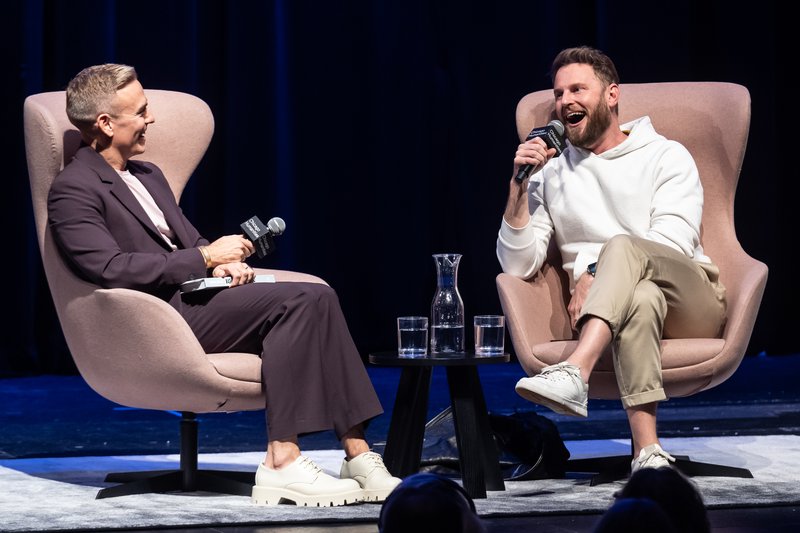
Matthew Rodrigues ( L ) and Bobby Berk ( R ) at the Chicago Humanities Fall Festival at Francis W. Parker School in 2023.
Bobby Berk, Right at Home
Recommended Listening

- Podcast
- June 27, 2023
Gigi Gorgeous and Gottmik on Transgender Expression
- Podcast
- November 7, 2023
Life Advice from Your Film Dads: Harold Ramis (2009), John Waters (2022)
- Podcast
- May 16, 2023
Jessica Lange Captures Truth in Photos
Become a Member
Being a member of the Chicago Humanities Festival is especially meaningful during this unprecedented and challenging time. Your support keeps CHF alive as we adapt to our new digital format, and ensures our programming is free, accessible, and open to anyone online.
Make a Donation
Member and donor support drives 100% of our free digital programming. These inspiring and vital conversations are possible because of people like you. Thank you!