Ed Begley Jr. Steps into the Energy Efficient Spotlight
Exclusive Interview
S2E3: Ed Begley Jr.
Apple Podcasts • Spotify • Pandora • Overcast • Pocket Casts
Actor, environmentalist, and all around mensch Ed Begley Jr. is in the house! We have a Chicago Humanities Tapes first, with our man of the hour joining podcast host Alisa Rosenthal in studio for an exclusive chat about his new memoir To the Temple of Tranquility… and Step On It! Topics include ‘70s-era electric cars, his friendship with Tom Waits, and the best vegetarian soups.
Read the Transcript
[Theme music plays]
ALISA ROSENTHAL: Hey all, what’s going on. Welcome to Chicago Humanities Tapes, the audio arm of the Chicago Humanities Spring and Fall Festivals. We’ve got a treat for you today - I’m joined in the studio by actor, environmentalist, and all around mensch Ed Begley Jr. His new book To the Temple of Tranquility… and Step on It! was just released! The link to check it out is in our show notes at chicagohumanities.org. And hey, while you’re there, you can nab a ticket to see Ed in person along with his friend and Chicago-born actor Bob Balaban at our Fall Festival on Saturday, October 28th at 4pm at the stunning First United Methodist Church.
You recognize Ed Begley Jr. from all your favorite movies and TV shows - St. Elsewhere, Christopher Guest mockumentaries, Better Call Saul, Arrested Development, and hundreds more. He’s here to talk about his incredible life - what he refers to in his book as a sort of Zelig or Forrest Gump effect of happening to be in the right place at the right time of major historical moments. Beyond his showbiz life, he’s been an outspoken environmental activist his entire adult life.
Without further ado - that was a lot of ado - Ed Begley Jr, thank you so much for joining me today.
ED BEGLEY JR.: Alisa, thanks for talking to me.
ALISA ROSENTHAL: And you have your your new book out to the Temple of Tranquility and step on it.
ED BEGLEY JR.: Yeah.
ALISA ROSENTHAL: And this is your third book, I believe.
ED BEGLEY JR.: Yeah, I wrote a couple of environmental books there. How to books, you know, how to save energy and hopefully save some money in the bargain. And those did fairly well. But people kept suggesting I do a memoir, and I thought about it for a while, and then it started off innocently enough. I started taking some notes with my daughter, so she brought her iPhone. We decided we'd capture my whole career with as much as our data plan and battery would allow. And so we started recording, and pretty soon I went, You know what? I'm going to start writing some of this stuff down too honey. And pretty soon I had 45 pages of a book and I went, This is fun. I'm going to do this.
ALISA ROSENTHAL: That's great. The stories are just amazing. I was really, it you really captured L.A. in the seventies. Sounds like a pretty cool place to be.
ED BEGLEY JR.: Very cool. The Valley was great. And for me, the allure of the other side of the hill going across Mulholland into Hollywood West, what's now West Hollywood and all of that, it just it was fantastic. The Troubadour was a big draw for me and all the other clubs and people that lived on the other side, the cool side of the hill there in Hollywood. It was just great.
ALISA ROSENTHAL: And you were very involved in the stand up scene.
ED BEGLEY JR.: I was. I started with a partner years ago. I went to college with Michael Richards, the actor and comedian Michael Richards. We had a duo for a while. He went off to the Army, so I decided I'd try things on my own and I did standup for a few years and then fortunately got busy with TV and films. And he did very well with standup then, did a lot of hit TV shows after that.
ALISA ROSENTHAL: What was the difference for you in doing stand up and doing TV and film?
ED BEGLEY JR.: Stand up were so much harder. You know, it's a lot of work. You get all the praise or all the criticism, but you're up there alone. And so and I, Alisa, I decided to make my life as difficult as possible. I was a prop comic and I had, you know, tape playback, a little cassettes that I put it in, and I'd playback some music. I had a slide projector behind me with images. I just how can I complicate my life with what I I unwittingly did? But I know better now. I try to keep things simple, but TV and film is great because, "Mr. Begley, 5 minutes please we are almost ready to shoot the scene." So they're going to help you with about, you know, every bit there's a department to help you. The sound guy is there to put the mic on you. You know, this one is there. The script supervisor is there to help you if you don't know your lines, the director will direct you. The you know, it's all kind of different departments handle everything. So stand up is great. I love it and I admire the people that do it. But I took the easier, the softer path with TV and films.
ALISA ROSENTHAL: Well, I was really impressed, too, with the amount of education you talked about, different classes you continued to take and classes throughout the book that you recommend. I feel like it's rare that we hear actors talk about that process. What's drawn you to continuing education in classes?
ED BEGLEY JR.: Two words Bruno Kirby. He was a dear friend of mine, the wonderful actor Bruno Kirby. And he went, We met as young actors working on some silly films together in being in interview, waiting rooms together. And so he, you know, went back to class and he changed his name from Bruce Kirby Junior to Bruno Kirby and got very serious about his work, really studied with Peggy Fury and other great teachers in L.A. And so I went back to class and studied with her and with Roiland and these people and finally began to learn on the job. Fortunately, I didn't get fired much. I kind of learned on the job and I hadn't a lot of skills my dad did, and my father made it look so easy. I went, “I can do that. In fact I want to be a regular. Can you get me a gig? I literally thought my father could pick up the phone. I literally thought he had the power or the will to do that. Imagine how little I'd appreciate it if he had just picked up the phone, but still somebody picked up some phone somewhere just to get me into the room to audition. How did I get that? I got that because I was Ed Begley's son, and I soon began to appreciate how lucky I was to be the son of a wonderful talent like him. Whatever your parents are in the field of law, medicine, entertainment. If somebody does very well at it, you're lucky enough to get a shot at it and you can deliver, hopefully, and don't, you know, do too badly early on. You can have a career, as I very fortunately have for 56 years now. I'm I'm blessed to still be working.
ALISA ROSENTHAL: I will say, Bruno Kirby is such a great actor.
ED BEGLEY JR.: Oh boy.
ALISA ROSENTHAL: When Harry Met Sally. He’s so -
ED BEGLEY JR.: Isn’t that a great movie? He's so good in that. I mean, I really studied at the knee of a great actor now with Bruno. He was my friend first and my unwitting teacher, too. He was just great and taught me a lot of kindness and loyalty, things I didn't have a huge supply of. My dad was a great father and was loyal in many ways, but there was also kind of a Darwinian thing going on at our household, kind of. But, you know, you'll learn better next time, boy. You know, and I needed some of that. But, you know, sometimes maybe it was a little bit much. But Bruno was fiercely loyal and kind and would help people wanting nothing in return. There was an actor called Leopold Trieste, maybe he's still alive. I hope he is, was an older gentleman back in the seven in ‘72 and three. And and Bruno took him around to different things when he was in L.A., took him to Palm Springs and showed him that in New York, he took them to upstate New York. And because he was alone in a room, an Italian actor that didn't speak much English, even that's what Bruno was like. I was in Pasadena after an injury one night at the Ice House. I got my leg broken. Bruno came every day with mail and with nutritious foods, and he did. That wasn't just me and Leopold Trieste. He did it with everybody he encountered. He was a wonderful, wonderful friend for me and countless others.
ALISA ROSENTHAL: Your friendships really stood out to me throughout the book. I was. I really loved how you painted these really full pictures of so many different people. And I was particularly excited to see all the musicians that you were friends with. And you had mentioned being a drummer, friends with people like Tom Waits and Harry Nilsson.
ED BEGLEY JR.: Oh, boy. Two huge talents. And Harry, we lost many years ago, of course, in the nineties, but Tom is still in my life. I talk to him from time to time and his beautiful and talented wife, Kathleen, they work together, have collaborated for years, and I met him in 1974. I was I was going I would just coming out of a club called the Main Point there at Bryn Mawr. And he was just going in to do his week there at this wonderful little club. And we met at a radio station, I think, publicizing the club. And I went, Who is this guy? This guy's fantastic. And I got his music and I just was bowled over. I think I heard him first live in the club in Bryn Mawr there, and I went, Oh my God, I'm in the presence of greatness. And we've been friends to this day. Wonderful. He branched off into acting, something he was qualified to do from day one, and he's a brilliant actor as well, and probably saw the Coen Brothers movie where he plays a prospector. Everything he does is just, you know, amazing.
ALISA ROSENTHAL: So talented. It must have been just wonderful to see him live when no one really knows what's about to come.
ED BEGLEY JR.: Exactly. It was very exciting.
ALISA ROSENTHAL: Is there anything you can speak to about having a creative friendship? I think that's really interesting. You speak of so many different actors and musicians that you're friends with. Is there something with the the creativity of these relationships that impacts your your creative life or your personal life?
ED BEGLEY JR.: It definitely does. It affects you when you see people that are doing the kind of work. You know, my friend Joaquin Phoenix is doing, you know, see something like that. And I know I can never do that, but I can aspire to that and learn from that and see the kind of commitment that he has for a character, any movie movies ever done. He's always brilliant, always present, always totally in character. And it's just an acting lesson for me to be around somebody like that, you know, and Jack Nicholson to work with him. Incredibly, incredibly brilliant. Meryl Streep. I work with her and to be around people like that. You you learn you get on your game quickly because they're all so damn good. And I'm very lucky to have learned for those people. And, you know, some of them were kind enough to recommend, Hey, I had a great acting teacher. I work with this guy Roy London. I hadn't heard of him. This was in the nineties. I started work with Roy London and he gave me some words of advice that were really life changing and it's helped me improve as an artist to this day.
ALISA ROSENTHAL: I really loved how in the book you lifted up the women that you worked with, including Annette Bening, who's one of my favorite actresses.
ED BEGLEY JR.: Mine too.
ALISA ROSENTHAL: Just yeah, wonderful to hear that insight from working with such powerful women.
ED BEGLEY JR.: Yeah, they it started early on. My mother and father split up when I was about one year old. My my birth mother was not married to my father. She had two children, my sister and I, to Ed Begley and his wife Amanda, who could not have children as it turns out, we knew none of this. We just thought our mother had died at age seven. We didn't know this woman who left when I was about one. That was not part of our conscious life, my sister and I. So we got to know her. But this woman, Jeanette Pierre from Alsace–Lorraine, came into our lives and she was tough, but kind as well. A perfect combination of both. When I say tough, I mean strict, you know, and properly strict for kids who are starting to get wild with their mother passed away and sometimes the wrong kind of people watching us. And so this woman came in and she was just great. She played the organ. She made beautiful art. She planted a garden. She did everything. She did handiwork. She was the strong and powerful, outspoken French German woman from Alsace–Lorraine and French woman from that region of Alsace–Lorraine and had hidden her brother from the Nazis herself, was part of the underground, you know, the resistance, I should say, and just amazing woman. And she came into our lives at my age seven to my age 12. My sister's a year older to her age at age 13, key years of course, for any young person, she came at the right time and got us on the wrong track when we were very much veering off somewhere bad.
ALISA ROSENTHAL: You spoke a lot about growing up in the shadow of your father in terms of your acting career. And you also mentioned how that was the beginning of your engagement with environmentalism. Your father and being in L.A.. When did that start for you?
ED BEGLEY JR.: It started from the earliest stage because my dad was influencing me in some of the best possible ways I could imagine. Looking back at it now, he never used the word environmentalist that I remember, but he was one because he had lived through the Great Depression. He was a son of Irish immigrants. We turned off the lights. We turned off the water. We saved string. We saved tinfoil. So when Earth Day came around in 1970, I was poised and ready to do something. And the best thing he gave me years before, when I was complaining about the smog. He said, "Eddie, I don't like the smog either. I know what you're against. You're against the smog. Me too. But what are you for? What are you doing to make it better? You're gonna ride your bike more? Are you going to take the bus? You're going to maybe one day, you know, build an electric car? Do something, do something positive. Don't just complain about things. What do you say yes to?" That was a great lesson. So I got involved in 1970 and bought my first electric car. I started recycling, started composting, became a vegetarian, you know, use nontoxic soaps and cleaners or what have you. And it all was not only good for the environment, but it was good for my pocketbook and saved me money. All these choices were good green choices for that other green - cold money. And so I stuck with it. I knew my dad would be proud, too. He died within a few days, the first Earth Day. So I did a lot of that stuff to honor him as much as anything else.
ALISA ROSENTHAL: Wow, that's beautiful. And you have, you seem to have very interesting luck with cars, particularly. You told a great story about going on a date with an electric car.
ED BEGLEY JR.: Yeah. I pick up Cindy Williams who I was in love with. I met her on the at the Christmas party. She was there for the Christmas party. And I went, Wow, who's that? She did an episode. I heard she's beautiful, she's smart, she's funny, she's great, And I had the temerity to take her out on a date. And so I did. I asked her out on a date. Unfortunately, I hadn't figured the uphill climb or the state of charge in the batteries. And so I picked her up. We were like crawling up to the restaurant. I think a kid on Big Wheels passes by. I think a butterfly went past us at a faster rate. So there wasn't the second date. Not that she was into the hot rod. Well, a few years later, she would be in the hot rods on screen. She's a great actress and we became great friends. Remains so to her sad passing about a year ago now. Great, great influence on my life, too, as an actor. Just a brilliant actress, not just the people think of her as the TV actress that she was that, of course, but a great film actress. A great film star. I love that woman and I miss her still.
ALISA ROSENTHAL: I love American Graffiti. She's so great.
ED BEGLEY JR.: She is great. Everybody's great. Richard Dreyfus is great. You know, Charles Martin Smith, everybody. Just fantastic. Harrison Ford, a young Harrison Ford with a line or two perhaps is brilliant and that everybody just so good.
ALISA ROSENTHAL: I think I saw from your Instagram or your your daughter's Instagram doing some some gentle Instagram stalking that you take the L.A. public transit to some some pretty big events.
ED BEGLEY JR.: Yeah, we went to the Oscars this year. I've done that. I've done that before with Hayden. Rachelle lives, you know, to ground up to do the subway commitment. But Hayden's really got the team spirit. She'll take off her high heels and walk with them in her hand. Fortunately, I convinced her to bring these little moccasins with us so she wouldn't barefoot the streets of Hollywood, but she's game for that sort of thing. So she did a wonderful TikTok where she she took transit all week. She takes it regularly anyway, but she took nothing but L.A MTA public transportation all week, culminating in the night of the Oscars. But we went there together and came home together. And of course, I left her little moccasins that I insisted on under the seat at the Oscars. And so we're walking along. She is now barefoot, holding our shoes, but we found a little store that sold flip flops, you know, a T-shirt, kind of Hollywood Boulevard souvenir shop. And we got her in some flip flops that we made at home without too much damage to my daughter's feet.
ALISA ROSENTHAL: That's so funny. Who are you wearing? CVS.
ED BEGLEY JR.: Oh, that's very funny. Very funny.
ALISA ROSENTHAL: That's great. I'm curious for other tips you can think of for actors who want to do their little part to help the environment and help the climate. And I think public taking public transit when possible is a really a really great start.
ED BEGLEY JR.: It is. I urge people to do it just exactly the way I did it. People rightly say, Hey, I can't afford a fancy electric car like you drive today, or nine kilowatts of solar like you got it on your roof. And I go, Neither could I when I started, I couldn't afford solar for 20 years. It took me till 1990 from that first Earth Day in 1970 to get solar electric on my house. But what I could do then was the cheap and easy stuff. But those choices exist more than ever today. Energy efficient light bulbs. Energy saving thermostat. Bike riding if weather and fitness permit. Public transportation if it's available near you. Home Gardening. Home Composting. Become a vegetarian one day a week. Meatless Monday or something that if you like to do in the second or third day, we can do as much as you can. It's not about you have to absolutely do everything. You know, I made a commitment years ago to not fly as much as possible, so I go years without flying. But occasionally you got to be Monday in L.A. and Tuesday in New York for a job, and you get in a plane like a reasonable person. So that's what I do. I just, you know, I try to, you know, be consistent, you know, but be flexible in some ways, that makes it practical for other people to do, too like my family. Now, I can't force them to do something that's difficult for their lifestyle. So I try to be reasonable with my wife and my daughter. So far, so good.
ALISA ROSENTHAL: Yeah. And in the book you mention your inspiration and relationship with Cesar Chavez and your commitment to the cause of farm work.
ED BEGLEY JR.: Yeah. Back in the sixties I became involved from a distance. I gave some money to the strike fund for the United Farm Workers because I heard of the difficulty in the fields working in that heat with no shade, no bathrooms, no water provided for any of the workers. So it was a very difficult life. And they had the grape boycott, the lettuce boycott. So I stopped, you know, no uvas, no grapes, no lechuga, no lettuce. And I helped in that way and as I said, gave some money to the strike fund. But then years later, in the eighties, I met him at a little restaurant in in Los Angeles, near LAX, I got to know him and I worked with him on pesticide issues. That was something that crossed over between the labor movement and the environmental movement because you'd see these people in the fields working there and a plane would come over and spray the field right where they're working in it. You know, they'd come home with these pesticides on their clothing. There were, sadly, these cancer clusters of young kids that had cancer, you know, in the Central Valley, McFarland and Earlimart and other places like that. And I think some contaminated water. So, you know, I tried to help in those matters. And he had an amazing, amazing life, The amount of people that he affected and the changes that he made, you know, with improvements in the conditions in the field, that still needs to be more work done today. People are still dying in the fields from the heat. And that needs to be more ways to protect the workers. But he did a great deal. And, you know, I had the sadness and the honor of carrying his coffin through the streets of Delano when he passed. And so he was a great man. 35,000 people turned out. I've never seen 35,000 people at a memorial, at a funeral. You know, maybe for a president or what have you, that amount of people turn out. But I've never seen anything like it. And he had been himself a farm worker like the people he was representing as a union leader and lived very simply and was just the closest thing to a saint I've ever encountered in my life.
ALISA ROSENTHAL: That's incredible. And in your book, you speak a lot to being aware of your privilege and how that helped you with work throughout your life. But I think you also really paint the full picture of the work that you personally have done grappling with that privilege and the work that you can do to lift up others who don't have the the same things handed to them. I just was really moved by that.
ED BEGLEY JR.: Thank you for that. I certainly had no idea of my privilege as a young man. I thought, boy, I've got it so hard, I'm the son of this guy and people are going to compare me to him. And what a rotten deal I've got. Jesus, I'm not him. I'm different I'm the different. I'm a tall, blond guy and he's shorter. And it were different. Why? And I quickly, not quickly at all. Slowly, finally realized what a great gift it was being his son. If you're going on a job interview, as any young actor is, it's a job interview to read for a part or what have you. There's two things that might be of help. Number one, they remember your name. My name is Ed Begley Jr.: They're going to remember that. Or Rob Reiner or Liza Minnelli. They're going to remember the son or daughter of, you know, for some very good reason. Number two, they're going have something to talk about. "I worked with your dad on the show. That was fantastic.” Rod Serling wrote that thing, I worked as a young man on that too. "Good luck Eddie, top of page eight. Let's begin." You got a leg up right away. They're kind of rooting for you. So that's the way it went. I didn't see that as a young man. But finally, by the time I got sober in the late seventies, you know, it's 1979, I began to see such things and see them clearly and see what a benefit it was being his son and how much I got out of it. I didn't I didn't have a lot of gratitude before that. They say when you start drinking and using you, you stop maturing as a person. So really, when I turned 30, when I finally got sober, I was really 15, you know, emotionally, because I hadn't really gone through the pain or the joy of certain things that when you grow because you're trying to as an addict or an alcoholic, you're trying to numb things. And if you're successful with that, you really stop growing because you don't learn much. So I began to be really grateful in the late seventies, and that gratitude is increased every year. I'm the luckiest guy I ever met. I just I can't believe my good fortune to still be working in any business. If you'd sold aluminum siding or storm doors or used cars, you're still working after 56 years in a business. Come on. Where did I go right, Alisa? I don't know. But I'm happy for it.
ALISA ROSENTHAL: Oh, it's just wonderful. I'm so excited for readers to work through your book because some of your stories from before your sober days are very wild and very fun. And it's really interesting too to see that turn when you start working more with people like Christopher Guest and your career moves in this whole different direction. And I find that very inspiring to people who have put in a lot of time and then there's a big change like that. Then things start to take. A lot of people, I think, have trouble waiting.
ED BEGLEY JR.: That's exactly what happened. I had a wonderful shot with that show in the eighties, '82 through '88, we did that. But after that, I did a few movies in a row that didn't do well. Critically, they weren't critically acclaimed, nor did they do any big box office. So there is a three strikes law in California, you know, and motion pictures as well. But if you do three turkeys in a row, you know you're not going to get a lot of work. So I can still work. And I had six weeks on that movie that Brian Grazer and Ron Howard gave me. Very nice of you to give me that. But that's it. That's a whole decade of the nineties. Six weeks and one week I could work in television. I could go down to Australia, do a movie with a little girl on a kangaroo. I did that. I could do a movie with a little girl and a bear. I did it in Canada. But in this country, three strikes, you're out. I was in movie jail and Chris guest like a dear friend, a family member came in, bail me out of movie jail, gave me a part and it's been uphill ever since I met, well, I met Chris many years ago. But after that kind of low that, okay, Ed? What's he got next? You know, not not too exciting. But then with Chris, I started working in movies again, started doing better work in every way. And it was a lucky day when I when I got working with Chris. Yes. I'm very fortunate to still know him well.
ALISA ROSENTHAL: And those ensembles are just so fun. I can only imagine those sets are just an absolute blast.
ED BEGLEY JR.: They are. And Bob Balaban, son of Chicago, the great Bob Balaban, who I'm going to see soon in Chicago, I believe. I did my little shtick spouting all this Yiddish, and that's fine. But without Balaban, it doesn't work. He's sitting there like, What is this guy talking about? Why is he trying to? He's clearly this goyishe blond guy. Why is he talking in Yiddish? He's from Sweden originally. I don't know what is going on here. And that sells the joke is Bob, that makes the scene funny. He's a great, great friend and a great director and a great actor.
ALISA ROSENTHAL: That scene is very famous in the Rosenthal family household. We love it.
ED BEGLEY JR.: For you to schep nacchas like that. I'm telling you, it's a mitzvah. I'm just. I can hear you kvelling there with the rest of your mishpocha. Thank you.
ALISA ROSENTHAL: Exactly. Well, we've just got a couple minutes here and you read my mind. What can we expect from the live event we're about to have you here on October 28th with Bob Balaban?
ED BEGLEY JR.: Well, Bob Balaban is a great improvisational actor and he'll have some questions he's planned, I'm sure, but he's great off the cuff. Me? Not so much anymore. I'm starting to slow down a little bit mentally, but if I can keep up with Bob, I'll be fine. It's going to be fun. It's going to be whatever it is. I like to go into situations like that kind of wonderfully unprepared and see where the evening takes me and, you know, it'll it's just great any time I spend on mic or on stage with Bob Balaban, I know it's going to be good. And I hear it's a wonderful event. I haven't been to it. So it's a gift for me to be part of the Chicago Humanities Fest, and so I can't wait to be there for that. I hear it's wonderful.
ALISA ROSENTHAL: We really appreciate it. Yeah, the audiences are so great. They're they're going to love you. They're going to love the book. I poured through your book so quickly. It's such a gem to have all of these stories compiled and and told in such a funny and thoughtful way. I think it's just wonderful.
ED BEGLEY JR.: Alisa, bless your heart. You've made my year. That's so kind of you.
ALISA ROSENTHAL: You got it. Well, last question for you. I got to know, what's what's for dinner tonight? What are you having?
ED BEGLEY JR.: I'm going to have some cream of potato leek soup. Vegan. No real cream. You do it with tahini. It tastes like regular cream. And I've got some broccoli that I did with some scallions and garlic and ginger and jalapeno. So I've got some lovely food. I made a nice guacamole, too. I made a spicy Thai basil eggplant that I have in the fridge too. And I made an olive tapenade. So I've got some wonderful food that I made myself the past day, and I'll have some very tasty leftovers.
ALISA ROSENTHAL: Oh, that sounds great. You know, it's fall in Chicago right now, so we're officially in soup season, so I think that's -
ED BEGLEY JR.: I love my soups.
ALISA ROSENTHAL: Gotta have it. Well, Ed, thank you so much for this time. I really appreciate it. And we look forward to having you live in Chicago.
ED BEGLEY JR.: Thank you, Alisa. It's been a joy to talk to you.
[Theme music plays]
ALISA ROSENTHAL: You can catch Ed Belgey Jr. live in conversation with Bob Balaban at the Chicago Humanities Fall Festival on Saturday, October 28th at 4pm at the First United Methodist Church. Head to chicagohumanities.org to snag tickets and easily add his book To the Temple of Tranquility… and Step on It! to your order to pick up at the event. By pre-ordering your copy, you save 20% while supporting our local independent bookstore partner Seminary Co-op.
Chicago Humanities Tapes is produced and hosted by me, Alisa Rosenthal, with help from the team over at Chicago Humanities. Shout out to the hardworking staff who are programming these live events and making them sound fantastic. For more than 30 years, Chicago Humanities has created experiences through culture, creativity, and connection. Check out chicagohumanities.org for more information on becoming a member so you’ll be the first to know about upcoming events and other insider perks. We’ll be back in two weeks with - are you ready for this? - A Very Chicago Humanities Halloween. But in the meantime, stay human.
SHOW NOTES
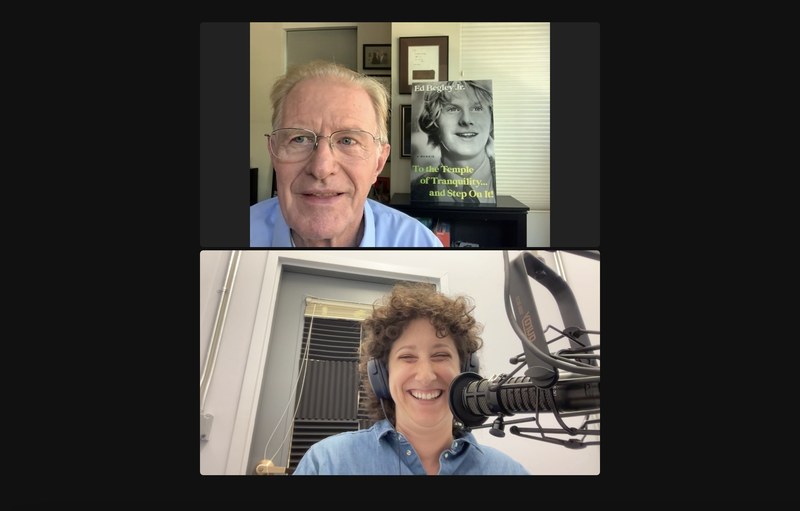
Ed Begley Jr. ( top ) and Alisa Rosenthal ( bottom ) chat over Zoom.
Ed Begley Jr., To the Temple of Tranquility… and Step On It!
Recommended Listening
- Podcast
- April 3, 2024
Getting Schooled in Hip Hop with the Notorious Ph.D.
- Podcast
- February 6, 2024
Henry Winkler: Lessons from a Real Sweetheart
- Podcast
- July 11, 2023
Joan Baez on Music, Art, and Lifelong Activism
Become a Member
Being a member of the Chicago Humanities Festival is especially meaningful during this unprecedented and challenging time. Your support keeps CHF alive as we adapt to our new digital format, and ensures our programming is free, accessible, and open to anyone online.
Make a Donation
Member and donor support drives 100% of our free digital programming. These inspiring and vital conversations are possible because of people like you. Thank you!