"The Most Powerful Thing in the World": Three Poems About Power
The Poems While You Wait collective is a staple at the Chicago Humanities Festival. We asked three of their poets to write on our “Power” theme and explain their approach to fast-paced poetry production.
CHF: What is Poems While You Wait, and besides our Fall Festival, where can one typically encounter you?
Hannah Radeke: Poems While You Wait (PWYW) is a team of typewriter poets. We go to events and public places around Chicago and compose poetry on demand using topics that people come up with and give to us. And then in 15 or so minutes, they have a poem to take home! Apart from festivals and similar venues, we like to go to places where someone may not expect to encounter poetry. We’ve poemed at places like the International Museum of Surgical Science and the Chicago Symphony. Weddings are popular too.
CHF: So, you’re saying you write your poems in just a few minutes? Don’t poets typically brood over their drafts, anxiously revising every minute detail of their works?
Kailah Peters: Yes! That’s what makes this so fun and challenging. We are forced to think quick and be okay with whatever happens, mistakes and all.
Hannah Radeke: To me, it’s the best exercise in being imperfect. Sometimes I have a hard time finishing poems because I’ll keep working on them until they’re exactly where I want them to be. But in PWYW, there’s no room for that. You have to be okay with imperfection.
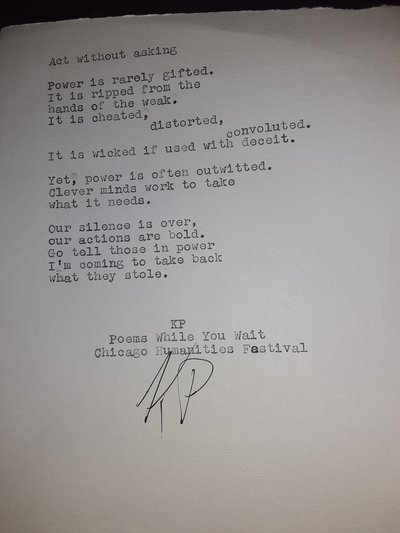
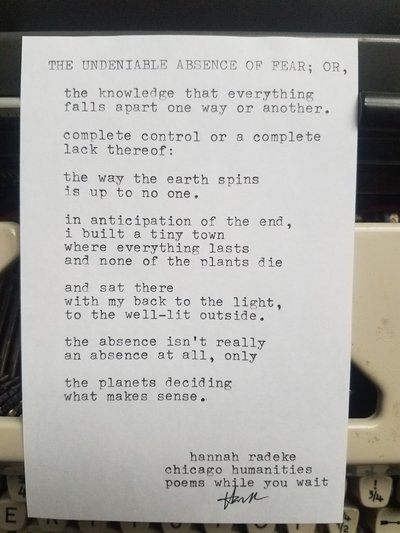
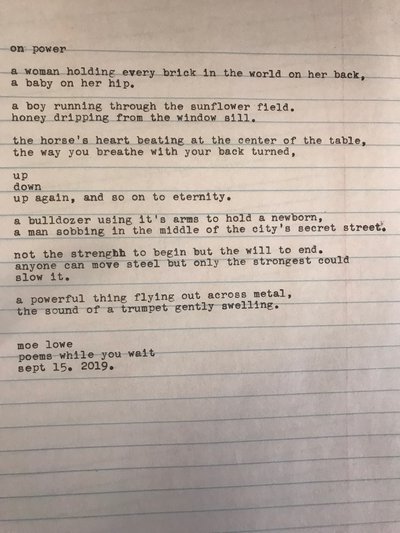
CHF: We asked you to write poems related to power. Hannah, in your poem the speaker deals with her fear of losing control by building a tiny town where “everything lasts / and none of the plants die.” Kailah, your poem is a forceful call to take back the helm from “those in power,” after they had “ripped” it “from the / hands of the weak.” Moe, your poem paints paradoxical imagery, where bulldozers use their “arms to hold a newborn.” It’s curious that our prompt to write about power evoked such diverse responses from you. What’s the process in your mind that leads to your poems after receiving simple prompts like these?
Kailah Peters: My process is a little different each time. Usually I try to gather everything I know about a topic, then see where my mind wanders from there. I’m conscious of my biases and I let them show in the poem. I also love when I can make weird connections between seemingly unrelated facts.
Hannah Radeke: I like to let the topic sit in my mind a bit and kind of see where it leads. I’ve been thinking a lot recently about loss of control and how life often goes against how we’ve planned it and about the scariness of that, but also about the liberation in that realization. After giving myself room to think, I’ll start writing. I usually don’t know how the poem will end until I get there.
Moe Lowe: My process is so messy—I wish I knew exactly how to blueprint an interesting poem or idea. A lot of the time I toy with the first few words of the poem until I can’t toy with them anymore, at which point I write them down. I usually try and sit with the prompt and think about what it means to me and what it evokes in me specifically, then what it means to the rest of the world. I try and play with that dichotomy. A lot of the time it lends itself to a form of writing you didn’t know you were capable of. Sometimes you get stuck. A lot of the time you don’t. It’s an ebb and flow.
CHF: What power do you ascribe to poetry? Wallace Stevens famously wrote that “It can kill a man”…
Kailah Peters: I think of it like a looking glass. By reading someone's poetry, you can see how they view the world. All our power poems were different because we all interact with and view power differently.
Hannah Radeke: I think poetry has a way of slowing things down and letting us see our thoughts in real-time. It’s description at its purest. I think poetry has a lot of power to connect people as well. Even the most different-seeming people share the same emotions, so it has the capacity to create empathy too.
Moe Lowe: Poetry lends itself to a certain universal truthfulness that other genres just don’t. It’s like the saddest and most satisfying surprise in the world; it’s complete and total clarity but with the absence of any sort of traditional grammatical or literary sense. Poetry is the only thing that is able to accurately describe, know, and experience whatever overzealous complexity life is, and to me, that’s the most powerful thing in the world.
HEADER PHOTO CREDIT: Patrick Fore
Become a Member
Being a member of the Chicago Humanities Festival is especially meaningful during this unprecedented and challenging time. Your support keeps CHF alive as we adapt to our new digital format, and ensures our programming is free, accessible, and open to anyone online.
Make a Donation
Member and donor support drives 100% of our free digital programming. These inspiring and vital conversations are possible because of people like you. Thank you!