Presenter Q&A: Heather McGhee on Race and the Solidarity Dividend
Heather McGhee is an expert in economic and social policy and the chair of the Board of Directors at Color of Change, the nation's largest online racial justice organization. Ahead of her CHF program, we talked to McGhee about her new book The Sum of Us: What Racism Costs Everyone and How We Can Prosper Together.
CHF: In The Sum of Us you talk about a Solidarity Dividend, which refers to the gains made when people come together across race. What are some examples of people practicing the Solidarity Dividend that resonated the most with you while researching your book?
1) The Fight for Fifteen Movement
McGhee: One example of the Solidarity Dividend is the success of the ongoing Fight for $15 movement. It began in 2012, when fast-food workers, mostly Black and brown, walked off the job in New York City to demand a raise from the poverty-level minimum wage of $7.25 an hour to $15 and a union. Within a year, the demand had spread nationwide. In 2014, Seattle became the first city to establish a $15 minimum wage.
Based on cross-racial organizing and led by workers of color, the movement has won a $15 minimum wage in states and cities across the country, and wage increases from giant employers like Walmart, McDonalds, and Amazon, resulting in over $68 billion more in the pockets of 22 million low-paid workers—the majority of whom are white. One white fast-food worker who joined the Fight for $15 told me that organizing side-by-side with Latina and Black workers had changed how she saw the world. “[A]s long as we’re divided, we’re conquered,” she said.
2) Cecile Thornton from Lewiston, Maine
McGhee: I was moved by the Solidarity Dividend that reinvigorated the town of Lewiston, Maine, which had lost factories, jobs, and residents in the 1970s. In the 1990s, refugees from African countries began to fill Lewiston’s vacant apartments, storefronts, and classrooms, expanding the town’s tax base.
For white retiree Cecile Thornton, the refugees brought a new sense of community. Her parents had been French-speaking Canadian immigrants. In Cecile’s youth, “Francos” were mocked, so she stopped speaking French; by the time she was in her 60s, she had mostly forgotten how. Feeling lonely, Cecile visited a French Club in town. She was shocked to find that she was the only white person there; she had no idea that French-speaking Africans lived in Lewiston. Cecile told me that she “fell in love” with the refugee community. She helped new arrivals get settled, and helped elderly white Mainers from French-Canadian backgrounds connect with their new Black neighbors who spoke what had once been their mother tongue.
3) Residents of Richmond, California
McGhee: Richmond, California is dominated by a massive Chevron refinery and dotted with toxic industrial sites. Due to prevailing winds, North Richmond, which is 97 percent people of color, seems to receive most of the airborne pollution, and has disproportionately high rates of cancer and asthma. But when I examined the data, the nearby neighborhood of Point Richmond—predominantly white and wealthy—recorded about the same amount of toxins in the air.
Chevron controlled Richmond’s city council, so the only way for residents to have a say was for activists representing different ethnic communities to join together, which they did in the early 2000s. Today a multi-racial coalition has elected progressives to the city council and a Green Party mayor, blocked Chevron from a major plant expansion, and won community benefits that include a 60-acre solar energy field owned by the public. Richmond’s Solidarity Dividend has resulted in reduced pollution, new jobs, and the chance for better health for everyone.
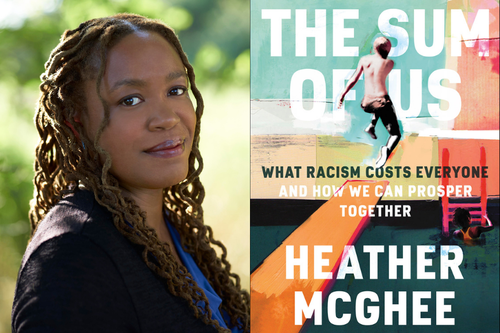
Heather McGhee is an expert in economic and social policy. The former president of the inequality-focused think tank Demos, McGhee has drafted legislation, testified before Congress and contributed regularly to news shows including NBC's Meet the Press. She now chairs the board of Color of Change, the nation's largest online racial justice organization. McGhee is the author of The Sum of Us. McGhee holds a BA in American studies from Yale University and a JD from the University of California at Berkeley School of Law.
Watch McGhee's conversation with Helene D. Gayle, President and CEO of The Chicago Community Trust.
[Hero image description: The banner image at the top of the web page is a photograph of a Fight for $15 rally in Oakland, California. In the photograph, five people stand in a line, hands raised, holding a large red banner that reads: “Fight for $15: NCY, Chicago, Oakland.” Behind them are a group of supporters. Image credit: Wikimedia Commons]
Become a Member
Being a member of the Chicago Humanities Festival is especially meaningful during this unprecedented and challenging time. Your support keeps CHF alive as we adapt to our new digital format, and ensures our programming is free, accessible, and open to anyone online.
Make a Donation
Member and donor support drives 100% of our free digital programming. These inspiring and vital conversations are possible because of people like you. Thank you!