The Great Lakes: Visual Lakescapes
The biodiversity, seasonal landscapes, and force of the Great Lakes have inspired sculptors, painters, and photographers across the states and territories that share their great shores.
They offer the Great Lakes as sites of connection and activation, reflection and introspection:
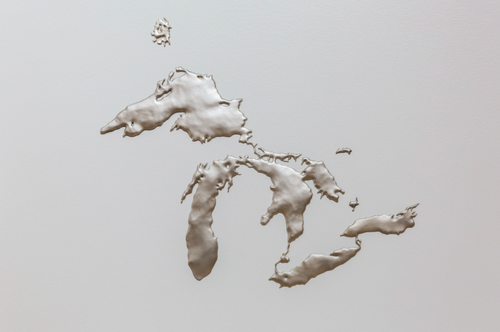
The Traces Left Behind (From the Great Bear Lake to the Great Lakes) (2019)
Maya Lin, best known for her work designing the Vietnam Veterans Memorial in Washington D.C., created The Traces Left Behind (From the Great Bear Lake to the Great Lakes) for her water-focused exhibition Maya Lin: Flow. In this work, the artist, architect, and committed environmentalist, charts the span of contemporary bodies of water from the Arctic to the Great Lakes. The image she creates brings the Great Lakes and their connection to other bodies of water—and to the geological forces that created them—into relief.
Image credit: Grand Rapids Art Museum. Description: An artwork by Maya Lin of the five Great Lakes made from recycled silver.
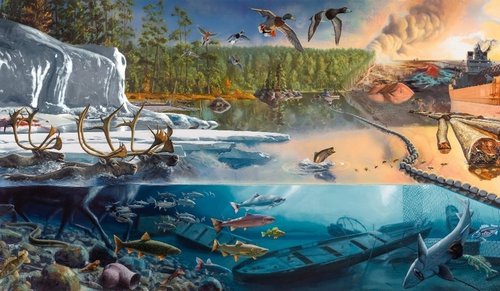
Cascade, 2015. Oil and alkyd on wood panel, 72 x 144 inches.
Painter and environmental activist Alexis Rockman conceived The Great Lakes Cycle after seeing tourist posters depicting romanticized landscapes of the lakes. By adding environmental threats like invasive species, disease, and pollution to the idyll, Cascade and the other paintings and drawings in the series ask viewers to reconsider their imaginative relationship to the Great Lakes ecosystems.
Image credit: Grand Rapids Art Museum, 2015.19. Description: A painting of a lake by Alexis Rockman depicting below water, where animals are swimming, and above water, where birds are flying. The natural and pristine environment gives way to industrialized waters on the right side of the image.
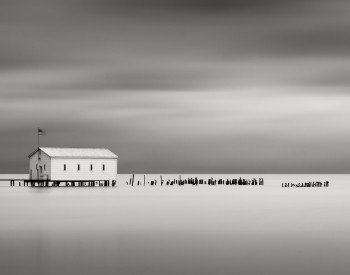
"On Anchor bay, Lake St. Clair, Michigan," 2010, Jeff Gaydash, American. Collection of the artist.
Seeking a different kind of honesty about the Great Lakes, Detroit area photographer Jeff Gaydash traveled to coastlines throughout Michigan to capture their vastness and solitude. Gaydash is an expert in long-exposure and digital printing and enthusiastic about nature. His photograph On Anchor Bay, Lake St. Clair, Michigan reflects the tension between the deteriorating human artifacts and the enduring natural beauty of the shorelines. “When I head to the shores of the Great Lakes”, he reflects, “I continually witness nature behaving in all its glory…. While the pursuits of humanity have had negative effects…my confidence lies in nature’s ability to renew, repair, and cleanse itself from our destructive habits.”
Image credit: Detroit Institute of the Arts. Description: A black and white photograph of a bay on a cloudy winter day with a white house on what seems to be a pier, the water frozen over all around.
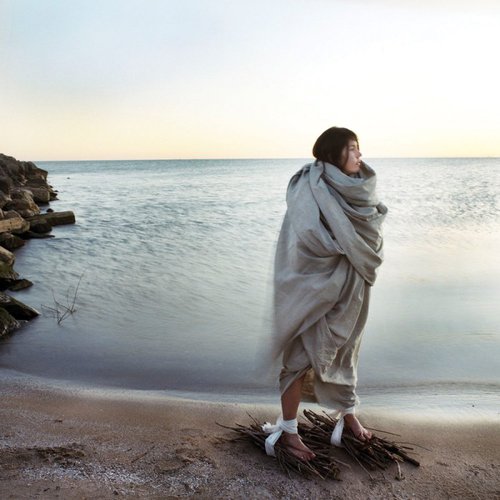
Viage, Lake Ontario, 2010.
Contemplation of self-discovery, identity, and place inspired photographer Meryl McMaster’s series In-Between Worlds. Viage, Lake Ontario and other pieces in this project explore the challenging feelings she experienced related to her bi-cultural heritage of Plains Cree and British/Dutch.
Image credit: Identity: Art Inspired by the Great Lakes. Description: A chromogenic print by Meryl McMaster of a person standing on the shores of a lake, looking into the distance.
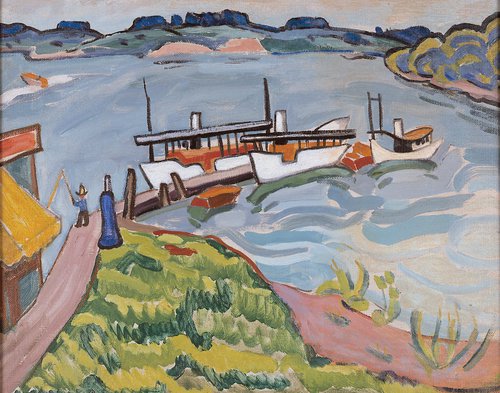
Jean Crawford Adams, Lake Geneva, 1989
If you are curious about Great Lakes inspired-art from the 19th and 20th centuries, The Inlander Collection of Great Lakes Regional Painting," held at the Flint Institute of Arts in Flint Michigan includes many pieces from Midwestern artists, like Jean Crawford Adams’s Lake Geneva.
Image credit: The Inlander Collection of Great Lakes Regional Painting, held at the Flint Institute of Arts, Flint, Mich. Description: A painting of a shoreline resort with boats docked at a pier, someone fishing on the dock, and green foliage all around.
For more information click here to check out our Great Lakes Cultural Resource Guide!
[Hero image description: The banner image at the top of the web page is a photograph of lake water beginning to break on a rocky shore. The water is teal and translucent. Under the water are different color rocks, mostly shades of red and brown. Image credit: Unsplash]
Become a Member
Being a member of the Chicago Humanities Festival is especially meaningful during this unprecedented and challenging time. Your support keeps CHF alive as we adapt to our new digital format, and ensures our programming is free, accessible, and open to anyone online.
Make a Donation
Member and donor support drives 100% of our free digital programming. These inspiring and vital conversations are possible because of people like you. Thank you!