Presenter Q&A: Dr. Grace D. Gipson’s Favorite Comic Book Characters
In May 2021 Black future feminist and pop culture scholar Dr. Grace D. Gipson was joined at CHF by Bianca Xunise (Say Her Name) for a conversation about the past and future of comics.
After the program, we spoke to Dr. Gipson about some of her favorite comic book series, characters, and authors.
CHF: In your CHF program, you mentioned comic books and characters (like Dark Horse’s Martha Washington, who grew up in Chicago). Can you talk a little bit more about the history and significance of some of your favorite series, characters, and authors?
1) Storm (X-Men, Marvel Comics)
Gipson: When it comes to selecting my favorite comic book characters, I have a pretty solid line-up. While my introduction into comics was through the funny papers, there would be one character that truly drew me into the genre: Marvel Comics’s Storm from the X-Men.
As a Black woman who not only served as a leader of the X-Men, but also a goddess that controlled the weather elements, Storm as a fictional character provided an example of progressive representation and a fantastical escape.
Her presence in the comic book world made a significant impression on me as a young, Black girl from the Midwest. I was able to see myself, at the center and not on the fringes, within this popular medium that had been dominated primarily by white and male characters. Storm also opened the door for me to discover more Black female characters, as well as Black female comic book writers and artists.
2) Martha Washington (Dark Horse Comics)
Gipson: Another character who would have a significant impact on me personally and professionally is that of Dark Horse Comics’s Martha Washington. Created in the early 1990s, Martha Washington resonated with me in a very close way, considering her character was based in Chicago, IL. As a Champaign, IL native her story literally and figuratively felt close to home.
Martha Washington’s narrative as explored through The Life and Times of Martha Washington in the Twenty-First Century comic book series sought to showcase a “regular” relatable character that, despite her circumstances, becomes a heroine for her local community and ultimately the world.
Set in the urban space of the Cabrini-Green projects, Martha Washington’s beginnings (which are told in the first issue Give Me Liberty) explore, from a dystopian perspective, a current and relevant story of public housing, crime, poverty, Black youth, adulthood, womanhood, and even patriotism. Uniquely, her story offers a rare opportunity to explore American patriotism from a Black woman’s point of view. This is especially noteworthy considering the lack of Black female leads in comics, during the 1990s.
When it comes to comics, one can never underestimate the power of a diverse story and the impact it can have on all types of readers. These next two characters not only contribute diverse storylines but also have the impact of reaching a young audience. When looking at the landscape of comic book characters, most of them are adults, so it is refreshing to see a Black female youth presence.
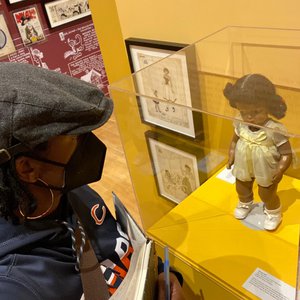
Image of Gipson at the Chicago Cultural Center's exhibit on Chicago comics.
3) Raquel “Rocket” Ervin (Milestone Comics)
Gipson: Raquel "Rocket" Ervin from Milestone Comics (a Black publishing company) is one of the earliest examples of a Black teen character that I have encountered. Also, Rocket’s storyline is one of the first comics to deal with complex and practical issues such as teen pregnancy, balancing motherhood, Black mentorship, and community access. And it was done in a way that avoided stereotypes, while providing hope.
As a character influenced by notable figures like Toni Morrison and W.E.B. Du Bois, Rocket provides an existing reality and a story of dedication and perseverance. Although she is deemed as a superhero, for Rocket her true superpower and strength is her ability to inspire.
4) RiRi "Ironheart" Williams (Marvel Comics)
Gipson: Another character that humanizes the Black girl experience is that of Marvel Comics RiRi "Ironheart" Williams. Through RiRi/Ironheart, as a fictional character, she personifies what it means to be a young, gifted, Black teen in today’s society. Her character also shares another look into the STEM world by encouraging Black girls to embrace one’s giftedness and intelligence.
This is a comic that I wish existed when I was a teenager, but nonetheless grateful that young Black girls and the world are able to appreciate it now. What is also significant about the Ironheart story is that it is written by a Black woman and Chicago-native, Eve L. Ewing, this is key as most stories in past comic book history have been written and drawn by white men (thankfully there is a growing landscape of representation).
To know that I am represented on the page and behind the panel inspires and further confirms that Black women and girls deserve to take up space in this popular medium. Ultimately, both Rocket and Ironheart are perfect examples of how comics can rewrite the script regarding Black girlhood and the importance of why “Representation Matters!!”
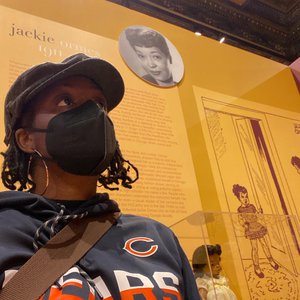
Image of Gipson at the Chicago Cultural Center's exhibit on Chicago comics.
5) Torchy Brown (created by Jackie Ormes)
Gipson: Lastly, I felt it was important to not just recognize the importance of some of my favorite characters, but also one of my favorite writers/artists. Before there was even a Storm, Martha Washington, Rocket, or Ironheart there was a Black female lead named Torchy Brown created by cartoonist and writer Jackie Ormes. Similar to the Martha Washington character, Jackie Ormes legacy and work would find a home in Chicago.
As the first Black female cartoonist, Ormes was instrumental in resetting the standard in cartooning and comic strips. She did this by creating her own lane of telling stories that primarily featured Black voices, while also challenging the stereotypes and caricatures often presented in mainstream press. With readers from coast-to-coast, Ormes used her comic strip series and panels to discuss unapologetic commentary on such issues as racism, labor and taxes, U.S. Foreign policy, violence against women, unfair housing, segregated schools, and environmental injustice. She was able to use her talents to not only inform but also showcase (while entertain), in full color, the existence of intelligent, stylish and fashionable Black characters (particularly Black women). With Chicago as an honorary character, much of Ormes cartoon and comic strip work mirrored her real life as she was a community advocate and mentor, fundraiser, and trendsetter.
“These characters present an opportunity, in real life, to transform our thinking when it comes to Black female agency, activism, and advocacy.” — Grace D. Gipson
Gipson: As the medium of comics continues to evolve and change, the experiences of these fictional characters and creators will continue to generate healthy and provocative dialogues among readers, fans and critics, while also challenging past portrayals, stereotypes, and tropes.
Overall, these characters present an opportunity, in real life, to transform our thinking when it comes to Black female agency, activism, and advocacy. Their stories and the characters can be read as blueprints and models that are working towards Black people in reality not being feared and misread; but respected, accepted, and praised as future leaders and innovators of society.
As someone who has always had an interest in the identities and stories of Black characters in comic books, comic strips, and graphic novels, it is important that all of their voices are not just heard but explored. Thus, when thinking about the history of Black comic book characters there will always be a discussion around representation, iconography, and the ways in which the characters and their creators are able to reclaim, redefine, and retell the stories of Black/African Diaspora people.
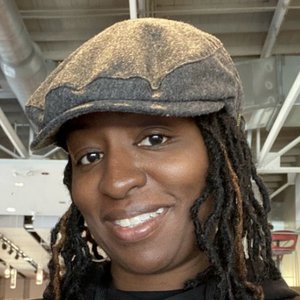
Grace D. Gipson, Ph.D., is an Assistant Professor in the department of African American Studies at Virginia Commonwealth University. Dr. Gipson is a Black future feminist/pop culture scholar. Her work has been featured in various publications and book chapters in such outlets as Huffington Post, NPR.org and Black Perspectives. Dr. Gipson’s current book project seeks to explore Black female identities as personified in comics and fandom culture. A second project examines how online Black female academic and popular networks produce cultural and technical capital, which act as safe spaces that showcase, interrogate, and celebrate the blending of popular culture and the academy. She is a co-host of the video series Conversations with Beloved and Kindred and is as part of the #BlackComicsChat podcast crew. You can also follow her on Twitter @GBreezy20.
Watch The Past and Future of Comics with Dr. Grace D. Gipson and Bianca Xunise.
[The banner image at the top of the event page is a spread of comics and books about comics, including: Jackie Ormes: The First African American Woman Cartoonist by Nancy Goldstein and Ironheart, written by Eve Ewing and illustrated by Kevin Libranda. Image credit: Grace D. Gipson]
Become a Member
Being a member of the Chicago Humanities Festival is especially meaningful during this unprecedented and challenging time. Your support keeps CHF alive as we adapt to our new digital format, and ensures our programming is free, accessible, and open to anyone online.
Make a Donation
Member and donor support drives 100% of our free digital programming. These inspiring and vital conversations are possible because of people like you. Thank you!