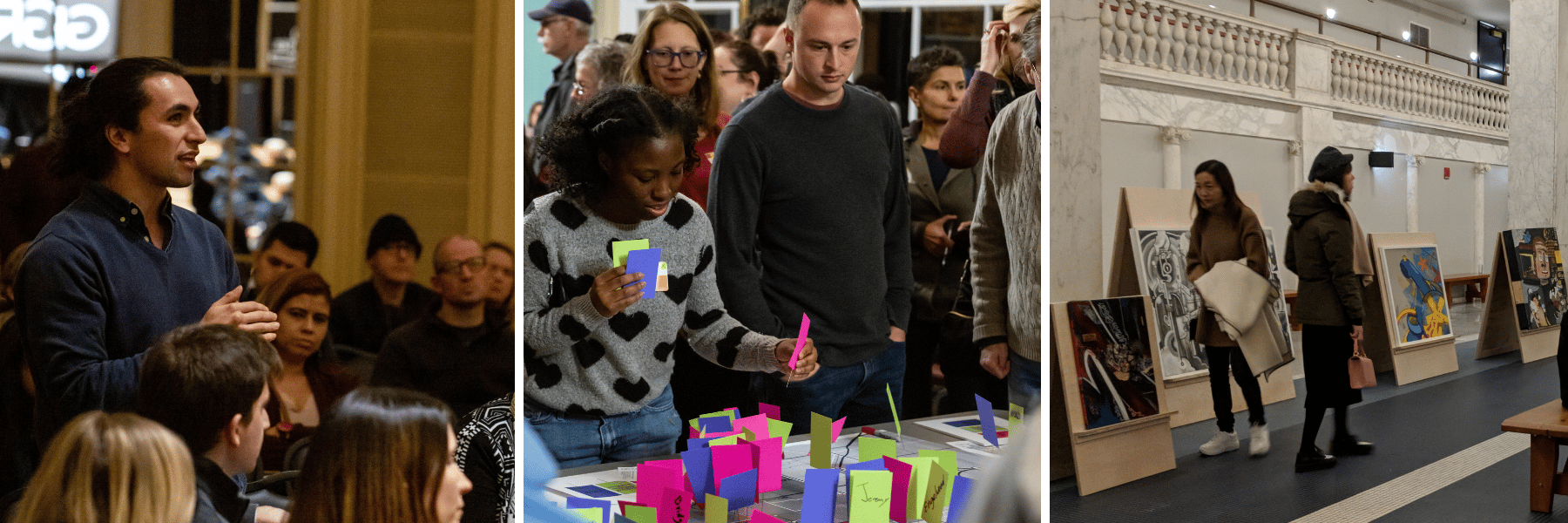
It’s not a minor feat–especially for a small nonprofit organization–to put on a festival of 80+ programs, of tremendous breadth and depth, in various formats, with hundreds of presenters, interviewers, panelists, and partners, presented in dozens of venues, all across the city.
So before we get to recapping, we must say a hearty THANK YOU to all the audiences, presenters, partners, members, volunteers, seasonal teams, and other supporters who make the Festival come to life.
And now a recap of the final week of Graphic! This past week we browsed a pop-up exhibition of Chicago’s street art history, tapped our toes to “Sittin’ on the Dock of the Bay,” created a collaborative geospatial visualization of Chicago, marveled at the beauty of Philip Glass’s compositions, and challenged ourselves to think about visually representing data of the future, or data that doesn’t exist at all. Here are some of our takeaways.
“At its best this country can learn from its mistakes. But it requires constant vigilance.” –Tim Wu
1) Many presenters urged us to push against too much consolidation and technocratic power.
Tim Wu, who coined the term “net neutrality,” warned: “We are engaged in a very dangerous experiment. We've abandoned all regulations of monopoly, leading to greater inequality...Companies think they have escaped democracy. It speaks to the inhumanity of bigness.” Wu called for a return to antitrust policies, urging “we must return to American traditions that put people first, believe in democracy, and a citizenry that would rise to the greatness of the Constitution. All power should be accountable.”
Artist and data researcher Mimi Onouha spoke about data that doesn’t get collected and why, and how classification and computational categorization don’t necessarily align with the complexities of human beings and identities: “We are witnessing the implications of a machine readable world, and what it’s like if you don’t fit those spaces. There's always a tension between who wants to collect the data vs. who has the resources to do the collecting.”
Journalist Franklin Foer confirmed passionately that reading printed books is the “ultimate act of resistance,” and aligned the sense of polarization with the consolidation of big tech: “We live in a world with a public square that's dominated by a few companies. This led to filter bubbles where our emotions are constantly toyed with...manipulation is the product. We've become intellectually incapacitated.” He suggested that we can be critical of technology without necessarily tossing our phones into Lake Michigan: “We've been merging with technologies for a long time, the difference is that today we are merging with intellectual machines. We must remember that we're also merging with the companies that own the machines. Their values end up becoming our values. They are there to transform our thinking, habits, and daily patterns.”
This critique was echoed by Jaron Lanier, tech pioneer in virtual reality (a term which he coined), is an outspoken critic of social media: “The social media platforms engage you in order to change you and make you become more predictable, with less free will.” Later he said, “I use the term addiction for social media because it is the diction of the industry itself.”
Architect, urban planner, and passionate sustainability advocate Doug Farr talked about the power of graphics to convey the urgency of environmental challenges. He suggested that top-down policy change isn’t working: “The clock is ticking. Cultural change is the most powerful change, and it doesn't happen in government. It happens with people.”
Public Policy Professor Louise Shelley gave terrified audiences an overview of illicit commerce and the Darkweb. She said, “Human trafficking had scaled immensely in the digital age. The Europeans have done more than us to curb it; we're behind.” Shelley also addressed the environment, since so much of Illicit trade threatens the sustainability of life and the planet: “It goes much further than deforestation. There are no jobs on a dead planet.”
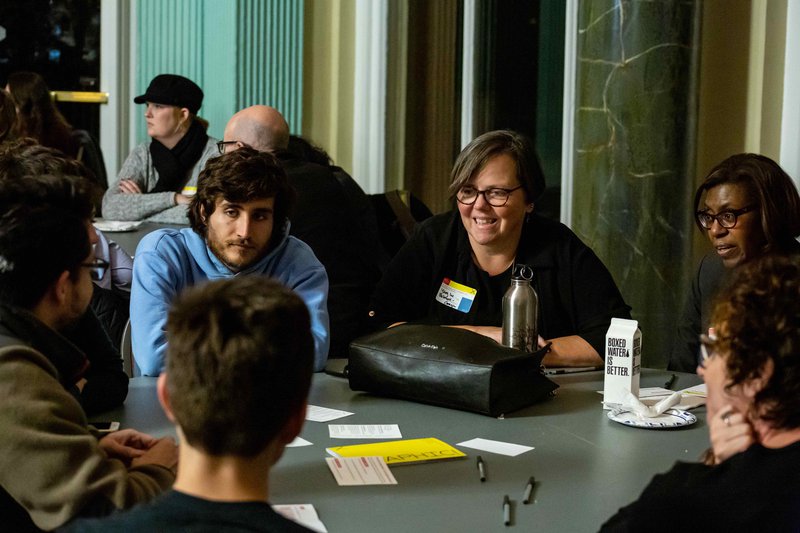
Audience members at the interactive Folded Map Project program on South Shore Night talk to one another about Chicago neighborhoods.
“When there's fear of talking to others, fear of immigrants, and our heads are down in our phones, that's tough for democracy. One thing we're wired to do is to be with other people.” –Doug Farr
2) The assumptions we make about others don’t just live in our heads–they do real harm.
Kristen Sollée gave an engrossing presentation about how the history of witch and slut archetypes are tied to the ongoing oppression of women: “The witch is something we project our fears and desires onto to this day. Visual art was the primary means to drum up fear about the witch, and the most marginalized women–poor women, older women–were scapegoated for society’s ills.”
Jacqueline Stewart discussed how images in the South Side Home Movie project “show a history of Chicago that hasn’t been made official yet…[they] also give lie to some of the assumptions of what the south Side is about.”
Scholar Jasmine Nichole Cobb historicized racist representations of African Americans, interrogating early daguerreotypes: “Many of the early images of formerly enslaved people set up the idea of freedom as Black theft. If Black freedom is ill begotten, then how is it represented in our visual culture?”
Julie Widholm on the landmark 1968 MCA exhibition, “Violence in American Art,” which has its 50th anniversary in 2018: “There’s a lot to critique about this show. There were only two women artists in the show. There were a lot of generalizations about people of color.”
Photographer John Moore, who took the photo that most people think of when they think of family separation at the US-Mexico border: “We tend to concentrate on what’s happening on the border...but migrants say Mexico is the hardest part of the journey to America.”
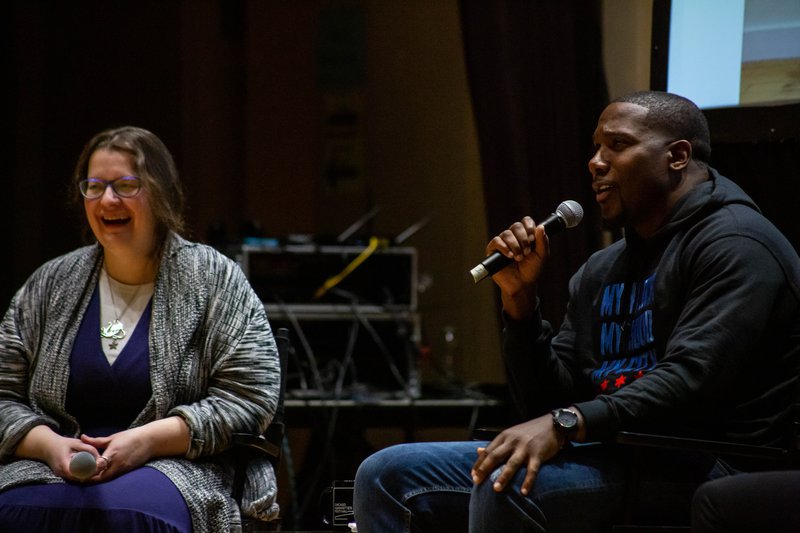
Chicago activist and mentor Jahmal Cole talks with historian Amanda Seligman about the role of Chicago block clubs.
“Democracy must come from block outward, not the policy level inward." –Jahmal Cole
3) As simple as it sounds, having conversations with one another propels cultural change.
Our South Shore Night really typified what the Festival is all about: bringing people together in conversation who might not otherwise meet or talk, about issues affecting us all.
Artist Tonika Johnson explained the background of her Folded Map Project: “I saw the gradient of change in Chicago neighborhoods on my daily commute to school...Chicago's segregation made such an impression on me I started to think in terms of addresses.” After a series of interactive art activities involving sticky notes, photography, placing pins on a giant printed map of Chicago, and conversation, Johnson gave audiences this call to action: “Get to know people from different neighborhoods, talk to them, and visit them.”
Film scholar Jacqueline Stewart set up a screening of films from the South Side Home Movie Project: “We encourage people to talk during our screenings. These are silent films, so we want it to be interactive. Sometimes people actually identify places we haven’t identified yet.”
When asked by an audience member how to combat social isolation and get people to show up, Jahmal Cole replied, “I lead by example. You wanna do more than people expect." He added, “Segregation has created exclusion...The more connected you are, the healthier you are, the safer you are, the happier you are.”
In a conversation about abortion with journalist Katha Pollitt, bioethics professor Katie Watson suggested “Private storytelling about abortion can have a impact on de-stigmatization on a smaller level than public storytelling, without the negative personal cost.”
Sara Hendren presented several adaptive design projects, and in discussing the Accessible Icon Project of a wheelchair-riding icon that shows a figure moving through space, she explained the social contexts of design: “The real change was not the new graphic, but the conversations and things that happened around it.”
Daniel Giles, on the subject of pervasive violence in America and art that tries to address it, stated: “It’s all of our responsibility to pay attention to what’s happening and to talk about it truthfully.”
Esther Perel outlined her analysis of the forces that shape modern relationships and infidelity, and when asked how to “affair-proof” a relationship, her reply included: “Too many people will start a conversation after the sh*t hits the fan. The best you can do is be in a relationship that evolves: how it evolves is different for different people. But you must have a conversation about what will happen in the long term to emotional and sexual needs. These conversations must not be secret.”
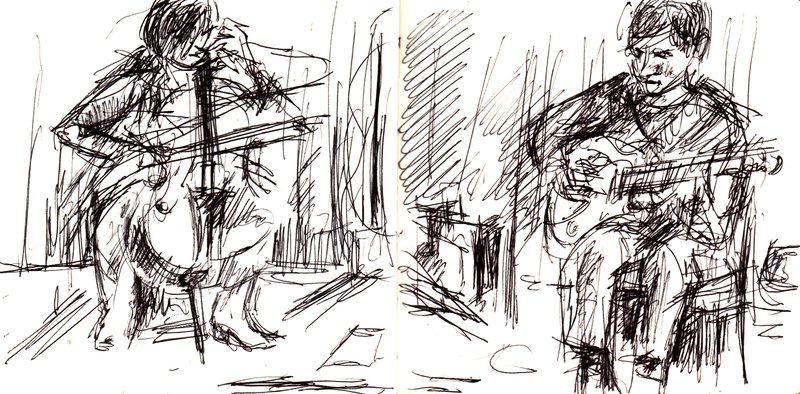
Local artist Dmitry Samarov sketched Bill McKay and Katinka Kleijn's performance on the closing night of the Festival.
Asides, Observations, & Miscellany
- Kristen Sollée cited an excellent photo of Elvira / Cassandra Peterson as a “palate cleanser” in her presentation on the history of harmful female archetypes, witches and sluts. In response to an audience question about astrology, she also recommended the sex positive tarot deck by Morgan Claire Sirene, The Slutist Tarot.
- Esther Perel joked to a fully enrapt audience, “You’re so quiet! Are you listening?!”
- Jahmal Cole claimed Chicago’s diversity as our greatest asset: “If you go to Greektown, you're gonna eat pita, beef, and rice. If you go to Devon, you'll eat naan, beef, and rice. In Pilsen you'll eat tortillas, beef, and rice.”
- Philip Glass explained to Third Coast Percussion ensemble member David Skidmore the origin story of his new composition’s title, "Perpetulum": “Perpetual momentum: Perpetual, plus momentum, equals ‘perpetulum.’ It's what kids in Baltimore do, make stuff up.”
- Doug Farr on why he feels such urgency around sustainable architecture and design: “alarming graphics that show Chicago will likely have the climate of Dallas by 2080.”
- Mimi Onuoha’s research began when a Brazilian academic found out that favela residents couldn’t play Pokémon Go: “If you’re not on Google Maps, you won’t be included in anything built on top of that, like the Pokémon game.”
- Molly Wright Steenson shared some hilarious AI generated Halloween costume ideas: “Alien Chestman, Sexy Michael Cera, Sexy Beet, Ruth Bader Hat Guy.”
- The act of reading books and librarians got a few shoutouts: “Librarians are pretty obvious revolutionaries.” - Franklin Foer And Mimi Onuoha on librarians: “They’re doing the work!”
- According to Michael Friendly, carbonated water was invented in 1769 inventor by 18th century chemist Joseph Priestly. Now you know who to thank for your Spindrift obsession. Friendly also joked about coding data in SPSS and all the stats nerds cackled.
- Presenters Danielle Wood and Sara Hendren both gave their presentations with an intense awareness of the body and the space of the presentation: Danielle Woods sang Black spirituals and moved around First United Church to transition through her program, and Hendren started her talk by inviting everyone to “Let body and affect be alive in this room.” Hendren also joked about her approach to pedagogy: “Come for the cool cyborg stuff and stay for the critical theory!”
- Joanne Freeman’s research made it into Hamilton’s “Ten Duel Commandments”: "I'm a historian who has a little tiny line of my first book being sung on Broadway!"
What's next? The Fall Festival may be wrapped, but there's plenty to explore online.
Become a Member
Being a member of the Chicago Humanities Festival is especially meaningful during this unprecedented and challenging time. Your support keeps CHF alive as we adapt to our new digital format, and ensures our programming is free, accessible, and open to anyone online.
Make a Donation
Member and donor support drives 100% of our free digital programming. These inspiring and vital conversations are possible because of people like you. Thank you!