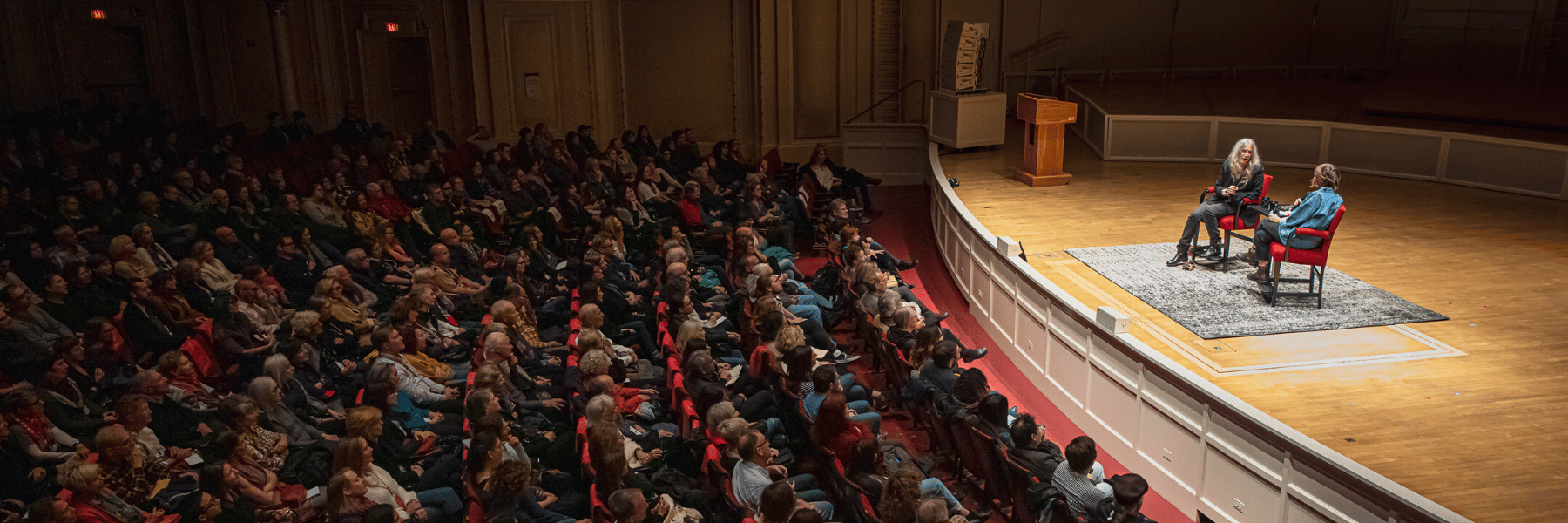
Our first weekend of the 2019 Fall Festival featured programming throughout downtown Chicago and across Northwestern’s Evanston campus. Powerhouse presenters included Julia-Louis Dreyfus, Alison Roman, Anabel Hernández, and David Blight. Though the subjects of each program varied, some throughlines emerged. Below, find four takeaways from our first weekend of Festival programs, and then explore our our Year of Power video archive!
1) Our history makes us powerful
Frederick Douglass: A linguistic prophet, a prose poet, perhaps the greatest memoirist of the 19th century. You can’t put Douglass in just one box, claimed Pulitzer prize-winning historian David Blight. Blight also poses a question to CHF's audience: How do biographers impose order on a heroic life such as Douglass’s? The answer, Blight says, is simpler than you might expect: “tell [the narrative] as it happens, start at the beginning, always telling both the private and the public story. Write as one lives.”
In history classes, we all learn that Pearl Harbor was attacked on December 7th, 1941, marking the beginning of America’s involvement in World War II. Daniel Immerwahr came to CHF to tell another, hidden, story: on the same day, Japan also attacked the Philippines, which was at that point a US territory. “My hope,” said Immerwahr, “is that we consider US history not just about thinking about the mainland, but also about the greater United States,” including often overlooked territories.
“I’m always fascinated by words, and their histories, and how they knit things together.” —Amitav Ghosh
Author Amitav Ghosh wonders why more authors aren’t writing about climate change. He sees novels as a way to understand history: “my book is an attempt to...respond to the realities of our time.” In the spirit of climate sustainability, which includes decentering humanity, Ghosh offers a new name for our festival: the All Beings Festival.
Journalist Patrick Radden Keefe echoes Ghosh’s sentiment regarding the connections between history and novels: “My hope had been to write something that would feel more like a novel than a history book,” he said of Say Nothing, his account of the Troubles in Northern Ireland.
“The power of the will to survive can outlast even the greatest evil.” —Debbie Cenziper
Pulitzer Prize-winning investigative reporter Debbie Cenziper wrote about the Nazis who moved to America after World War II to live in hiding, and the people who fought to bring them to justice. Cenziper was moved by the fact that these Nazi hunters had “no tolerance for intolerance.” “This kind of justice matters,” she explained, “even today, when there is hatred and prejudice everywhere.”
2) Our education makes us powerful
“Education is uniquely empowering. I made it my mission to bring that power to others” —Jennifer Lackey
Jennifer Lackey, Director of Northwestern University's Prison Education Program, believes education is “the best way to positively intervene in the criminal justice system” because “when you connect with a person’s mind over the power of an idea, it becomes impossible to deny their humanity.”
Journalist Anabel Hernández has paid a steep price for educating the public on the corruption and power of drug cartels. She has been forced to leave her native Mexico to live in hiding. Despite this, she refuses to be seen as a victim: “Every time the cartels push me from Mexico they make me stronger”, she insists, “because I meet new people, I see new things, I continue my investigation.”
Journalists Jim Warren and Lynn Sweet discussed how Mark Zuckerberg revolutionized media. Sweet noted, “The Zuckerberg position is that Facebook is a stage, one that anyone can appear on, and it’s up to you, as the audience, to decide what’s true and what isn’t.” Given this burden, Warren and Sweet said, education in media literacy and credible journalism is empowering and urgently necessary.
3) Our self-reflection makes us powerful
What does punk rock legend Patti Smith think we can learn from writing our memoirs on napkins while sitting alone in coffee shops? “How cool we are!” she tells Jessica Hopper, although Smith has a disclaimer about her book’s genre: "Year of the Monkey is probably my most irresponsible novel...I see it in the nonfiction section of bookstores and think 'oops.'"
Author Sarah Smarsh agrees with Smith, “What you remember is not the objective facts of what happened.” Still, Smarsh thinks memory, however imperfect, is powerful: “I wrote Heartland to reckon with my family’s history, with rural poverty, and the fact that I was the first woman in my family to go to college instead of having a baby as a teenager.
“I came to Chicago for the theater.” - Julia-Louis Dreyfus
Julia-Louis Dreyfus gave a shout out to Chicago’s theater and improv scene, while reflecting on her career as a cast member on SNL, Seinfeld, and Veep: “My source of empowerment in the industry was me,” she told the audience. Her advice to young actors? “The rough years make you strong, trust your gut, and when you go back to host SNL, always nail the opening monologue.”
“You are exceptional Black women writers who have penned biographies about extraordinary Black women writers,” poet Sandra Jackson-Opoku praised authors Angela Jackson and Imani Perry. Their biographies celebrate the literary genius, social justice activism, and powerful legacies of Chicago’s Gwendolyn Brooks and Lorraine Hansberry.
4) Our culture makes us powerful
“Tell me there is at least one culture who has a worse attitude towards death than us,” pleaded The Interview Show host Mark Bazer. Mortician Caitlin Doughty didn’t sugarcoat the truth: “Oh no, we’re the worst.” The good news: we have the power to destigmatize death and change the for-profit funeral industry into an “introvert’s dream,” where loved ones can grieve in whichever way they choose.
We’ve never had so much accidental power as consumers than we do right now. - Jonathan Safran Foer
Author Jonathan Safran Foer reminded us most restaurants in America now offer vegetarian options, not because legislation requires them to, but because of consumer demand. We don’t have to completely stop eating meat, Foer explained, but we do need to eat drastically less meat. His plan to save the planet? No animal products before dinner, limiting car usage, and volunteering for climate causes.
In a conversation about food and her new cookbook Nothing Fancy, food writer Alison Roman wants to prove to writer Sam Irby that “cookbook people” don't only eat fancy French cuisine: “I have always preferred hotdogs to hamburgers,” Roman confessed to Chicago, “I’m glad to be in a city that recognizes that feeling.” Strong opinions also include that hotdogs are not sandwiches, because the “bun goes all the way around...I hope someone wrote that down because that’s the smartest think I’ll ever say.” Shoutout to the CHF staff member who did write it down, thus making Alison’s dreams come true (and this recap possible).
Become a Member
Being a member of the Chicago Humanities Festival is especially meaningful during this unprecedented and challenging time. Your support keeps CHF alive as we adapt to our new digital format, and ensures our programming is free, accessible, and open to anyone online.
Make a Donation
Member and donor support drives 100% of our free digital programming. These inspiring and vital conversations are possible because of people like you. Thank you!