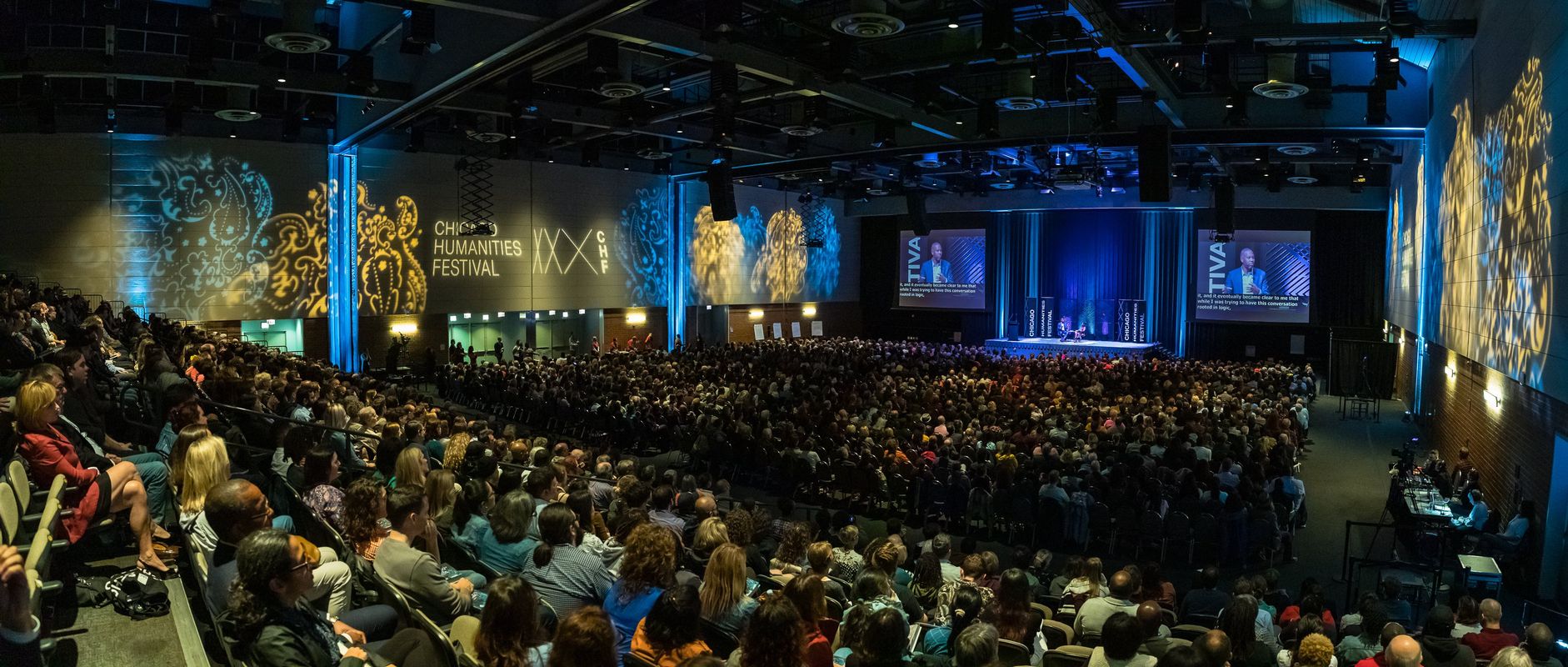
Our pre-Fall Festival season was our most robust yet, featuring four stand-alone CHF Presents programs—Ta-Nehisi Coates, George R. R. Martin, Rachel Maddow, and Jodi Kantor + Megan Twohey—and one day-long, free event focusing on Chicago-style creativity, past, present and future. Though the subjects of each program varied, some throughlines emerged. Below, find three takeaways from our pre-Festival programs, and then explore our Year of Power video archive!
1) Our persistence makes us powerful
At Creative Chicago: Arts and the City, Meida McNeal pointed out that persistence = success: “There’s much expertise and ingenuity among people who keep asking, ‘How can we create change?’ until they find a solution.”Despite the pressures that New York Times reporters Jodi Kantor and Megan Twohey faced, and their own concerns about public apathy surrounding sexual assault, they kept digging. “We had to hold on to our belief that people would care, that these stories matter,” said Twohey. Even when Harvey Weinstein himself showed up at the New York Times, they weren’t cowed. Twohey revealed, “We saw a lot of what Harvey Weinstein was made of in those last few days. Part of the reason I wanted to meet with him is so that he could see what we were made of. To show him our strength, to show him that he couldn’t bully us.”
“Confronting the powerful is what we love to do. It’s why we wake up in the morning.” —Jodi Kantor
Ta-Nehisi Coates seems to be “good at everything he does,” said his interviewer and college friend, WBEZ’s Natalie Moore. But that doesn’t mean that writing his first novel, The Water Dancer, was easy. He started work on the book more than a decade ago, before his journalism career began to take off. And though millions of people have read George R. R. Martin’s books, and watched HBO’s Game of Thrones, he discussed struggling with obscurity early in his career. Ultimately, though, Martin said that he was happy fame came to him later in life, because the pressure of the public eye is “too much for a sixteen-year-old kid to handle!”
2) Our experiences make us powerful
Jodi Kantor and Megan Twohey discussed how their perspectives as women helped them uncover the Weinstein story. “Gender is like a can opener for journalism,” Kantor said, “If you can understand the way women experience things, you can understand how the power structure works.”
Rachel Maddow didn’t plan on going into broadcast journalism—in fact, she began her career working as an AIDS and prison activist. Organizing, she said, “gave me the skills I use now. I had to learn how to talk to different people, and get information from different people, and synthesize it all into a story.”
Similarly, Lake Forest professor Chloe Johnston discussed the universal relevance of arts skills, “The tools you need to create a performance are just great skills to have in life, skills that can be applied more widely and have a larger application.”
George R. R. Martin wouldn’t be where he was without his early love of Marvel comics. “My whole career was based on Avengers #9,” he said, which taught him the power of “creating complex characters, where you don’t quite know their motivations, and where they’re going, and then...killing them.” (Game of Thrones fans may wish he’d ignored that last lesson!) His first published work, he revealed, was a fan letter he sent to Marvel: quoth a young George, “move over Shakespeare, Stan Lee is here!”
Ta-Nehisi Coates discussed the dangers of ignoring our past traumas, both personally and as a nation: “We can’t actually escape the thing, even though we try to bury it.” Trying to bury something—in this case, American slavery—leads to “people building stories over each other. They’ll try to forget, but the thing we try to bury, it keeps confronting us.”
3) Our stories make us powerful
“What is there, but the story?” —Ta-Nehisi Coates.
“Stories are how we process the world,” Coates told CHF, “It is our oldest art form. Storytelling is how we reconstruct the past. All we have is stories. We have facts, but the thing that gives those facts life is stories.”
Storytelling, Coates continued, is also how we can “change how we act in the future.” Jodi Kantor and Megan Twohey echoed this idea. When meeting with sources for their Weinstein exposé, they hoped to empower the women they interviewed with the idea that, though “we can’t change what happened to you in the past, if we can publish the truth, maybe we can make a difference for people in the future.”
Stories also help us grapple with real life problems, which is why George R. R. Martin doesn’t like to give readers easy answers: “I like the reader to have to wrestle [with the dilemmas in his books],” he said, “because they’re never easy when we encounter them in real life.” To make the stakes feel more real, Martin tries to incorporate as much evocative detail as possible. “I want the reader to not just read the book, but live the book,” he explained.
So how do we get more stories out in the world? Rachel Maddow’s answer: “We need to grow investigative reporters by the bushel in this country.” Also, “Supporting local journalism is the best thing you can for this country.” Jodi Kantor concurs: “Facts, stories, and personal bravery can change the world. Journalism is powerful.”
Become a Member
Being a member of the Chicago Humanities Festival is especially meaningful during this unprecedented and challenging time. Your support keeps CHF alive as we adapt to our new digital format, and ensures our programming is free, accessible, and open to anyone online.
Make a Donation
Member and donor support drives 100% of our free digital programming. These inspiring and vital conversations are possible because of people like you. Thank you!