“Violent,” “rampant crime and killings,” “full of carnage.”
The all-too-familiar national media narratives about Chicago regularly portray the city as dangerous, a hotbed of violence and persistent racial conflict–especially when describing Chicago’s South and West Sides. Solutions offered generally involve sending someone or something in to "fix" the problems. This overlooks how many people within these neighborhoods–artists, journalists, organizers, scholars, neighbors–are already working—often with great success–to change what’s happening within their communities for the better. Come to our South Shore Night on November 7 and you’ll see them at work.
Tonika Johnson and Paola Aguirre give us their backstory in advance of their Fall Festival program.
Take, for example, artist Tonika Johnson, who was frustrated by the images and stories of her Englewood neighborhood, and uses photography to bring attention to racial segregation and inequality in the city. But equally also central to her work is the real human interaction required to gain insight and empathy, embodied in her Folded Map Project. Audiences who attend South Shore Night night will get to experience this firsthand in an interactive workshop with Johnson and urban designer Paola Aguirre, founder of Borderless Studio.
"Democracy starts on a block level."
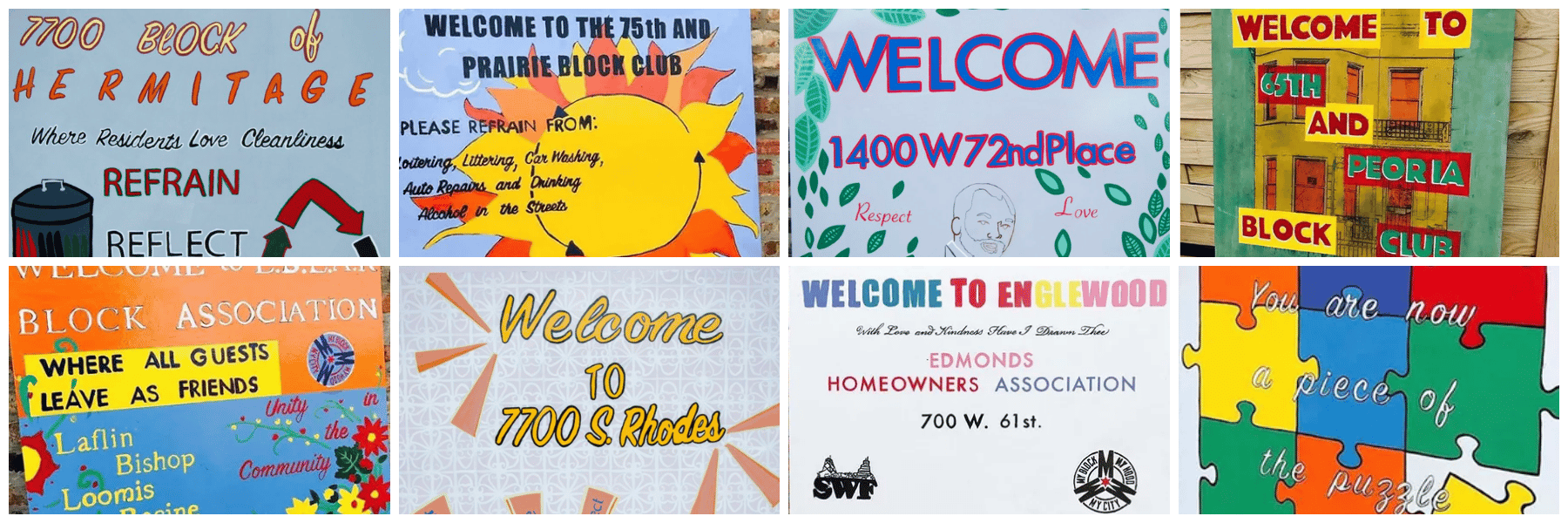
Or consider Jahmal Cole, a writer, activist, and mentor to teens, who co-founded My Block, My Hood, My City to provide underserved youth with educational opportunities and new experiences, exposing them to possibilities beyond their own communities. A tireless advocate for education reform and “the importance of viewing democracy from the block level outwards, as opposed to big city inward,” Cole started a Block Club program with young Chicagoans to design new block club signs that align with the current values and ambitions of their communities (seen in the banner above).
In partnership with a number of local community-based organizations, the Chicago Humanities Festival presents a range of programming this fall that questions and contests the larger received narratives about Chicago neighborhoods.
Taken as a whole, this Chicago neighborhood programming makes a claim about the power in communities to combat the larger narratives about them from within.
Moreover, these programs also take up important questions about neighborhoods and cities, like who is represented, who is left out, and who gets to speak for whom?
We reflect on these questions regularly at the Chicago Humanities Festival, and compiled some resources to help you connect more deeply to the powerful presenters, change-making organizations, and compelling issues around the portrayal–and engagement–of Chicago neighborhoods.
Through programming in Bronzeville, Hyde Park Day, and the South Shore Cultural Center Night, you can:
- Dig deeper into the inspiring legacy of journalist and activist Ida B. Wells
- Discover how “map twins” are bringing people together in new ways across segregated neighborhoods
- Glimpse an intimate look at everyday family and community life with the South Side Home Movie Project
- Learn about soon-to-be-demolished houses that became sites of public art and engagement
Dig deeper with these resources around our South Shore Night programming:
601 | South Side Home Movie Project
Jacqueline Stewart, champion for African-American cinema
602 | The Folded Map Project
Tonika Johnson Bridges Neighborhoods to Break Down Walls of Segregation
Activist’s art project analyzes Chicago’s segregation in ‘Folded Map’ project
Map Twins Bridge the Gap in a Segregated Chicago
Chicago Designer Offers a Model for Repurposing Closed Public Schools
Design 50: Who Shapes Chicago 2018 - #34
603 | Signs for Community
Jahmal Cole wants to change the conversation
My Block, My Hood, My City’ Founder Jahmal Cole on Why ‘Exposure is Key
Chicago's Block Clubs': An In-Depth Look at Urbanite Relationships and Self-Governance
South Shore Night Partners
The Center for the Study of Race, Politics & Culture at the University of Chicago
Leadership Greater Chicago
Metropolitan Planning Council
The Weinberg/Newton Gallery
Image credit: Block Club Signs from My Block My Hood My City
Become a Member
Being a member of the Chicago Humanities Festival is especially meaningful during this unprecedented and challenging time. Your support keeps CHF alive as we adapt to our new digital format, and ensures our programming is free, accessible, and open to anyone online.
Make a Donation
Member and donor support drives 100% of our free digital programming. These inspiring and vital conversations are possible because of people like you. Thank you!